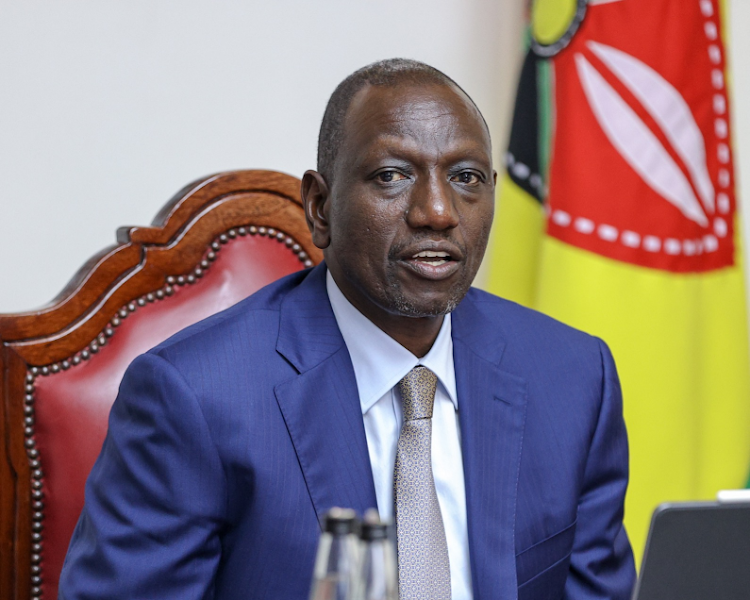
President William Ruto’s government is working hard to win over young people in the country to their side amid the 2027 drumbeats.
Together with his deputy, Kithure Kindiki, they are doing this through new economic revival programmes and strong messages.
Why? Politically, because the youth, mostly Gen Z, recently held protests across the country.
They were angry about unemployment, the rising cost of living, and what they saw as broken promises.
These protests were different. They were not led by opposition politicians. They were largely leaderless.
Instead, young people used social media like TikTok and X (Twitter) to organise themselves.
Their main chant was ‘Ruto must go,’ and they showed they could be a powerful political force.
Now, the government sees young people as the most important group for the country’s transformation.
At the upper echelons of Kenya Kwanza, failure to utilise the youth drive, innovation skills and energy, portends a huge risk.
The feeling is that it could result in a restless population that is a national security and political risk.
Over time, political commentators have underscored the irreplaceable value of young people in the 2027 arithmetic.
The Independent Electoral and Boundaries Commission plans to register about 5.6 million new voters by 2027, most of them Gen Z.
Ruto and Kindiki know they must get these voters on their side.
Against this backdrop, efforts to turn economic empowerment into political goodwill are in play.
The government admits it cannot give every young person an office job.
So, it has started many programmes to help them start businesses, learn skills and find work online.
Top of the list is the Nyota cash programme, the biggest plan. It will give money directly to 820,000 young people.
Each person will get Sh25,000 in the first phase to start a small business. Later, they can get another Sh25,000.
The government hopes each person will start a business and hire at least one other person.
Their goal is to create more than two million new jobs in one year.
Hot on its heels, President Ruto announced a plan for 90,000 young people who left school after Class 8, Form 2, or Form 4.
The government will pay them Sh6,000 a month to learn a skill like tailoring, plumbing or hairdressing.
After six months, the government will pay for their exams and give them a certificate.
Ruto said if more than 90,000 apply, they will still be supported, framing it as central to his bottom-up economic model.
The digital front is also being pushed aggressively.
According to the latest disclosures by the National Treasury, the government says it has tripled the number of young people earning money online through programmes like Ajira Digital and Jitume.
“Youth digital employment under the programmes has skyrocketed from 99,071 in 2022 to 297,866 in 2025 (a 200 per cent growth),” the report states.
"Overall, more than 300,000 youths now work in the digital economy, “earning income online through these and related Business Process Outsourcing (BPO) sectors.”
There are more plans, like mentorship for 43,000 young entrepreneurs, and talent shows to find and support 4,422 young artists.
The 4,422 youth talents will be identified and nurtured through the WHO’Z Next Talent Search Programme.
Another 580,000 youth are projected to access ICT services and career development through One-Stop Youth Empowerment Centres.
The government reports that 13,455 youths have been trained in accredited maritime courses to grow the country’s pool of seafarers.
The government also plans to establish 100 modernised TVET centres to train 200,000 youth annually.
In the creative economy, 16,300 licences will be issued to film distributors and exhibitors.
The government, according to the Draft 2026 Budget Policy Statement, plans to build another 100 new technical training colleges across the country.
While Ruto announces the programmes, DP Kindiki often goes to meet young people and explain to them.
First, the promise: He tells the youth that the government’s help is just the beginning.
“What we are giving today is what the government can provide at this time. This is not the end of government support. This is only the beginning of your journey,” Kindiki said recently.
He links the support by the government to peace and stability, saying with more youth engaged in business, they will not be hirelings for politicians.
“As we receive support from the government… we also have a duty to protect our communities, protect our nation and love our country,” Kindiki said.
He asks young people to express their views without ‘undermining the interests of our nation’, a sentiment seen as a reference to the recent protests.
The government’s plan is clear. They are offering jobs, skills and cash to the young generation that protested against them.
In return, they hope for a peaceful country and, in 2027, their votes.
Prime Cabinet Secretary Musalia Mudavadi said the government is investing heavily in youth.
“President Ruto has put a lot of effort into youth empowerment. He seeks to ensure a better future for the country,” Mudavadi said.
He cited the Nyota programme and massive investments in education and sports infrastructure, including the Talanta Stadium and revamps of Nyayo and Kasarani stadiums.