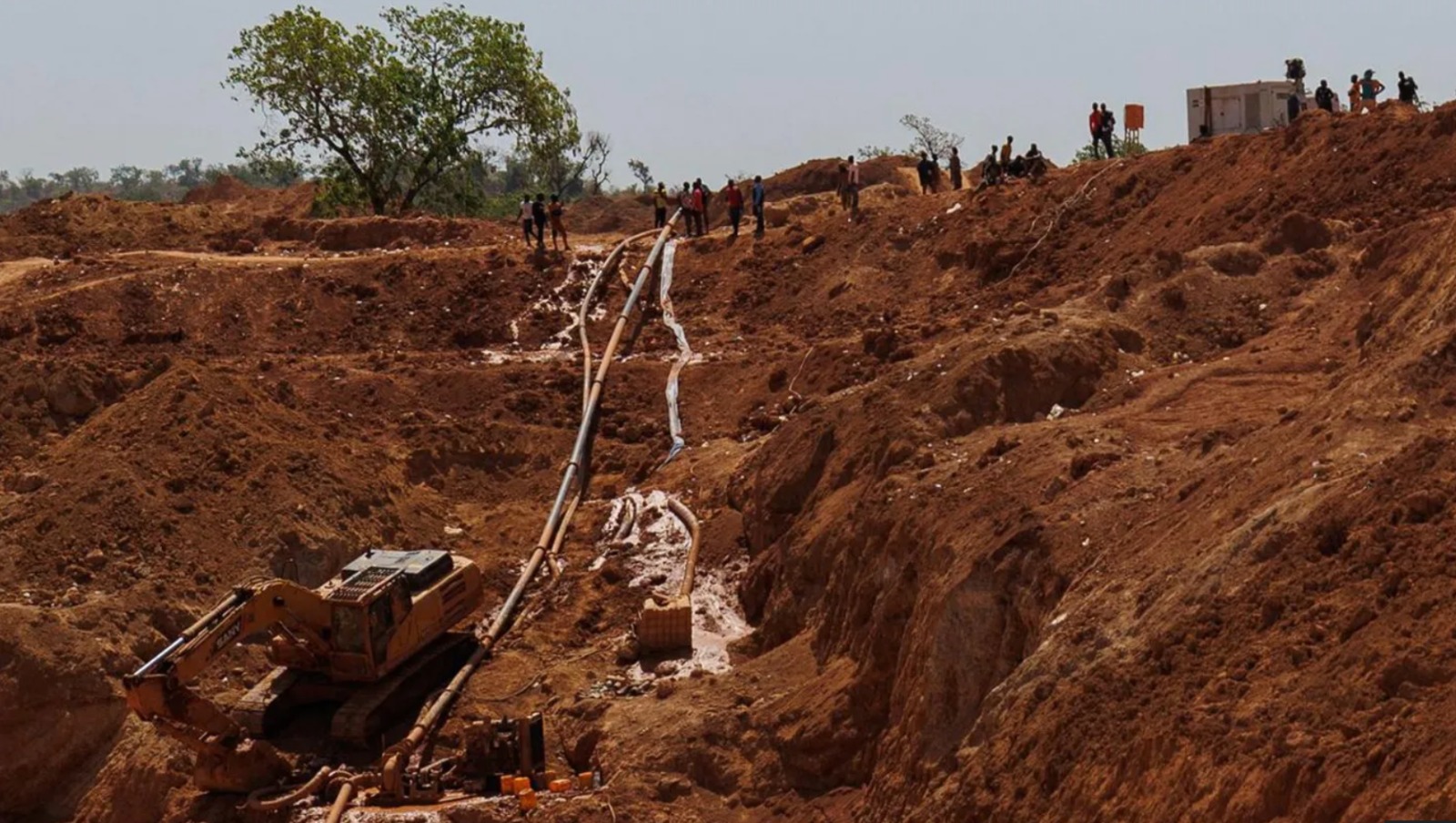
 Mine site /FILE
Mining rarely fails at once. It fails over time, through unstable goafs that collapse without warning, air that quietly becomes unbreathable, dust that scars the lungs one breath at a time and toxins that poison bodies long after the gold has been sold at a throw away price. None of these outcomes are random. Rather, they are predictable consequences culminating from mining without engineering.
Mining, an activity commonly trivialised as an act of digging for minerals, is not all that simple. The moment a rock is removed, the stresses redistribute, airflow patterns change, heat builds up and contaminants such as dust and natural occurring radioactive material are released.
With proper mining practices, these hazards can be averted through continued monitoring and control. However, this is not the case in most informal mines as most hazards, both seen and unseen, are left unattended.
In confined underground spaces, structural failure is the most common hazard, often occurring as sudden roof or sidewall collapse driven by stress redistribution and progressive weakening, with little or no warning available to miners.
Stress redistribution basically is the reorganisation of rock stresses to re-establish equilibrium within the surrounding rock mass after excavation alters the original in-situ stress field.
This hazard is averted in mines using geotechnical designs which carefully models excavation designs to properly define the rock extent to be removed, pillar sizes to be left for support and type of reinforcements to withhold rock bursts.
Despite its crucial role, mine support is mostly overlooked in informal mines, without any safety constraint. Failure occurs when redistributed rock stresses exceed rock-mass strength, driven by geological discontinuities, water ingress and mining-induced stress concentration.
Though this phenomenon termed as ‘sudden accident’, it is in fact delayed mechanical responses to poorly excavated mines.
Air, the most basic life-support medium, presents even greater risks. Underground mines are physiologically hostile unless optimum ventilation designs are deployed to supply just the right amount of air to support breathing and remove contaminants.
This involves quantifying airflow requirements based on contaminant loads, heat sources and oxygen demand, then distributing that airflow through mine spaces to maintain safe underground conditions. Informal mines mostly rely on natural ventilation or improvised fans which mostly promote recirculation of contaminants and noxious gases from blasting, diesel engines and rocks.
Such toxic gases affect human health when inhaled beyond the maximum threshold. Miners experience dizziness and confusion before passing out or suffocating.
Some of these gases are flammable and give rise to fire explosions, not only burning the miners but also ravages assets. This unseen hazard is avoided in standard mines using gas sensors which continuously monitors the air quality and trigger alarms when concentrations exceed allowable limits. However, when such systems are overlooked, dangers from gases remain invisible but lethal.
Another devastating health hazard in these spaces unfolds slowly and has attracted far less attention. Crushing and grinding ore generate clouds of fine dust, often rich in crystalline silica.
These particles penetrate deep into the lungs, where they lodge permanently. Over time, scar tissue forms, reducing lung capacity and turning routine physical effort into a struggle for breath.
Silicosis, chronic respiratory disease and increased vulnerability to tuberculosis are common outcomes. This is avoided in formal mines using suppressants and masks, making it a controllable hazard. However, in the informal mining sector, this sadly poses an occupational legacy.
Chemical exposure compounds this burden. Mercury remains widely used in informal gold recovery because its harm is delayed rather than immediately. Heating amalgam releases mercury vapour that is readily absorbed through the lungs and distributed to the nervous system. What escapes into the environment contaminates soil and water, where it transforms into methylmercury and accumulates through food chains. Neurological impairment, developmental disorders and ecological damage often emerge far from mine site and long after extraction has ended.
What unites these hazards is the lack of feedback. Engineering limits risky conditions through monitoring, anomaly detection and control. For example, deformation sensors can detect instabilities before mines collapse.
Gas sensors identify lethal concentrations in mines before exposure. Dust monitoring quantifies long-term health risk before disease develops. Informal gold extraction operates without this feedback loop. Risk is discovered only after injury, illness, or death. That is, when prevention is no longer possible.
The solution I am proposing is not rhetorical but engineering. Health and safety risks can be dramatically reduced through basic, scalable interventions: defined excavation layouts, simple ground-support rules, low-cost ventilation designs, portable gas monitoring, wet processing to suppress dust and mercury-free recovery methods. These measures do not eliminate risk, but they confine it within manageable limits.
Precious minerals will continue to draw people into mining. Whether minerals sustain livelihoods, promote national prosperity, or destroy them depends on a single factor: whether proper mining engineering is present to protect health, preserve life and prevent harm that is entirely avoidable.