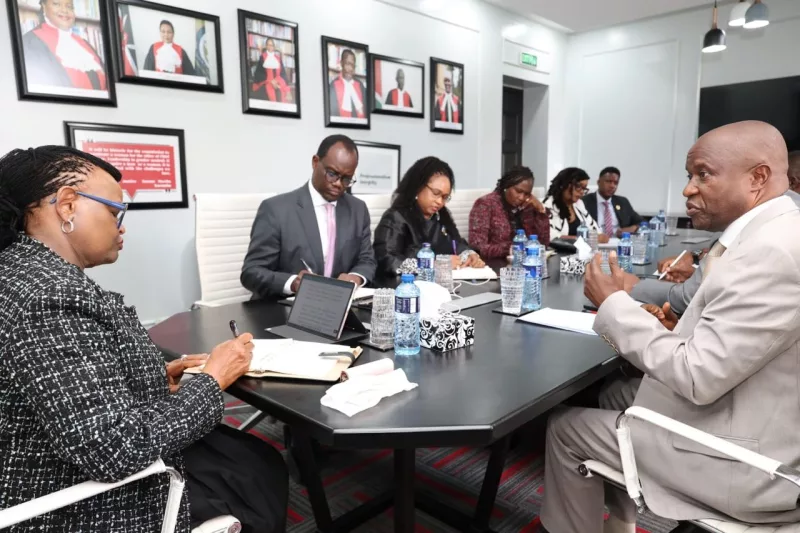
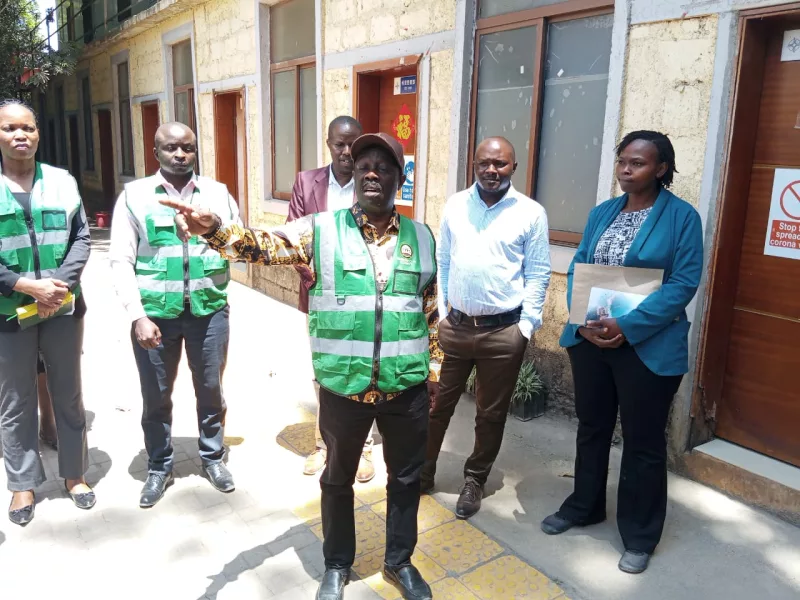
 Nairobi City Water and Sewerage Company officials during the flag-off of state-of-the-art leak detection vans/HANDOUT
The government is exploring the possibility of deploying modern technologies in the latest bid to reduce water losses.
Water losses, also known as non-revenue, account for 44 per cent.
This translates to an estimated Sh11 billion in foregone revenue annually.
State Department for Water and Sanitation PS Julius Korir says modern technologies can help curb the loss.
“Non-revenue water remains one of the most critical challenges facing water service providers, accounting for losses of up to 44 per cent of treated water,” Korir said.
“This translates to an estimated Sh11 billion in foregone revenue annually, resources that could otherwise be invested in expanding coverage, improving reliability and enhancing the quality of water services for Kenyans.”
It is for this reason that the PS, together with
the Water and Sanitation Providers Association (WASPA) of
Kenya, led by chairman Thomas Odongo, convened a detailed technical
engagement with the Acumen Group.
The meeting sought to explore an advanced solution for the management of Non-Revenue Water (NRW) in Kenya’s water sector.
The Acumen Group presented a satellite-based system capable of mapping water distribution networks in urban centres and towns with high precision.
Korir said the technology enables the early detection of leaks, illegal connections and inefficiencies, allowing for timely interventions and evidence-based decision-making.
“Our discussions focused on the potential of this solution to significantly reduce water losses, strengthen operational efficiency and improve the financial sustainability of Water Service Providers (WSPs),” he said.
“This engagement underscores the importance of partnerships, innovation, and technology in addressing systemic challenges.”
Korir said the state department remains committed to supporting
scalable, cost-effective and technology-driven solutions to safeguard water resources,
enhance accountability and ensure sustainable, equitable water services for
all.
Already, the Nairobi City Water and Sewerage Company has already flagged off newly acquired state-of-the-art leak detection vans.
The vehicles will help to slash water losses and elevate service delivery across Nairobi.
Equipped with advanced tools, our teams can now swiftly detect hidden leaks, prevent costly pipe bursts, spot illegal connections and respond to faults faster than ever.
A performance report by the Water Service Regulatory Board covering 2023-24 showed that the economic impact of NRW within the water sector is substantial.
The report says even after accounting for allowable losses, the remaining non-revenue water amounts to about 203 million cubic metres, translating to a financial loss of Sh11.9 billion.
It says digital technologies, especially smart water management systems, present a compelling opportunity to address the challenge by improving water supply systems' efficiency, resilience and sustainability.
By leveraging real-time data and advanced analytics, these systems enable water service providers to detect leaks early, monitor consumption patterns and optimise operational efficiency.
The report says while the benefits of smart metering are evident, their implementation requires careful consideration.
Water service providers must evaluate the financial viability of such systems, balancing upfront and maintenance costs against potential gains.
Smart meters are especially beneficial for production and bulk meters, where accurate data is essential for determining water abstraction volumes and levies payable to the Water Resource Authority.
They are also valuable for large consumers—such as private clients in affluent areas—who use water for high-volume luxury purposes like gardening, car washing and pool maintenance.
In these cases, real-time feedback can encourage more responsible consumption.
However, for lower-consumption consumers, the high cost of smart meters—often upwards of Sh25,000—may not be economically justified, especially when monthly water bills average just Sh1,000.
The report says conventional metering may remain the more practical option for lower consumption in the short term.
The impact report documents the performance of Kenya’s water services sector over a given period.
The report is meant to spur comparative competition in the sector, thus creating impetus for institutions to improve their performance.
The report shows that by 2022, about 59 per cent of Kenyans had access to safely managed drinking water services, a significant improvement over the past decade but below the global average of 73 per cent.
Only 29 per cent of the population used safely managed sanitation services in 2022, well below the global average of 57 per cent.
Kenya also faces high water stress.
About 54 per cent of available freshwater resources are withdrawn annually—more than double the global average of 25 per cent.
This pressure is driven by population growth, climate variability, and inefficient agricultural practices.
The report assesses the performance of the sector through monitoring nine key indicators such as water coverage, sanitation coverage, unaccounted for water (non-revenue water), water quality, hours of supply, metering, revenue collection efficiency, operation and maintenance and staff productivity.