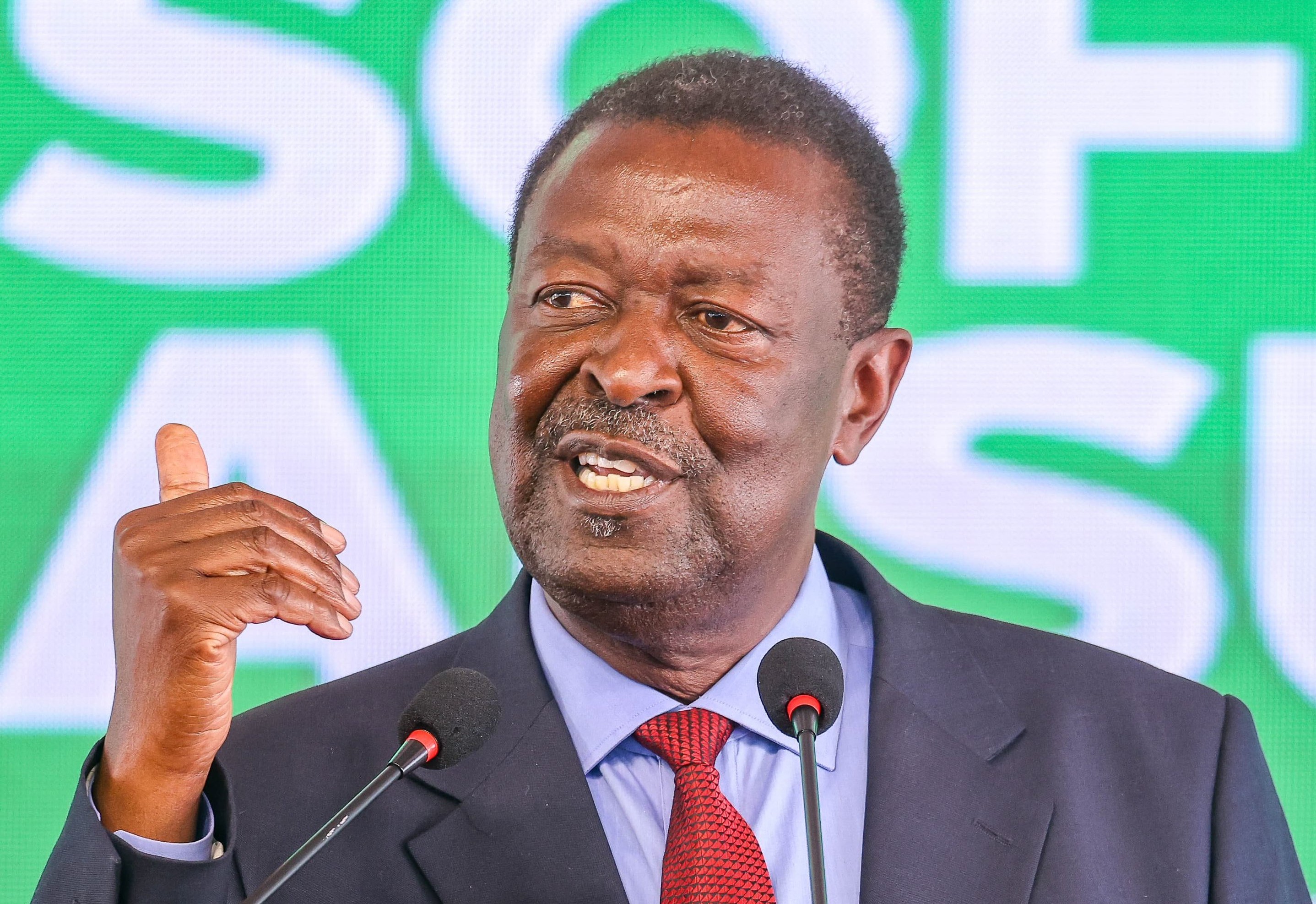
As the year 2025 came to a close, Prime Cabinet Secretary Musalia Mudavadi declared the country needed to undertake crucial reforms before the next election.
This came after the apparent stalling of the National Dialogue Committee report which created rapprochement between former opposition leader Raila Odinga (now deceased) and President William Ruto regarding the violent sufuria protests.
Nadcoreport had made a raft of recommendations that would require administrative and legislative reforms. However, foot dragging by political players led to putting the report in abeyance. It became overtaken by events when extraordinary political decisions had to be taken in response to the Gen Z protests of June 2024.
The establishment of the broad-based government shifted the political tectonics in a way that eclipsed the need for the national reforms. The political order had to be reorganised to reflect the new arrangement leading to the impeachment of then Deputy President Rigathi Gachagua. Then Raila suddenly died towards the end of the year and the nation spent the next months in mourning.
However, facts are stubborn and the remarks by Musalia on a constitutional referendum alongside the general elections cannot be wished away. Fifteen years since the promulgation of the new constitution, Kenyans are required to introspect and assess the veracity of the supreme law.
The reality during its implementation has shown that there are critical areas that do not respond robustly to the needs and desires of the citizens. The social dynamics of the nation have also demonstrated that political reforms are required to align the nation with its growth.
The population has increased and yet there also exists a judicial dispute over the 2019 national census that should be addressed. Some constituencies were protected in the 2010 review, but that provision was never meant to be indefinite.
Then there is the country’s political heritage, which has stubbornly and consistently defined how politics is conducted in spite of the constitutional order. While the new constitution envisages a presidential system like the United States model, Kenya continues to subconsciously fall into parliamentary practices to address their existential challenges.
During the handshake regime of Uhuru Kenyatta, attempts were made to redress the inconsistencies through the Building Bridges Initiative process. However, the process was rejected in spite of its pragmatism. In fact, the Nadco report closely mirrored the BBI one. These efforts clearly demonstrate that reforms are key for the stability of the nation.
The circumstance that led to the handshake between President Uhuru and Raila and now the broad-based government are a clear indication that the constitution alone cannot address the country’s serious political crisis. It has, however, emerged that many political leaders and opinion shapers always oppose these reforms for opportunistic reasons.
At any given chance to undertake the reviews, the politics of the day overrides the necessities of posterity. The key players always make calculations to either support or oppose based on their current and existing survival instincts.
Therefore, the country has always lost the opportunity for these reforms at the altar of idiosyncratic considerations. Already there have emerged proponents and opponents of the current push. As the 2027 general election approach, the country finds itself in a unique situation. President William Ruto has radically rewritten the political architecture of the country.
Since Independence,Kikuyus strongly feel that they are not in firm control of the government. With the exit of Gachaguafrom the number two perch, there has been orchestrated open rebellion from the region. The rebellion is based on the perceived betrayal by the President.
Apparently the now DCP leader and team had planned to have Ruto as a figure head president while they controlled the wheels of government.
That partly explains why no effort and resources were spared to decampaign Raila in the Mt Kenya region because he came across as a strong personality incapable of being manipulated. The GenZ revolt seems to have exposed the scheme a little early and Ruto responded decisively.
The political crisis that perennially bedevils Kenya can be addressed through objective reforms. The leaders must admit that the constitutional framework as was negotiated in Naivasha is not entirely consistent with the nation’s political culture and psyche. Kenya had a long relationship with Britain through colonial heritage. Thus, modern political practice was modelled on the Westminster traditions.
However, the initial bureaucrats of the country together with the pioneer political leaders had heavy American influence owing to their overseas studies. Most obtained their training in American universities and lived through the Civil Rights Movement. They had admiration for the American independence war against Britain.
The creation of the presidency was the result of the fusion of the monarchy as head state and prime minister as head of executive arm of government. The first President, George Washington, out character and his personality gave the White House presidency its traditions and practices.
In recent times, US President Donald Trump has shown that those traditions and practices are not anchored in law but based on political good behaviour. Therefore, the USA presidential system, when put to strenuous test, has come out not as stable as was initially taken for granted.
Musalia suggested a referendum be held alongside the general election and said it should ask a few questions, such as whether there should be a substantive prime minister, among other issues.
In his immediate response to Musalia’s proposal, Suba South MP CaroliOmondi posited that Kenya is a presidential system that cannot have parliamentary practices within. He chairs the crucial parliamentary committee on the Constitution Implementation oversight. His view is important and shared by many.
Omondi is not only a seasoned lawyer but also played a key role in the Naivasha negotiations that eventually settled on the American presidential system model. The Naivasha team was fixated on either parliamentary or presidential systems.
However, the country must now consider the hybrid system. The semi-presidentialism exists and is practised in many countries of the world, especially in Europe. The experience the country has gone through demonstrates that neither presidential nor parliamentary systems in their pure form will serve well.
The government requires a head of state and head of executive arm of government as separate and distinct entities. The powers of both institutions can be distributed within the constitution as best suits the country’s circumstances.
The vesting of state authority and mundane government operations in one office creates internal contradictions and conflict of interest. For example, Ruto as head of executive arm of government, may act in conflict with the Legislature.
That conflict should be referred to the head of state for resolution. Yet he is the head of state as well. In Europe, semi-presidentialism is practiced by, among others, Switzerland, France and Russia. Political leaders should sober up and not squander this opportunity to conduct political and constitutional reviews once again.