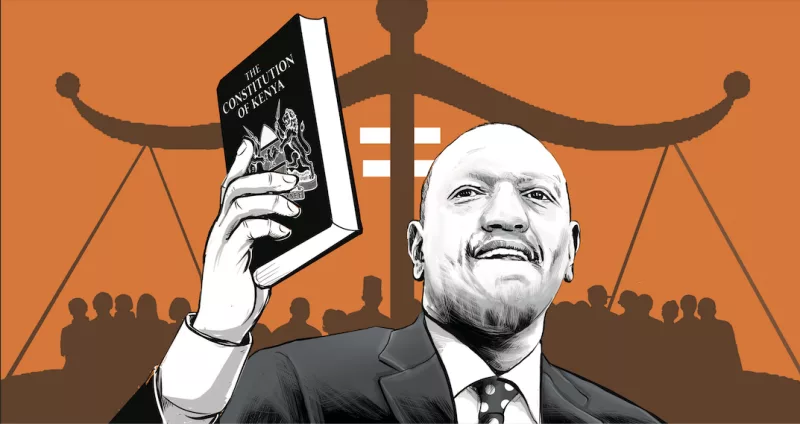
The following is a highlight of some of the decisions delivered by Kenyan courts in 2025 that attracted significant public interest and addressed important constitutional, governance, and rights-based questions.
On January 23 2025, the Environment and Land Court delivered a landmark decision underscoring the importance of adherence to zoning regulations. High-rise developments have increasingly emerged in areas previously designated as low-density residential zones in Nairobi.
The court found that Nairobi City County had exceeded its authority by approving developments that contravened its own Development Control Policy.
It held that approvals for high-rise developments, some rising to as many as twenty-eight floors, were inconsistent with the applicable zoning framework.
The matter proceeded to the Court of Appeal, which reiterated that development approvals must comply with lawful zoning regulations, constitutional principles, and relevant statutory frameworks. The Court of Appeal directed Nairobi City County to enact comprehensive zoning and development control plans for the entire city within six months.
In January 2025, the High Court sitting in Garissa quashed the results of the 2019 Kenya Population and Housing Census for certain sub-counties and constituencies in Garissa, Wajir, and Mandera counties. The court ordered the Kenya National Bureau of Statistics to conduct a fresh mini-population census in the affected areas within one year.
This decision came at a time when the Independent Electoral and Boundaries Commission had already missed the constitutional deadline within which it was required to undertake the delimitation of electoral boundaries ahead of the 2027 General Election.
Population data is one of the factors that the Commission must consider in reviewing constituency and ward boundaries. Compliance with the court’s judgment is therefore crucial to ensure the availability of accurate data required by the Commission, as well as by regional and national governments, in policy formulation.
In the same month, the High Court quashed the nomination of Mr Mokua Muruka as a Judge of the East African Court of Justice. The court held that the nomination had been undertaken by the Cabinet Secretary for the Ministry of East African Community Affairs rather than by the Judicial Service Commission. The court’s decision effectively affirmed that the mandate to determine nominees to the regional court rests with the Judicial Service Commission and not the Executive.
In February 2025, the Court of Appeal upheld a High Court decision declaring that local tribunals are subordinate courts falling under the Judiciary. The appellate court further held that members of such tribunals must be appointed by the Judiciary and not by the Executive.
Kenya’s constitutional history reflects periods marked by concerns over executive interference with the Judiciary. These decisions reinforced constitutional principles on the separation of powers and judicial independence.
Discussion of judicial decisions affecting the Judiciary would be incomplete without reference to the High Court judgment delivered on 18 December 2025, which barred the Judicial Service Commission from considering any petition lodged against judges until it promulgates regulations governing the handling of such petitions. The judgment attracted criticism from sections of the legal fraternity on the ground that it constrained the Commission’s constitutional mandate to discipline judges.
The conduct of the police has remained a matter of public concern. In July 2025, the Court of Appeal upheld an award of Kshs 10 million in damages to the widow of a Pakistani journalist who was shot dead by police officers. The court found that the shooting violated the deceased’s right to life.
In September 2025, the High Court awarded damages of Sh500,000 to each of seven petitioners in a case where the court found that they had been arrested and charged with the offence of sharing pornographic content, an offence that the court held was unknown in law. The court further found that the arrests were unlawful, noting that there was no complainant.
In another decision delivered in September 2025, the Court of Appeal ruled that the killing of Mr Bunty Bharat Kumar Shah, a former director of mattress manufacturer Bobmil Group of Companies, by police officers was unlawful, illegal, and contrary to the Constitution.
Judicial scrutiny of police conduct was further demonstrated on September 30 2025, when the High Court issued a declaration that the use of water cannons, tear gas, live ammunition, rubber bullets, and brute force against Gen-Z protesters was illegal and unconstitutional.
The court further declared that extrajudicial killings, unlawful arrests, abductions, detention, harassment, and torture of protesters amounted to gross violations of the Constitution.
These decisions, delivered at a time of heightened public concern over police conduct, underscored the availability of judicial remedies for victims of alleged police misconduct.
On October 30 2025, the Employment and Labour Relations Court declared that the National Police Service Commission does not have the power to employ members of the police service. The court held that the authority to employ police officers is vested in the National Police Service and the Inspector-General.
On family law matters, the High Court dismissed a case seeking to permit divorce by consent. The petition had challenged the constitutionality of Part X of the Marriage Act, which requires proof of statutory grounds such as adultery or cruelty before a divorce can be granted.
The court held that allowing consensual divorce would undermine the institution of marriage and affirmed that divorce in Kenya cannot be granted solely by consent of the parties.
In another family-related decision, the Supreme Court affirmed that children born out of wedlock are entitled to inherit from their deceased Muslim father’s estate. The Court held that it is unconstitutional to deny such children the right to inherit while allowing only children born within wedlock to do so.
The matter involved claims by three women who sought recognition as widows of a Muslim man and the inclusion of their respective children as beneficiaries of his estate.
One of the women challenged the inclusion of the other women’s children on the ground that they were born out of wedlock. The Supreme Court emphasised that all children are equal before the law and that the circumstances of a child’s birth cannot be used as a basis to deny inheritance rights.
Willis Oluga is an Advocate of the High Court of Kenya.