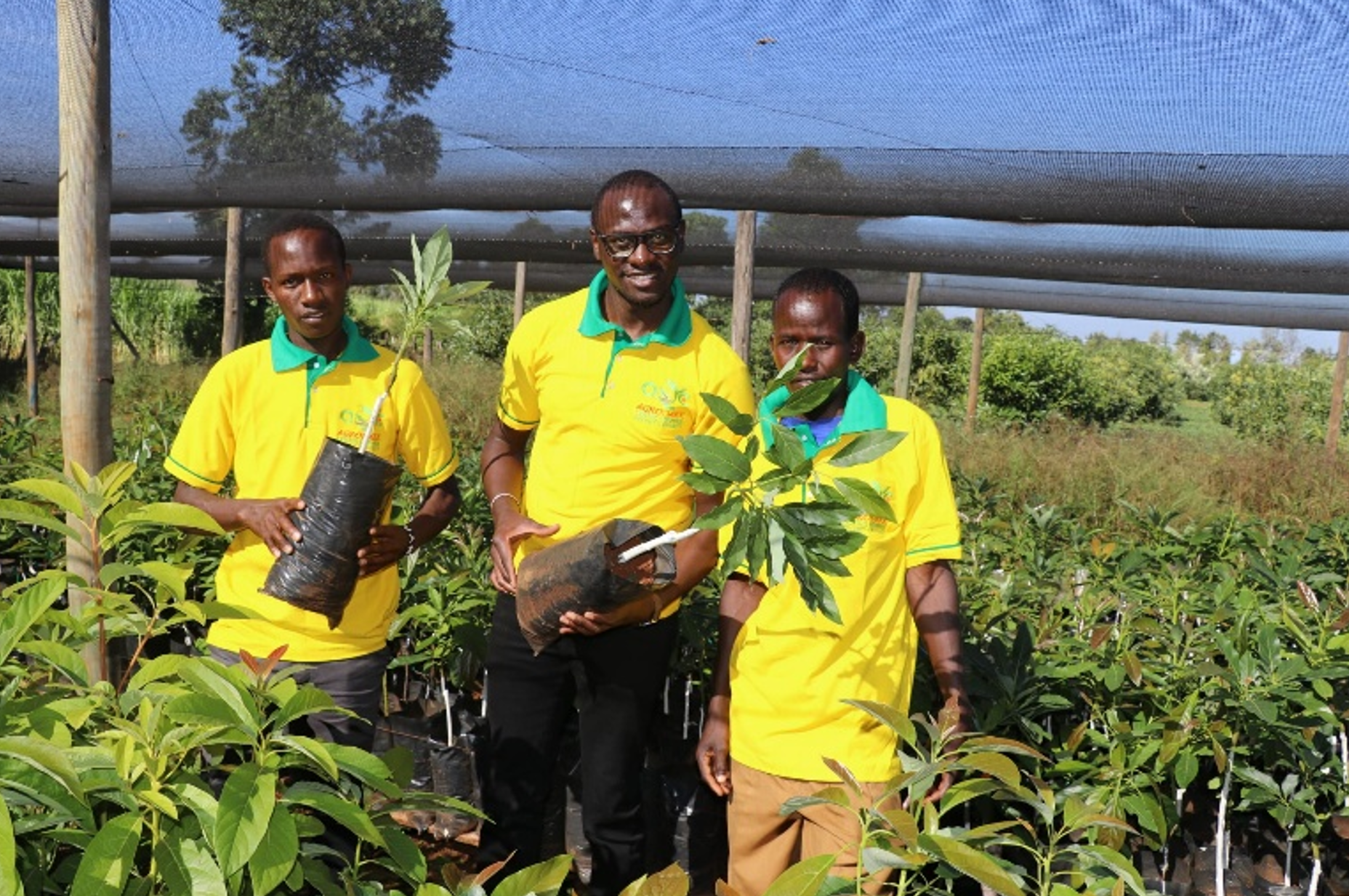
 Agrodakk founder and CEO Daniel Kimtai (centre) with staff during a field visit supporting farmer advisory and training services.
As these pressures intensify, some agribusinesses are focusing less on production alone and more on advisory services, skills development, and market linkages as ways of improving outcomes for farmers.
Agrodakk Ltd is one such company operating in western Kenya. The firm works with farmers on agricultural advisory services, training, and market access, reflecting a broader shift toward knowledge-driven farming support.
The company was founded by agronomist and plant pathologist Daniel Kimtai to apply technical expertise to practical, on-farm challenges. Kimtai remains closely involved in shaping the company’s strategy and operations, with a particular focus on ensuring farmers, youth, and women are included in its programmes.
Based in Trans-Nzoia County, one of Kenya’s key food-producing regions, the firm operates as more than a production farm. It functions as an agricultural support platform built around advisory services, training, and market coordination, working directly with farmers throughout the growing season.
“Agriculture should not trap people in cycles of loss,” Kimtai says. “When farmers have the right information at the right time, farming becomes a source of dignity, income, and opportunity.”
He says the company’s activities are structured around three core areas: knowledge, skills, and access to markets. Through its agricultural consultation and advisory services, the company supports farmers with crop planning, soil health management, and pest and disease control. A key emphasis is placed on early diagnosis and prevention.
“Many problems show up too late,” Kimtai explains. “By the time the crop looks sick, the yield is already lost. Our work is about helping farmers see and act earlier.”
By helping farmers understand what is happening both above and below the soil surface, the company aims to reduce losses before they become irreversible. For farmers operating on narrow margins, earlier and more informed decision-making can translate into better use of inputs, more stable yields, and lower production risks.
He said his firm also places strong emphasis on skills development and youth engagement. The company runs hands-on training, mentorship, and structured internship and attachment programmes for students and young professionals entering the agricultural sector.
Participants gain practical field experience in crop management, diagnostics, and advisory work, helping bridge the long-standing gap between classroom learning and on-farm realities. According to the company, this exposure can change how young people perceive agriculture as a career.
“We want young people to see agriculture as a profession, not a last option,” says Kimtai. “With the right skills, agriculture can be innovative, profitable, and globally connected.”
“When women and young people are equipped with skills, the entire farming system becomes stronger,” Kimtai notes. “They are not just labourers; they become decision-makers.”
Through direct involvement in field activities and structured training programmes, women and young people gain technical skills, confidence, and access to employment opportunities. This engagement also seeks to reposition agriculture as a viable and dignified livelihood, particularly for groups that are frequently marginalised.
To help farmers manage climate uncertainty, Agrodakk also provides online advisory services. Kimutai said these enable growers to access guidance on drought-resistant practices and all-weather crop production, allowing them to respond more quickly to changing conditions.
“For us, impact is not only about yields,” Kimtai says. “It is about people farmers, families, and communities and ensuring agriculture contributes positively to their lives.”
He said the firm has also partnered with the Smile Warriors Foundation to support less fortunate members of society through targeted donations, linking its agricultural work to broader community support.
For many farmers, producing a good crop is only part of the challenge. Access to reliable markets remains a major obstacle, with price volatility, inconsistent demand, and lack of aggregation often undermining profitability.
Kimtai said they are working to address this by connecting small-scale farmers to larger and more consistent markets, including the United States, the United Kingdom, Australia, Europe, and the Middle East.. Through aggregation, quality assurance, and value-chain coordination, the company supports farmers to meet buyer requirements more reliably.
“Our goal is to help farmers move from subsistence thinking to market-oriented production,” Kimtai says. “When farmers understand what the market wants, farming becomes more predictable and rewarding.”