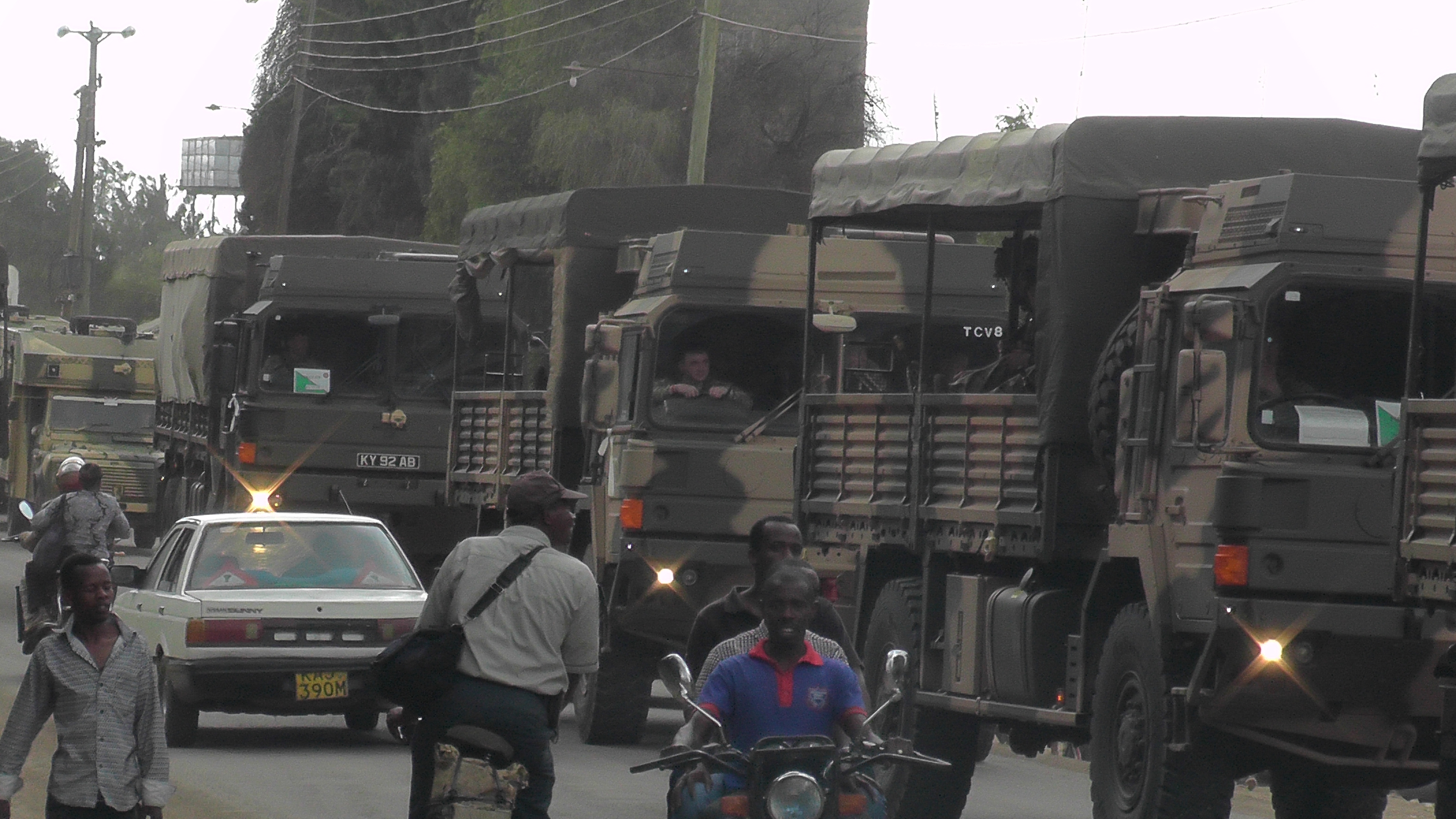
 British Army trucks moving in Nanyuki town. File
For decades, the presence of the British Army Training Unit in Kenya (Batuk) in Nanyuki and across Laikipia county has been accompanied by pain, trauma and unanswered questions. While official statements speak of partnership and military cooperation, local communities have lived a very different reality— one marked by abuse, abandonment and a deep sense of injustice.
This week, I travelled to Nanyuki with the VOCAL Africa team for our annual review meeting. What was meant to be a routine organisational exercise, quickly transformed into a painful reckoning.
Almost immediately after our arrival, news spread among the communities that VOCAL Africa was in town. Our phones would not stop ringing. We were inundated with urgent requests from local groups, survivors and victims of Batuk related abuses. These are people who just wanted someone to listen to their cry and support their cause for justice.
My team and I had no choice but to pause everything else. We rearranged our schedule and made time to sit with them. What we heard was heartbreaking, disturbing and impossible to ignore.
Women told us stories of rape by British soldiers. Stories spoken with trembling voices and long silences. Some of these women gave birth to children as a result of those violations. After the violations, the soldiers returned to their barracks, then to their country but women were left behind with lifelong trauma, stigma and the burden of raising children alone in poverty.
One account, in particular, still haunts me. We were told how up to six British soldiers would hire a guest house, bring in one local girl and sexually exploit her throughout the night. Subjecting her to degrading and obscene acts as if she were an object, not a human being. The cruelty of that story was not only in what was done to her but in the knowledge that justice never came.
The suffering did not end with the women. We heard from children fathered by British soldiers and who now walk among us as adults. They were raised by mothers and grandparents who had little to nothing. Many of these families struggled to put food on the table, let alone provide education or healthcare. These children grew up in grinding poverty, abandoned by the men who fathered them and forgotten by the institutions meant to protect them.
We met one such child, now an adult, who quietly told us how he went to school without shoes. Not once or twice, but for years. Not because he wanted to, but because there was no money. His story is not unique; it represents a generation of children condemned to invisibility.
Because many of these children are very light-skinned, they faced daily humiliation. They were mocked by other children, called “wazungu,” and cruelly told to go back to where they came from. Yet they had no other home. No other country. No other place to belong.
Beyond sexual abuse and abandonment, the physical scars of Batuk’s operations are etched across Laikipia’s landscape. Communities spoke of unexploded ammunition left behind after military exercises — deadly remnants hidden in grazing fields and villages. In some cases, these explosives detonated, maiming people, amputating limbs and permanently altering lives. Livestock, the backbone of pastoral livelihoods, was also killed, plunging families into even deeper poverty.
Even when victims sought justice through the courts, the system failed them again. Compensation, when awarded, was insultingly small. Legal fees swallowed large portions of it and corruption ensured that some of what remained never reached the real victims. Instead, money reportedly found its way into the hands of strangers, while survivors were left with nothing but bitterness and exhaustion.
These are not rumours. These are lived realities. The Batuk problem is real, and it is ongoing. Both the British and Kenyan governments must stop pretending otherwise.
The British High Commission in Kenya cannot continue to look away. Children fathered by British soldiers are children of British nationals. They should not be condemned to lives of poverty, stigma and neglect. Britain has a moral and legal obligation to acknowledge them, support them and restore their dignity.
Equally, the Government of Kenya must urgently review the bilateral agreements that govern Batuk’s presence in our country. Military cooperation cannot come at the cost of Kenyan lives, bodies and futures. Local communities must no longer be treated as collateral damage.
The people of Nanyuki and Laikipia are not asking for sympathy. They are demanding justice. They are demanding accountability. They are demanding to be seen, heard and treated with dignity.
Their pain has lingered in silence for far too long. That silence must end.