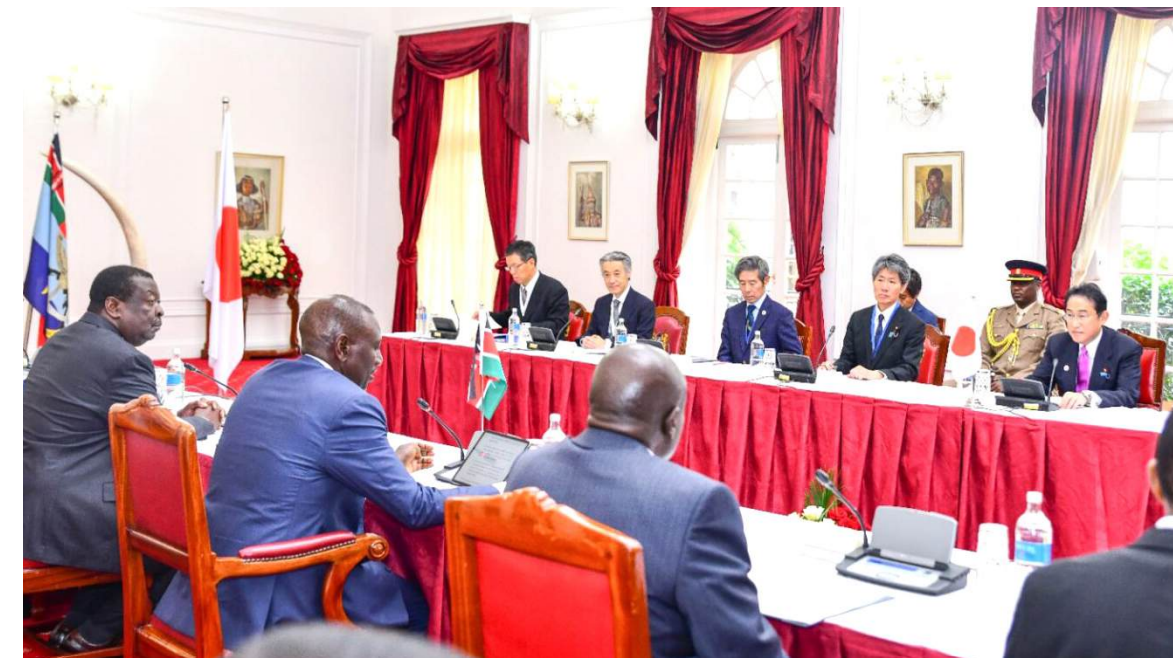
 President William Ruto and Japan Prime Minister Kishida Fumio at State House, Nairobi on May 3, 2023
As the global maritime economy undergoes significant changes,
the partnership between Kenya and Japan emerges as a pivotal force in
transforming Eastern Africa's blue economy. Rooted in over 60 years of
diplomatic relations and development cooperation, this collaboration has the
potential to reshape the region’s engagement with emerging value chains in the
blue economy.
Since the establishment of diplomatic ties in 1963, Kenya and
Japan have developed a robust relationship, marked by Japan establishing a diplomatic
mission in Nairobi in 1964 and Kenya reciprocating by opening its mission in
Tokyo in 1979. This partnership has become one of Japan's most prominent
engagements in Sub-Saharan Africa, leveraging its financial and technological
capabilities to support regional development.
Japan, the world's fourth-largest economy with a Gross Domestic
Product (GDP) of $4.28 trillion, provides not only financial resources but also
extensive technological expertise. Kenya serves as Japan’s key economic hub in
Eastern and Central Africa, hosting regional offices of the Japan International
Cooperation Agency (JICA), the Japan External Trade Organization (JETRO) and
the Japan Bank for International Cooperation (JBIC). This strategic presence is
crucial for advancing blue economy initiatives and enhancing regional
cooperation.
Economic exchanges between the two nations illustrate their
complementary strengths. In 2024, Kenya exported goods valued at approximately $69.29
million to Japan, including cut flowers and tea, while importing Japanese
products worth $816.97 million, such as automobiles and industrial machinery.
Over the past six decades, Japanese official development assistance to Kenya
has exceeded $5 billion, and roughly 120 Japanese companies have established operations
in the country, capitalising on its strategic location.
The Kenya-Japan collaboration is also aligned with the Free and
Open Indo-Pacific (FOIP) framework, which was initiated by Japan’s former Prime
Minister Shinzo Abe at the first Tokyo International Conference on African
Development. This framework fosters robust economic development and security
cooperation, with Japan and Kenya committed to enhancing bilateral relations in
line with Japan’s 2025 Diplomatic Bluebook.
The economic component of the FOIP partnership has seen
significant financial investments and infrastructure development, including the
modernisation of the Kipevu Oil Terminal and the Lamu Port–South Sudan–Ethiopia
Transport (LAPSSET) corridor. These projects not only enhance regional maritime
efficiency but also secure Japan’s shipping interests while integrating Eastern
African nations into broader trade networks.
One of the standout achievements of this partnership is the
Dongo Kundu Special Economic Zone (SEZ), which combines port infrastructure
with industrial processes. This initiative not only bolsters regional value
chains and productivity but also creates job opportunities, establishing Kenya
as a vital operational base for accessing emerging markets.
Eastern Africa’s Exclusive Economic Zones (EEZs) offer vast,
underutilised resources, providing opportunities for Japanese collaboration to
expand seafood production through technology and expertise. Initiatives like
the introduction of cage aquaculture for fish and shellfish are already
offering sustainable livelihoods while combating illegal fishing.
The region’s potential in renewable energy sources, such as
offshore wind and thermal energy, aligns with Japan’s innovative practices in
floating offshore wind systems and grid integration. Japan is supporting
Kenya’s efforts to achieve its clean energy objectives, reinforcing economic
stability and reducing dependence on imported fuels.
Human capital development is another cornerstone of this
partnership, as Japan provides scholarships and training programmes to develop
a skilled workforce capable of supporting the region's blue economy.
Collaborations in marine biotechnology and research pave the way for Eastern
Africa to engage in high-value knowledge sectors while simultaneously
benefiting Japan.
Beyond economic dimensions, security cooperation has also
solidified, strengthening Kenya's capacity to safeguard its maritime resources.
Japan’s support has enhanced the operational capabilities of the Kenya Coast
Guard and Navy, crucial for protecting trade routes and combating blue crimes
such as piracy and illegal fishing.
The Kenya-Japan partnership demonstrates how a triangular
approach can unlock the potential of the blue economy in Eastern Africa. By
combining Japan's technological innovations with Kenya's institutional
leadership and the region's resources, this collaboration offers the potential
for sustainable economic growth, regional integration, and active participation
in global maritime supply chains. Ultimately, this partnership could be the key
to developing a competitive and resilient maritime economy in Eastern Africa.
Senior Research Fellow, The Global Centre for Policy and Strategy and Kenya’s former Ambassador to Japan