Art exhibition Between Signals challenges and invites viewers to be present, to involve their senses and to report the experience back to themselves and to the environment around them.
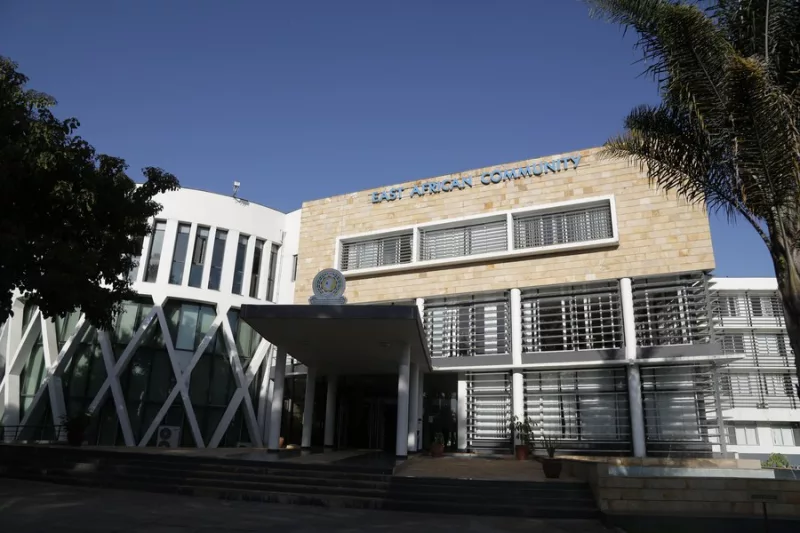
It opened onNovember 20 at the Nairobi Contemporary Art Institute (NCAI) and runs until December 31.
The exhibition is the product of a collaboration between NCAI and Munyu Space, presenting works from 17 artists working through different mediums.
Curated by Munyu Space, the event is a departure from the linear art viewing and conventional practice of art presentation. It engages directly with the viewer through a multisensorial approach.
The expo communicates how we transmute the signals picked in our environments through our bodies and how this influences our ways of life. It also brings to focus the subliminal manner in which our bodies pick up signals and presents the results in the works making up the exhibition through research-based explorations.
The exhibition asks you to listen, with both outer and inner ears, to be still as you listen, and explore where the listening takes you. What does this show about how you interact with spaces around you? What limitations and challenges do these spaces and what they hold carry, and how does that affect how you live?
SONIC INQUIRY
Each of the three gallery spaces has its own pattern of sound, presented and heard in different ways. Gallery one presents a sound that is of a humming beauty and quiet simmering rage. Antony Musiyo presents Astuta, a lamp designed collaboratively through a research-based exploration of the intersection and coexistence of traditional and modern technologies in design practice.
The lamps’ shades are made from dyed hyacinth harvested from Lake Victoria, and the legs are aluminium sand cast 3D moulds modelled from a fictional character named Astuta. The functional lamps emit a warm yellow glow, highlighting the harmony of green and brown colours on the lamp shades and a glimmer of their silvery legs, a humming beauty.
Cynthia Nyakiro and Chela Yego share their research and material exploration through Kerketai, a Nandi foreseeing ritual, which involves reading entrails to predict happenings. Rage, dissected intricately, presented using found materials on handmade paper, suspended in a semi-circular manner inviting a circular movement around them; a prelude to the cyclical nature of rage the artists intend to convey in the work.
Kabi Kimari’s Paths of Desire delicately explores home as a place you can continuously return to, one that softly welcomes you.
Gallery two offers an insistent sound. Muthoni in Mimi's work invites the viewer to experience deeply. The space is littered with poetic fragments from a larger poem, musings of a life riddled with equal amounts of grief and beauty. The poems are a dirge for this dying planet.
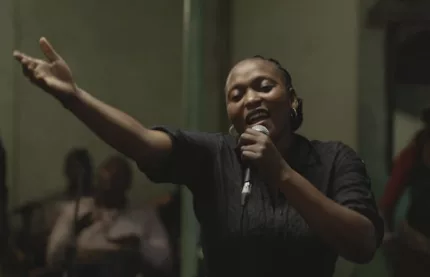
Muthoni Ni Mimi’s performance during the exhibition opening was hauntingly beautiful. It opened with a soft melody, a soft hum that ultimately built up to a confrontation of the audience, how they care superficially, and a commentary on capitalism: “A doctor giving you pain killers, then handing you a bill.”
Sounds of Nairobi presents a sound walk on the map of Nairobi CBD traced in a walking route on the floor, listening to different sounds collected from Nairobi. The sounds, if anything, invite a deep introspection and collective intense exploration of the city’s pain, joy and being through its people. What do these sounds mean? What are they to you?
Sophia Bauer’s work is intriguing in the way it is presented, not as sound but from sound. It results from an exploration of the experience of listening and perceiving sound, and how that can be translated onto textile materials through hand stitching.
Sonic stitchings are created from the memory of sound. By the time you have made a stitch, the sound you were listening to as you made it has already been replaced by another, so your stitch results from how you remembered it.
This is a beautiful ode to memory of sound and how it is carried in a stitch seconds after it has left our ears. We often think of our memory as a visual experience of what we saw, but what does the same memory look like as a sound?
Gallery three is a pulsing rhythm, its sound like a heartbeat. It is a coming together of two projection-mapping installations. Awour Onyango’s Library of Silence: Lawino is an intentional essay on silence as both an erasure and a resistance in the histories of Black womanhood.
The installation shows fragments from colonial-era documentary footage, seeking to question, answer and invoke feelings for the treatment of the African woman as a thing that can be redefined to suit its definers.That a woman is seen in value and from the lens of desire and functionality, a tool.
Kimani’s Installation, Sol Novus,feels like a trip deep into yourself that you almost get trapped in. It explores the liminal space between human consciousness, technological augmentation and cosmic context.
Kimani describes his work as a life-sized collage of papercraft human figures in a collective constellation onto which light, sound and motion are precisely mapped to evoke a journey through altered states of awareness.
This was an intriguing installation, especially as it doesn't necessarily demand presence but an awareness of motion subconsciously.
HISTORY, MEMORY AND KNOWLEDGE
Kamwangi Njue’s work is presented as a research publication: The making of technical meaning. Presented in four parts, Njue aims to present his research on making concrete new imagined objects through language. Kamwangi’s work aims to expand our thinking of what creation means to us, and how we have the power to make space within these creations to make meaning and new objects for ourselves and our needs. It is an opening up to a different kind of freedom, one which you grant to yourself.
This idea of creating from creation invites me to talk about Adam Yawe’s work, Mahindi Choma/Mbembe cia Ngara.Through it, he presents a creation conceptualised from an existing creation: an incense holder shaped like a street-side maize holder.
He examines how we create meaning from things that already exist in our lives, and how we interact and work with them to expand these interactions, and how they serve us. What can we create from what is already created, and what does this mean to us? This work invites a continuous dialogue and interest in our daily practices, which is not only grounding but culturally significant.
The Shrine of the Unspoken:Continuum, by Wakianda, is composed of recycled filament, textiles and sculptural elements. This installation grows from an earlier installationexploring silence, pain and unspoken experiences carried by women’s bodies, and it explores how they deal with these heavy emotions.
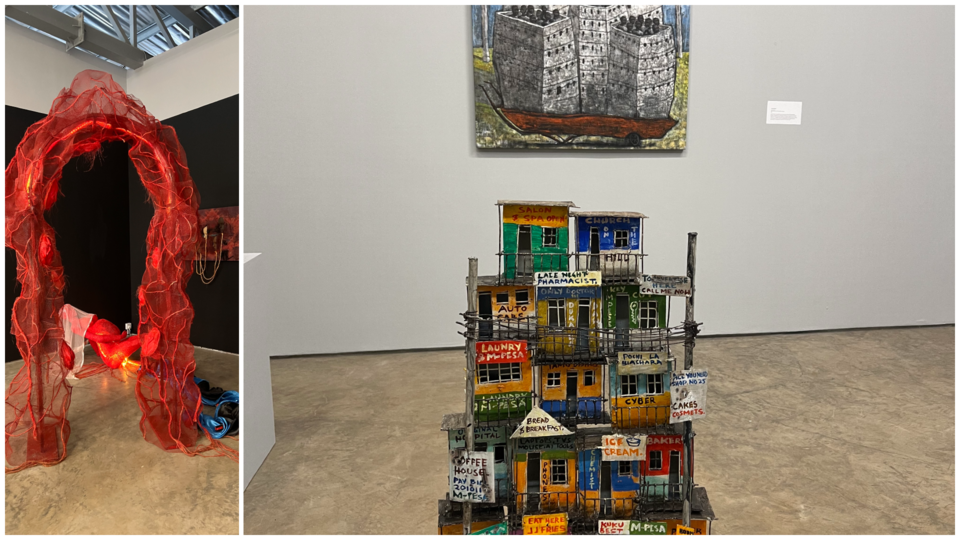
James Kamande’s work Urban Shelters is very inviting and captivates you easily, maybe because it aims to examine the memory of Nairobi through its buildings. Kamande’s work is a commentary on how Nairobi has been planned and remembered; how it is interacted with through its structures, and how this is transforming and evolving.
The multimedia installation Echoes Between Wires by Kevo Stero, placed at the end of the room in Gallery two and opening to Gallery three, insists on being moved through and interacted with. It allows dialogue and reflection on an almost subconscious rather than intentional transfer and remembrance of knowledge and culture.
It insists on the kind of treatment local and Indigenous knowledge gets. It is shelved for a future that is not defined, failing to recognise that it in itself should be a tool to shape this undefined future.
In Gallery three, Tizzita Tefera’s the Queen Mother’s Shrine is an olfactory immersive sight: various spices arranged in bowls, flowers, coarse salt and several other olfactory offerings placed onto a table.
These, together with fabric work on Taiwanese silk and Ethiopian shema draped on the wall, make up a shrine honouring Queen Mother of Idia of Benin and other iconic Black figures.
It is a symbol of divine protection, ancestral guidance and a continued memory of the same. Tizzita describes her work as an invitation into a shared ritual of questioning, introspection and inner listening, and it asks, “What’s best for you, and your society?”
FINAL THOUGHTS
Between Signals exhibits a curatorial and cultural coherence. It communicates an urgency and stillness in the way we use our bodies to translate the language the world around us speaks, and how the awareness of both is a space to explore what these meanings are to us, and how they can be expanded to keep serving us.
In exploring these meanings, we are also invited to question how we act. Are we reproducing the same circumstances that have made our lives harder? In what ways are artists making space to technically explore possible avenues of transformation and change in their environment?
The exhibition presents artists as creators, researchers, agents of advocacy and as signals between us and our ways of life. It is a meditative experience worth visiting before it ends on December 31.