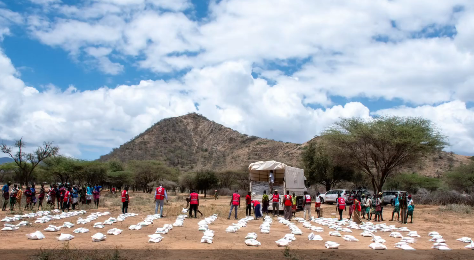
 Kenya Red
Cross officials
during a food
distribution
drive to
drought-affected
communities
in Tana River
county on
December 5
/HANDOUT
Kenya Red
Cross officials
during a food
distribution
drive to
drought-affected
communities
in Tana River
county on
December 5
/HANDOUTThe number of people going to bed hungry in drought-prone counties is set to rise, a new report warns.
At least 2.1 million people across 32 counties are facing food and nutrition shortages, a situation that government officials say could worsen if swift action is not taken.
On Tuesday, the government announced measures to cushion those affected.
“The food stress we are witnessing is largely the result of poor and erratic rainfall, which has led to widespread crop failure and reduced pasture for livestock,” Deputy President Kithure Kindiki said.
Kindiki cited forecasts by the Kenya Meteorological Department, indicating that affected counties will require sustained humanitarian, nutritional, health and livestock support for at least the next six months, until harvests from the March–May long rains become available.
The Deputy President chaired a high-level crisis meeting with Cabinet Secretaries, Principal Secretaries, governors, heads of state agencies and chief executives to assess the scale of the drought, the cost of interventions and resources needed to support households and protect livelihoods in the hardest-hit regions.
“A follow-up meeting involving development partners, humanitarian organisations and the private sector will be held, after which the government will release a comprehensive roadmap on drought mitigation,” he added.
Counties bearing the brunt of the drought include Turkana, Machakos, Makueni, Kitui, Taita Taveta, Kajiado, Tana River, Mandera, Wajir, Garissa, Marsabit and Isiolo.
A forecast by the Igad Climate Prediction and Applications Centre (ICPAC) and other agencies indicates that the October–December 2025 rainy season has largely failed across much of the eastern Horn of Africa.
“The rainy season has essentially failed across much of Somalia, eastern Kenya and southern Ethiopia, with October–November rainfall amounts extremely low and poorly distributed. Recovery through late-season rains in December is now unlikely,” the forecast says.
Many areas received less than 60 per cent of normal rainfall, while southern Somalia and neighbouring areas of Kenya and Ethiopia, as well as parts of northern Somalia, received less than 30 per cent. Some regions experienced near-record low rainfall, marking their driest season on record since 1981.
Hotter-than-average temperatures coincided with these severe rainfall deficits, accelerating soil drying and vegetation loss. Several affected areas also experienced below-average rainfall during previous seasons, making this the second or third consecutive poor season in some regions.
In southeastern coastal counties, including Kwale and Kilifi, residents are facing a third consecutive below-average rainy season. Crop yields during the March–May 2025 season were 40–70 per cent below normal in some agro-pastoral areas despite above-average cumulative rainfall, due to poor rainfall distribution.
“The successive poor seasons have halted livelihood recovery, including efforts to rebuild herd sizes,” the forecast notes.
The National Drought Management Authority reported abnormally long dry spells in Garissa, Wajir, Mandera, Tana River and Kitui, with communities relying on emergency water trucking.
In central and eastern Kenya, crop water availability is very poor, with delayed onset and extremely low crop water satisfaction levels. Below-average rainfall in October–November, coupled with predicted low rainfall for December, threatens crop failure or low yields.
While 2.1 million people are estimated to be in crisis or worse (IPC Phase 3+) in Kenya, these estimates are expected to rise as the full impact of the failed rainy season becomes apparent.
For agro-pastoralists, below-average or failed harvests in January and February will lead to early depletion of food stocks and greater reliance on market purchases amid rising food prices and low household incomes.
Pastoralists are expected to face poor milk production and reduced livestock-related income as livestock body conditions deteriorate, with some deaths likely during the dry season.
Communities are also at risk of disease outbreaks as livestock congregate around limited water points and competition over scarce resources may trigger conflicts.
The report warns that gender-based violence risks may increase as women and children walk longer distances to fetch water, while population displacements may rise.
Levels of acute malnutrition are likely to increase as households lose access to food and livestock, further reducing children’s access to milk. Currently, 1.85 million children in Somalia and 742,000 in Kenya face acute malnutrition.
The report concludes that addressing these interconnected crises—from food insecurity and malnutrition to population displacement and livestock losses—requires substantial humanitarian resources.