
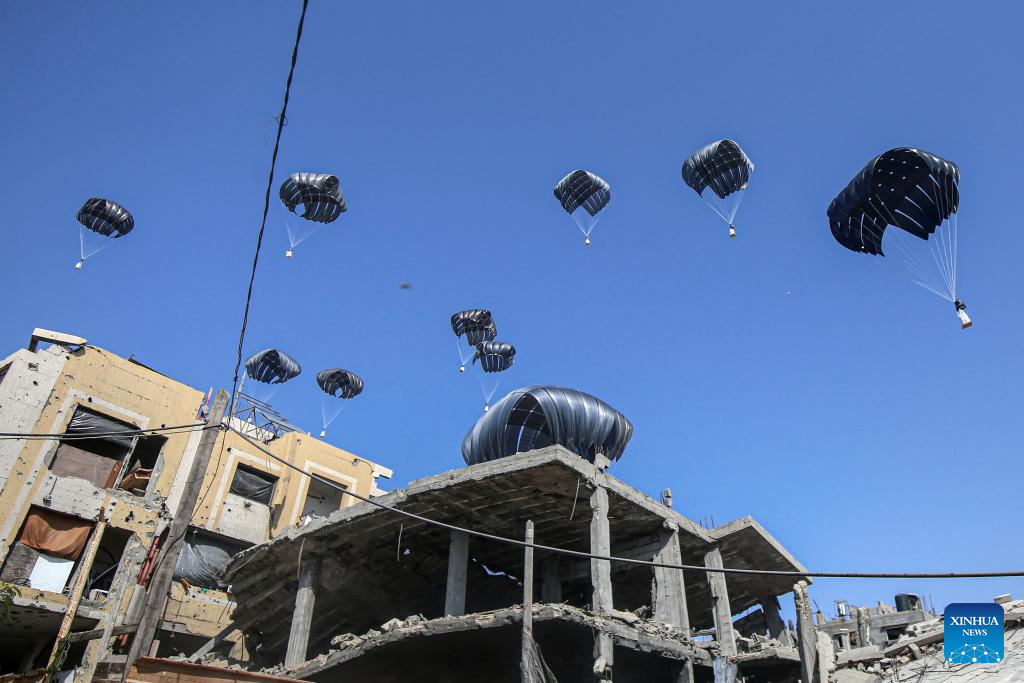
 An airdrop of food aid in the northwest of Gaza City on August 15 /RIZEK ABDELJAWA
Customs delays can add as much as 30 per cent to delivery times, while tariffs might inflate aid costs by 15-25 per cent. A $300 (Sh38,757) per-truck fuel tax imposed in April last year in South Sudan briefly halted UN and NGO fuel convoys, forcing agencies to suspend airdrops that served more than 60,000 people because even “exempt” shipments were held at checkpoints pending payment.
In January last year, a consignment of humanitarian aid donated by the Egyptian Red Crescent Society to Pakistan, which was severely hit by floods, was delayed at Karachi port. Despite clearing all duties and taxes, unforeseen delays led to demurrage charges exceeding the value of the relief items. The Pakistan Red Crescent Society appealed for a waiver of these charges to ensure the aid reached those in need promptly.
Humanitarian front-line workers report that customs bottlenecks and additional duties have become a recurring obstacle. Even when governments claim to waive fees for aid, cargo often piles up in bonded warehouses accumulating unexpected costs.
The World Bank highlights that these customs delays also increase expenses for humanitarian efforts, as relief shipments awaiting clearance can accumulate storage fees. In several crises, such as the earthquakes in Nepal and Cyclone Pam, delays meant expired medicines, spoilt food and soaring labour costs (driven by extended deployment of logistics staff, overtime payments for customs handlers, and mounting storage fees as shipments sit idle).
Upholding international conventions and delaying tariff negotiations are cutting off aid supplies just when conflict, climate disasters and severe funding cuts are heightening needs.
Aid agencies should be considered partners in trade negotiations and leaders should institutionalise these humanitarian exemptions. Conventions such as the World Customs Organization's Kyoto Convention already recommend duty-free priority clearance for relief shipments, yet few governments fully follow through on those recommendations.
The IMF and World Bank emphasise that open trade ensures essential food supplies and fertilisers reach the vulnerable. However, many of those countries are now introducing new barriers, jeopardising the fragile lifelines upon which relief agencies depend.
Early this year, a policy freeze in the US halted purchases of wheat, soy and other food products for major aid programmes. Reuters reported that this freeze could "hinder or halt the operations of organisations that provide millions of tonnes of food each year to help alleviate poverty in countries such as Madagascar, Tanzania and Honduras".
The UN's World Food Programme has warned of a 40 per cent decrease in this year's budget, leading to 30 per cent cuts in staff and food aid. These reductions come as costs escalate. Rising freight, fuel and raw material prices, partially driven by tariffs, lead to increased humanitarian expenditure.
Heightening the strain, major donors such as the US and the EU are shifting priorities from aid to more national priorities such as defence, leaving agencies to navigate an environment of increasing demands with limited resources.
The IMF's latest briefing on the global food crisis calls for removing trade barriers for food staples, fertilisers and other agricultural inputs and for phasing out export bans. Trade policies should support humanitarian efforts; however, when export bans and retaliatory tariffs are in play, provision of humanitarian goods and services is at stake.
In May, the US and China announced a 90-day tariff truce, cutting US levies on Chinese imports to 30 per cent (from as high as 145 per cent) and Chinese duties on US goods to 10 per cent (down from 125 per cent), a move prompting stocks to rise in the financial market.
Although this was a temporary fix, it signals that trade tensions are much alive. For humanitarian actors across Africa and the Global South, a 90-day window is not feasible as supply chains for Food, NFIs and medicine, depend on long-term contracts and predictable tariffs, not interim political solutions.
The following recommendations could be considered to ensure provision of humanitarian services and supply of good are not caught in tariff crossfires.
Tariff exception for humanitarian goods – the World Customs Organization (WCO) urges countries to waive duties, taxes and fees on consignments to approved organisations in emergencies.
EU member states temporarily exempted all Covid-19 medical supplies from import duties and VAT in 2020 and did the same for goods sent to Ukrainian refugees in 2022. Likewise, Benin’s 2021 agreement with the World Food Programme expressly exempts all WFP imports from indirect taxes such as VAT and customs duties.
These tariff waivers have proven to cut costs and delays ensuring shipment reaches the beneficiaries instead of languishing at ports.
Priority customs clearance. Several countries have acceded to the WTO trade Facilitation Agreement in expediting Special Relief measures to goods marked as “humanitarian”. For instance, the Ukraine crisis of 2022 saw the UK introduce a “temporary process” allowing humanitarian goods to pass through customs without delay. Poland simplified border procedures at key crossings (Korczowa and Dorohusk) so trucks carrying humanitarian aid could use a single pre-approved form and be cleared immediately.
Humanitarian voice in trade talks. Humanitarian actors should have a seat at the table. Frequent forums are needed, such as the WTO Aid-for-Trade Global Review in June last year where Unicef co-hosted a session with trade facilitators to address humanitarian supply-chain bottlenecks. Such forums show that when entities such as the Red Cross and Red Crescent Movement, the UN and other NGOs are included in policy dialogues, countries can adapt regulations that may fast-track delivery of humanitarian services.
Flexible humanitarian financing. Mechanisms such as contingency funds and flexible budgets enable humanitarian actors respond swiftly when unforeseen costs arise. A case in point is Lebanon’s Humanitarian Fund (LHF), which provides rapid, unrestricted grants to NGOs. In late 2023, as violence intensified in southern Lebanon, the LHF allocated emergency funds that allowed NGOs to quickly initiate relief efforts. Similarly, Unicef utilises its core “Emergency Programme” funding to respond effectively. During the crises in Haiti from 2021 to last year, its flexible funds enabled the delivery of clean water and hygiene products to more than 1.14 million individuals impacted by earthquakes, flooding and conflict. Such flexible financing strategies allow humanitarian initiatives to absorb shocks without halting operations, ensuring assistance reaches those in need.
Though not easily implemented, these recommendations are crucial for protecting humanitarian service delivery from the impacts of trade disputes at a time when budgets are already stretched thin due to shrinking humanitarian funding.







