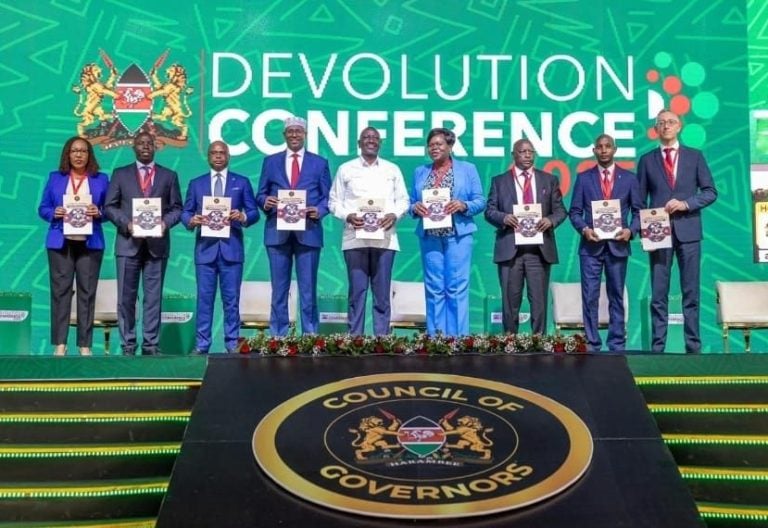
 Council of Governors chairman Ahmed Abdullahi and Deputy President Kithure Kindiki during the Devolution Conference Closing Ceremony at Homa Bay National School in Homa Bay county/DPCS
ODM leader Raila Odinga has often been hailed as the father of devolution, a title that may be partly deserved but could now be contested.
His recent calls for a three-tier government structure and stripping the Senate of its oversight mandate over governors risk misleading Kenyans about the true history, intent and future of devolution. Raila’s proposals risk turning him into the kind of parent who abandons his child after birth.
During the Katiba@15 celebrations, Raila argued that Kenya is too small for 47 devolved units covering 53 million people. He cited the US with 50 states for 340 million people, Nigeria with 36 states for 230 million and South Africa with nine provinces for 63 million. Paradoxically, he did not advocate for abolition of any county but believes we need a three-tiered government system with an additional regional level.
Selective history
Raila is being economical with the truth on multiple fronts. First, he creates a misleading impression that the US, Nigeria and South Africa operate two tier-government systems. In reality, the US has more than 3,000 counties, Nigeria more than 770 local governments and South Africa more than 250 municipalities, all beneath the state-provincial levels. Even California, the most populous American state with 40 million people, has 58 counties, more than Kenya’s 47.
Second, Raila is selectively retelling Kenya's constitutional history. Regional governments have been debated exhaustively in all Kenya’s constitutional making processes, from Lancaster in 1963 to CKRC and Bomas. The regional tier Raila is advocating was never meant to exist alone.
The Lancaster (Independence) constitution envisioned seven Majimbos with local governments (municipal and county councils) beneath them. The Bomas Draft envisioned 14 regions, while the subsequent harmonised draft retained the former eight provinces as regions. Each region was to have a premier, a regional assembly and a cabinet. And beneath these regions were to be 70 districts or counties, each with a governor, county assembly and an executive committee.
In both drafts, the county was always the principal level of devolution, while the regions were tasked with coordinating implementation of cross-county programmes and projects. The 47 counties emerged from a farsighted compromise that recognised regional governments were unsuitable for a tribally fractured country such as Kenya and that 70 counties were too many. By omitting these facts, Raila presents a distorted picture and misguides the national conversation.
Unanswered questions
Third, Raila is not telling Kenyans which functions he wants transferred to the new regional tier. Would regions control security, foreign affairs or monetary policy? Would counties surrender their competencies in agriculture, health, trade and works? If counties cede functions to regional governments, then why retain them at all? That fundamentally contradicts the whole purpose of devolution: guaranteeing communities the right to manage their own affairs.
If coordination between counties is the issue, Parliament already has the power to create regional coordination mechanisms without a divisive referendum. Counties are already cooperating through regional economic blocs. Strengthening such initiatives makes more sense than overhauling the constitution to accommodate political nostalgia.
Fourth, Raila should clarify whether he still has confidence in governors’ abilities to perform the functions assigned to counties. If not, then why add another level of government instead of reforming the existing architecture? And if the counties are performing, then why strip them of competencies and hand them to some regional government? He should invest his political capital in pushing for full devolution of functions and resources stuck in Nairobi, not in an expensive constitutional experiment.
Accountability double standard
Lastly, Raila’s stance on oversight is contradictory. In the last Parliamentary Group meeting, he insisted that only MCAs, and not Senators, have the mandate to oversight governors. He said senators should “stop wasting governors’ time” summoning them to Nairobi to answer audit questions. Yet, when Nairobi MCAs sought to impeach their governor, Raila personally persuaded them to back down, despite overwhelming support in that assembly to exercise its oversight mandate. He wants the Senate’s oversight weakened while simultaneously interfering with MCAs’ oversight. This effectively shields governors from accountability. If Raila genuinely believed in protecting devolution, he would be the loudest demanding accountability and service delivery.
Bigger government costly
Raila’s diagnosis may resonate with Kenyans who feel 47 counties are too many to manage. But creating an additional tier of government would only multiply bureaucracies and compound problems. At a time when Kenyans are tightening their belts under a harsh economic climate and demanding a leaner government, it is reckless to propose yet another level of government.
But this fits into Raila’s left-wing ideology that the bigger the government the better for society. In practice, bigger government means bigger bills for taxpayers, more offices to fund and more opportunities for political patronage and cronyism. Every shilling poured into sustaining new layers of government is a shilling denied to development and service delivery.
Choice ahead
Counties are already drowning in corruption and waste. Governors are spending billions on allowances and ghost projects while health systems crumble, garbage piles up in towns and water shortages persist.
The choice before Kenyans is therefore very clear. Bigger government and more bureaucracy or better government? More politicians or better services? After 15 years of devolution, the answer is obvious. Kenyans want leaner, more efficient and accountable governance that prudently spends their taxes on quality service delivery and not on more politicians.
Raila's proposals will not strengthen devolution. They will suffocate it and further erode public trust in government. For the celebrated father of devolution, this is an unfortunate and deeply ironic turn towards becoming its undertaker. Kenyans deserve functional accountable governance, not expensive, sectarian political experiments that serve the few at the expense of the many.
Mugendi Nyaga is an actuary, management consultant and public policy analyst