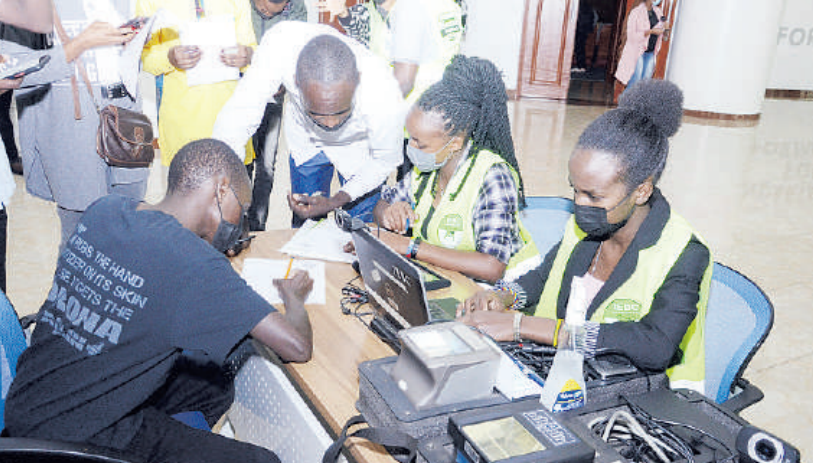
The IEBC is set to officially kick off a nationwide voter registration drive, setting the stage for a high-stakes political battle to control nearly six million new voters—predominantly the youth, ahead of the 2027 general election.
The resumption of the Continuous Voter Registration followed an elaborate and tightly scheduled preparatory phase unveiled by the Independent Electoral and Boundaries Commission on Sunday.
IEBC announced that registration centres will open their doors on September 29, an exercise pundits hold has “immediate and profound” political implications.
The ‘tyranny of numbers’, a phrase synonymous with leveraging ethnic numerical strength, is now evolving into a race for the ‘tyranny of the youth vote’.
Political parties are expected to deploy resources to areas with the highest concentrations of unregistered youth, turning registration centres into the first unofficial battlegrounds of the 2027 poll.
The IEBC’s ambitious target is to enrol over 5.6 million new voters by 2027, a figure that stands to alter the country's political landscape as campaigns for the next election gather momentum.
Going by past events, the number could be higher, considering the rise in the number of Kenyans eligible to vote in 2027.
According to the 2019 Kenya Population Census, approximately eight million more young people will have aged into the voting bracket by 2027.
The group, comprising largely of the Gen Z that has recently shaped national politics through anti-government demonstrations, represents the most coveted prize for presidential hopefuls.
The commission aims to register 2.27 million new voters in the current financial year and another 3.41 million in the next, bringing the total potential new registrations to 5.68 million.
If fully achieved, the national voters’ roll would swell to a historic 27.8 million, up from the 22.12 million who participated in the 2022 election.
Candidates who have expressed interest in unseating President William Ruto are already eyeing the youth vote as a potential game-changer.
Wiper leader Kalonzo Musyoka, former Interior CS Fred Matiang’i, Busia Senator Okiya Omtatah and former Chief Justice David Maraga have all tailored their early campaigns to appeal to Gen Z.
Despite the uncertainties of his participation in the next election, former Deputy President Rigathi Gachagua has also fashioned himself as having solutions for the young people.
“They (Gen Z) will define the election and tilt the numbers in favour of the person they will support, but most of them lack IDs,” Winnie Kaburu, a political observer, told the Star.
Kaburu said the success of IEBC’s new listing drive would depend on how many young people apply and collect IDs and whether the government would facilitate them without hitches.
As pundits observe, the path to registering these millions is fraught with significant hurdles beyond the financial challenges IEBC cited in the previous listing.
The FinAccess 2024 Survey paints a stark picture of exclusion, indicating that 23.1 per cent of Kenyans aged 18-25 are financially excluded, primarily due to a lack of National Identification Cards.
Of the 2.3 million people without IDs, 1.9 million (83.4 per cent) are in the referenced critical age group, with 72.1 per cent of 18-year-olds lacking the document.
KNBS data (2024 Economic Survey) paints a grim picture of the low number of Kenyans registering and collecting their IDs, the only tool that allows them to vote.
The survey, citing data from the National Registration Bureau, revealed that about 3.1 million ID cards were collected from the bureau in the last three years.
Of these, 967,067 were collected this year, from 1.1 million IDs that were produced in the year. About 1.2 million were collected in 2022 and 1.05 million in 2023.
Technically, it is possible the 1.9 million did not vote in the last election, which dwarfs KNBS’ count of eight million eligible new voters.
The highest collections for 2024 were reported in Nairobi (71,446) followed by Kiambu at 51,186, Kakamega (46,852), Nakuru (37,011), Bungoma (36,352) and Kilifi (33,936).
Some counties had as low as 3,100 new applications, with only 4.5 million not previously registered Kenyans seeking IDs in the past four years.
Recognising this bottleneck, the government has announced a rigorous ID registration drive in historically marginalised areas like Northeastern.
The government and its functionaries said the aim is to resolve a prolonged standoff over population figures and unlock voting potential.
“The barriers that previously prevented Kenyans, especially from Northeastern, from obtaining identity cards have been removed,” Public Service CS Geoffrey Ruku said.
Yesterday, he told the Star that the registration bureaus have been adequately facilitated to fast-track applications across the country.
“Our main issue is that while Kenyans are applying in massive numbers, they are not collecting the IDs with the same vigour,” the CS explained.
IEBC’s preparatory schedule underscores the complexity of the task, detailing the months spent on laying the groundwork for the September 29 launch.
Key activities included the national configuration and testing of the Kenya Integrated Election Management System (Kiems) kits’ voter registration module, completed on August 30.
Furthermore, the commission said it concluded the mapping and gazetting of all registration centres by September 10, to ensure nationwide accessibility.
The commission eyes completion of a Data Protection Impact Assessment and the filing of its report with the Office of the Data Protection Commissioner by September 5.
The move, as per the brief, is aimed at building public trust in the handling of sensitive biometric voter data.
IEBC expects to conclude the task of packaging and distributing voter registration materials and Kiems kits to all 290 constituencies by September 25.
It says the aim is to ensure that every registration centre is fully equipped for day one of the continuous voter listing.
On the side, the IEBC says it has rolled out a massive voter education and media campaign since late August, targeting the youth through traditional and social media platforms.
The campaign is viewed as crucial to motivating a generation known for its scepticism of traditional politics to formally engage in the electoral process.
The final phase of training for registration officers and the briefing of election observers and media is scheduled to be concluded on September 26.
The success of the registration will not only test the IEBC’s operational capacity but will also ultimately determine which political bloc successfully harnesses the power of Gen Zs, setting the tone for one of the most keenly contested elections in the country’s history.