An audit has red-flagged a Sh40.6 million mountain of rotting food worth millions of shillings at the Kenya National Trading Corporation.
The audit uncovered damaged and unsellable food stock, mostly rice and cooking oil, left to decay due to overstocking, poor handling and weak oversight by KNTC.
Advertisement
Advertisement
Auditor General Nancy Gathungu has raised concerns that instead of being written off, the losses were quietly excluded from the books, masking the true extent of waste.
“Examination of stock sheets provided for audit revealed some stocks of various categories were lying in various depots in a damaged state,” the auditor general said.
“In the circumstances, the effectiveness of the controls on inventory management could not be confirmed,” she said in the review covering the year to June 30, 2024.
The audit further exposed financial and operational collapse at the entity, which has on several occasions been at the centre of controversy over how it handles stocks.
Gathungu’s findings reveal a corporation drowning in mismanagement, with essential goods left to spoil in depots and incomplete, chaotic financial records failing to report an accurate picture of losses.
Advertisement
Advertisement
Besides the rotting stock, KNTC’s financial statements were found riddled with errors for which Gathungu issued an adverse opinion, declaring them unreliable.
The report exposed wide discrepancies, including a Sh22 million mismatch in reported losses — one document showed a loss of Sh3.85 billion, while another recorded Sh3.87 billion.
Even basic accounting checks failed: the trial balance was completely unreconciled, with a mysterious Sh2.7 billion debit entry and no corresponding credit.
Deferred tax liabilities were also contradictory as the main financial statement showed zero, while the notes buried in the report listed Sh1.3 billion.
Another unexplained Sh210 million provision for liabilities appeared without justification, leading the auditor to conclude possibilities of gross negligence or deliberate manipulation.
Also flagged is Sh187 million in unpaid customer debts, which are part of KNTC’s Sh5 billion debt listed in its books.
The auditor red-flagged the debts, some over a year old, without a clear plan for recovery.
The corporation had no policy for writing off bad debts, meaning these figures may be wildly optimistic.
Sales records were equally dubious, with the KNTC failing to provide documentation to verify if they were real or inflated.
The corporation reported Sh12.1 billion in revenue but could not produce approved price lists for key products, hence, the query.
“No document was provided to show the approved selling price of the rice, KNTC oil and imported oil,” the audit read.
Gathungu expressed concern that the cost of sales was overstated by Sh7.6 billion, thereby artificially depressing profits and raising red flags about possible irregularities.
“The accuracy and correctness of the cost of sales amount of Sh12 billion couldn’t be confirmed,” the auditor said.
Further to the finding, KNTC’s property records were disorganised, with Sh2.5 billion in land, including prime parcels in Nairobi, Naivasha and Nakuru, lacking ownership documents.
Some plots were the subject of legal disputes, while others had been illegally surrendered or encroached upon.
A Sh520 million write-down on land value was made without board approval, suggesting asset stripping or cover-ups.
Meanwhile, the board spent Sh39.4 million in meetings and allowances, leading to an over-expenditure of Sh9.4 million above the approved budget.
It also emerged that some directors were members of all four board committees, violating government rules.
About Sh2 million in duplicate mileage claims and unsupported training allowances were also flagged; the auditor said they pointed to outright abuse.
KNTC is also at the brink of collapse the auditor general said, with current liabilities exceeding assets by Sh3.2 billion and losses pushing retained earnings to a negative Sh4 billion.
Gathungu warned that KNTC may not survive as a going concern, saying suppliers are owed Sh1.5 billion, some unpaid for more than 120 days, risking lawsuits and supply cuts.
Instant analysis
From rotting stock to falsified accounts, KNTC’s sorry state is a case study in mismanagement. It is not the first time the entity has been drawn into controversy, the first notable one being the edible oils question that remains unanswered. The corporation was also mentioned adversely during the probe into the fertiliser subsidy scandal.


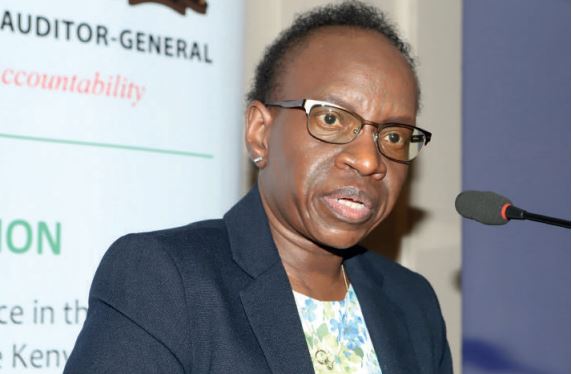 Auditor General Nancy Gathungu./FILE