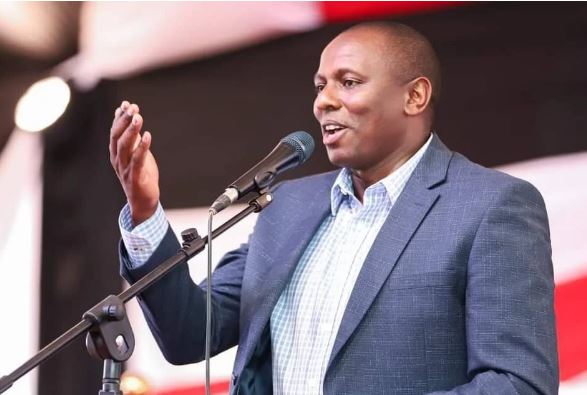
 Majority leader Kimani Ichung'wah./HANDOUT
The government has proposed a stringent law to strengthen the oversight of Savings and Credit Cooperative Societies, or Saccos and protect millions of depositors.
The Sacco Societies (Amendment) Bill, 2025, sponsored by majority leader Kimani Ichung’wah, seeks to address longstanding vulnerabilities in the sector.
It particularly seeks to formalise the Deposit Guarantee Fund (DGF) and introduce stringent regulations for secondary cooperative societies.
The Bill to be debated in the National Assembly reflects the state’s determination to regulate the usually volatile industry while securing member deposits.
Saccos are a lifeline for many low- and middle-income Kenyans, but the collapse of the Kenya Union of Savings and Credit Cooperatives (Kuscco) has exposed the vulnerability of the unions.
A recent forensic audit revealed Sh13.3 billion alleged fraud, leaving 58 Saccos at risk of asset auctions over Sh1.36 billion in unpaid loans and eroded core capital.
The proposed deposit guarantee fund would be a financial safety net designed to protect Sacco members from losses if a Sacco collapses.
Under the current framework, the DGF guarantees deposits up to Sh100,000 per member, shielding them from insolvency risks. However, the new Bill tightens the funds’ management for stricter control by the government and streamlines the claim processes.
In the changes, the board of trustees overseeing the fund will now include the Principal Secretary to the National Treasury and the PS responsible for Sacco matters, indicating tighter state oversight.
It would be headed by a non-executive chairperson appointed by the President, someone qualified in matters of banking, insurance, commerce, law, accountancy or economics.
Independent appointees with at least 10 years of expertise in cooperative or banking supervision will join the board. “No payments of claims shall be made out of the fund unless a date for commencement of such payments has been appointed and published in the gazette,” the Bill reads.
For the claims process, the law is being changed so members of a Sacco whose licence is revoked can now lodge claims directly with the fund.
The fund would have the authority to deny payouts to individuals linked to the Sacco’s collapse—a measure aimed at disrupting fraud.
The fund should operate in the same way as the Kenya Deposit Insurance Corporation’s role in banking, but it is tailored to the cooperative model. On the claims, the amendments clarify procedures, allowing members to seek compensation if their Sacco’s license is revoked, while barring payouts to those implicated in mismanagement.
Kuscco had made allegations that top bosses were ‘cooking the books’ and sanctioned unauthorised withdrawals. In the proposed dispensation, trustees and DGF officers would be shielded from personal liability for actions taken to intervene in troubled Saccos.
“No act or omission by any member of the board of trustees or by any officer, employee or agent…would render such member personally liable to any action, claim or demand whatsoever,” the Bill reads.
Beyond deposit protection, the Bill targets liquidity risks through a framework for secondary cooperative societies. The latter, under the proposed law, would pool resources to manage inter-Sacco lending and liquidity reserves.
The entities would be licensed by the Sacco Societies Regulatory Authority (Sasra) and would be required to maintain capital adequacy ratios and adhere to Central Bank of Kenya standards.
“A cooperative society shall not undertake central liquidity and shared service business unless that cooperative society has been licensed by Sasra,” the Bill reads. The Bill explicitly prohibits secondary societies from high-risk activities such as venture capital investments, lending to individuals and retail lending.
It further provides that the secondary saccos report daily liquidity and would also be subjected to external audits for early detection of irregularities. It also specifies fines of Sh3 million or five years in jail for any breaches of the provisions.
Instant analysis
As the Bill moves through Parliament, its success will depend on how MPs balance oversight with flexibility, while ensuring Saccos remain accessible to the communities they serve. By learning from Kuscco’s failures, whether in governance, liquidity management, or deposit security, the state aims to transform Saccos into resilient, transparent ins