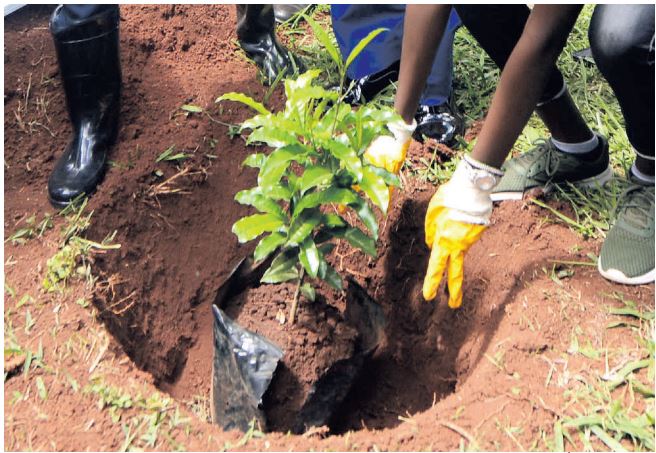
 A tree-planting exercise in Nairobi /FILE
Climate change is reshaping the fabric of life in Kenya: its farms, cities, forests and coastlines, and yet it remains largely absent from the country’s youth-driven agenda.
As rivers choke with waste, drought deepens hunger, and floods displace families, a critical question must be asked: will this generation rise up not only to protest the present but also to defend the future?
Across Kenya, the evidence is plain. Drought has turned once-thriving pastoral economies into fragile relief zones. Urban flooding has become routine in cities like Nairobi and Kisumu, with drainage systems collapsing under the weight of poor planning and indifference.
Water scarcity, food inflation, vector-borne diseases, and climate-driven migration are no longer future possibilities; they are the new normal.
The question now is not whether youth can speak out, but whether they can organise around the issues that will shape the next 50 years. Can they transition from episodic protest to sustained environmental leadership?
To be clear, there are already examples of what youth-led climate action can look like. One notable effort is the government’s Climate WorX Mtaani initiative, which has employed 21,000 young people to clean up rivers across Nairobi.
In Mathare, Mukuru and other informal settlements, these young Kenyans have unclogged more than 80 kilometres of waterways, repaired hundreds of broken sewer lines, planted thousands of trees and established nurseries now holding nearly half a million seedlings.
They are restoring dignity to riparian zones that had become death traps. They are earning a modest wage and reclaiming their environments. The government plans to scale this model to all 47 counties, engaging more than 200,000 youth in river restoration, urban greening and climate adaptation.
This is an important beginning but it cannot be the end. Cleaning rivers is not the same as reclaiming the future.
For this effort to matter, it must spark something bigger: a generational climate movement that speaks with clarity, acts with consistency and demands accountability not only for pollution but for every failed promise made in the name of environmental protection.
Climate WorX Mtaani should not only be seen as a job creation programme. It should be the seedbed of environmental consciousness.
It should compel young people to go beyond the shovel and demand a place at the table where climate policies are written, budgets are drafted and enforcement decisions are made.
There is so much ground to cover. Kenya still lacks a strong youth voice in the National Climate Change Council. County climate adaptation plans remain poorly funded or unknown to most residents.
Green spaces are routinely swallowed by concrete while wetlands are turned into real estate. Carbon credit markets are expanding without clear African youth participation or benefit.
Even where well-meaning tree-planting campaigns exist, they are often short-lived, poorly followed up or undermined by the very systems meant to protect them. These are issues that require bold civic action, sustained public pressure and long-term organisation.
This is why Kenyan youth must go further. They must challenge county governments to disclose and allocate adequate resources to climate resilience.
They must demand climate literacy to be mainstreamed in schools and technical training institutes. They must harness their digital influence to name and shame polluters, expose greenwashing and track climate financing.
They must organise not only in moments of anger but with the patience of those planting trees whose shade they may never sit under. The climate struggle demands this level of maturity.
It also demands ambition. In Uganda, Vanessa Nakate began with a placard and now speaks at global climate summits.
Across Africa, young people are suing governments for failing to act on emissions, organising court challenges against oil exploration and forcing multinational companies to account for ecological destruction.
There is no reason why Kenya’s youth cannot do the same and better. With our constitution recognising the right to a clean and healthy environment, and our courts increasingly responsive to public interest litigation, the tools are there. What is needed is focus and resolve.
If young people do not take ownership of the climate agenda, no one else will. The burden of a warming planet will not be borne equally.
It is the youth who will contend most acutely with the consequences of inaction: rising temperatures that threaten livelihoods, shrinking water reservoirs that endanger entire communities, and food systems on the brink of collapse.
It is their children who will be born into a world where dry riverbeds replace flowing streams, where cities become increasingly uninhabitable due to pollution and extreme weather, and where national economies teeter under the weight of climate-induced shocks.
This is not a distant concern but an imminent reality. And while governments can design policies and global institutions may debate frameworks, only the boldness, ingenuity and resolve of the younger generation can inject the urgency and innovation required to change course.
The question, then, is not whether the youth have a role to play, but whether they will rise with sufficient speed and conviction. The time for half-measures is over. The time to act is now.
Let Kenya’s youth understand that the true measure of their activism will not be in how loudly they shouted in 2024 or 2025, but in how sustainably they defended the earth that sustains them.
Let them rise not just in opposition to broken systems but in defence of creation itself. Because the real war has already begun and climate change is the battlefield they cannot afford to ignore.