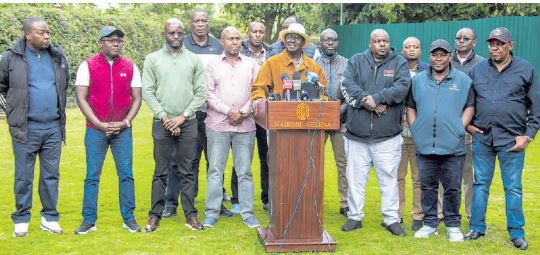
 Raila Odinga holds a briefing as the country marked 35 years of Saba Saba day, where he called for dialogue /EMMANUEL WANSON
Recent calls for dialogue in response to frequent Gen Z protests, while noble-sounding, have missed the mark, as talks have failed Kenyans before. But this has not stopped politicians, religious leaders and the business community from touting talks as the solution to quell the demos, hoping for the usual quick fix to the crisis.
Perhaps the most notable is former Prime Minister Raila Odinga’s call for "inter-generational dialogue". However, his proposal has been met with scepticism, as critics describe it as a "repetitive and ineffective" approach that has consistently failed in the past.
Nairobi traders, whose businesses have been disrupted by the protests and clergy have also joined the chorus, calling for structured talks to prevent further economic losses and worse, unwarranted deaths.
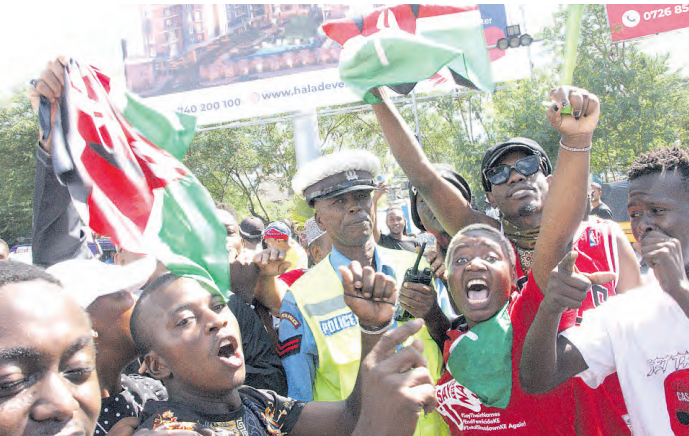
But with whom are the youth to dialogue? The same government that has issued a shooting order against them? If anything, the shoot-in-the-leg order, as good as a shoot-to-kill directive, is a prime example of instances where this administration has shot itself in the foot.
Besides, dialogue is a familiar refrain that has oftentimes led to a dead end. For Gen Z – a movement founded on principles of integrity, accountability and the rule of law – another round of talking without a genuine commitment to action would be a betrayal of its core purpose.
The public and particularly the youth at the forefront, are not asking for seats at a negotiating table; they are demanding a fundamental change in how the country is governed.
Historical records are littered with examples of reports and recommendations that have been ignored.
The Truth, Justice and Reconciliation Commission report is a powerful case in point. Established to address historical injustices, its findings warned that unresolved grievances and impunity would lead to future conflict. Yet, its recommendations have been largely shelved, allowing the same issues to fester and resurface today.
More recently, the Building Bridges Initiative and the National Dialogue Committee reports have also demonstrated the futility of such processes.
The BBI, a product of the 2018 handshake between President Uhuru Kenyatta and Raila, was widely perceived as an elite-driven arrangement that failed to address the concerns of ordinary Kenyans.
Similarly, the Nadco report, while highlighting valid issues, has been criticised as an "elite consensus" with its recommendations treated as mere political currency rather than as a blueprint for genuine reform.
These illustrate a recurring pattern; the political class uses dialogue to buy time and deflect pressure, only to continue with the status quo once the public attention subsides.
For dialogue to be successful in a political communication context, several basic tenets must be met.
Participants must engage with honesty, transparency and a willingness to acknowledge different perspectives.
Government and its spinmasters, with their disregard for truth, only help to erode trust, a commodity already in short supply between the political class and the citizenry. The perceived gaslighting and violent responses to peaceful protests widen the rift, making it impossible to build the trust required for effective dialogue.
Inclusivity and representation must also be upheld. Genuine dialogue requires all stakeholders at the table for meaningful participation and with decision-making power. Gen Z – largely "leaderless" and "tribeless" – and driven by organic, digital mobilisation, make it difficult for the government to identify legitimate representatives (a select few) to speak on behalf of a diverse movement. Yet, their facelessness has proved necessary for the protection of our youth, who are hunted for daring to raise their voices.
Constructive dialogue should focus on problem-solving, exploring common ground and seeking solutions.
The consistent demonisation of protestors and their demands by those in power, coupled with the brutal use of force, signals an absence of respect for the dissenting public, lessening any chance for constructive engagement.
Likewise, successful dialogue needs a clearly defined agenda and realistic, achievable goals. While the government appears oblivious of the demands being made, Gen Z have articulated the agenda; for integrity, accountability, prudence in managing resources and regard for the rule of law. The government, if genuine, should acknowledge these demands and respond by effecting meaningful change.
But perhaps the most crucial principle is a genuine political will to implement the outcomes of the dialogue and to hold those responsible for past failures accountable.
For Gen Z and the general citizenry, this lack of follow-through is not just disappointing; it's a betrayal of the democratic process.
The way forward, as proposed by the public, is not another round of talking shops, but a tangible commitment to reforms - sacking of officials responsible for the brutal crackdown on peaceful protesters, systemic reforms that would make future misgovernance difficult and that those in power adhere to the very principles they are sworn to uphold.
Specifically, these reforms would include a complete overhaul of the police service, ensuring it protects citizens rather than brutalise them and the prosecution of officers involved in extrajudicial killings.
The recruitment process for public servants should scrutinise their demonstration of and adherence to the principles of accountability, integrity and transparency as outlined in the constitution, in addition to their professional suitability.
Dialogue then, is not what is needed – that conversation has already happened. It is enshrined in the constitution and detailed in numerous unimplemented reports.
What is needed now is decisive action and a political class with the humility and integrity to deliver on its constitutional obligations. Anything less is, to put it simply, not worth the shot.