Kenya Railways is racing to conclude financing arrangements for the Nairobi Railway City project, with financial close targeted for early 2027.
This as the government seeks to move the ambitious Sh30 billion urban redevelopment programme from planning to construction.
The corporation is working with the National Treasury and UK Export Finance to finalise funding for the redevelopment of Nairobi Central Station and its surrounding public spaces, after completing the procurement of the main construction contractor and supervising engineer.
The financing arrangements remain the major outstanding step before construction can begin on the central station component of the project, which is expected to transform underutilised railway land in Nairobi's central business district into an integrated transport and commercial hub.
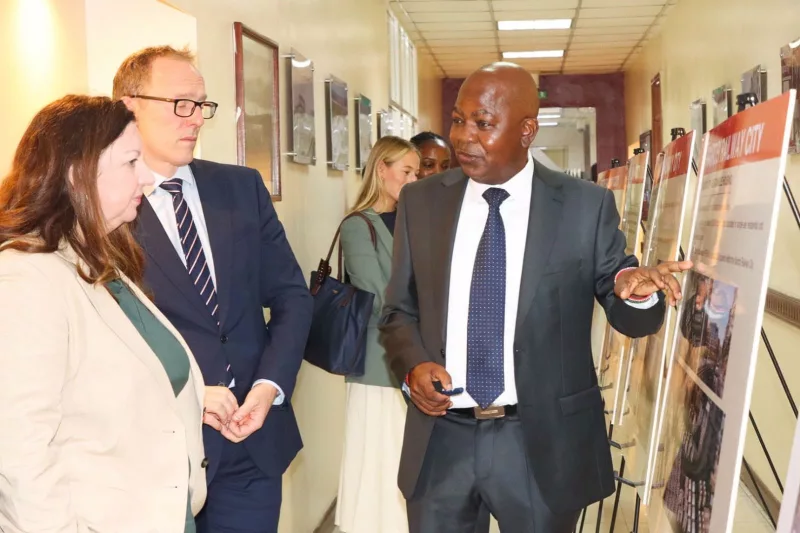
The financing discussions featured prominently during a meeting between Kenya Railways officials and Kirsty McNeill, the United Kingdom's Minister of State for International Development and Africa, who visited Nairobi on Thursday to assess progress in the partnership between the two governments.
Kenya Railways Managing Director Philip Mainga said the immediate priority was to conclude the outstanding funding arrangements and move into construction.
"Nairobi Railway City is a transformative programme for Kenya. Our immediate priority is to conclude the financing arrangements for Nairobi Central Station and move into construction," said Mainga.
He added that the corporation expected to commence the MICE Core development in the coming weeks, marking another step towards implementation of the wider programme.
The corporation had last month announced plans to reorganise matatu operations around Nairobi Central Railway Station to make way for the Project.
According to the UK minister, the involvement of UK Export Finance points to the role of international financing partnerships in supporting the delivery of the project, the proposed financing structure or the respective financial commitments of the Kenyan and British governments.
The UK has already provided technical assistance towards the planning and preparation of Nairobi Railway City, including support for commercial and financial structuring, programme delivery and investment mobilisation.
McNeill reaffirmed Britain's commitment to supporting the programme, citing its potential to attract investment, stimulate economic growth and improve urban mobility in Nairobi.
"The United Kingdom remains committed to working with Kenya to advance Nairobi Railway City. The programme presents significant opportunities to attract investment, stimulate economic growth and transform urban mobility in Nairobi," she said.
Kenya Railways Board chairman Abdi Bare Duale said the programme had reached a critical stage, with decisions expected over the coming months determining how quickly it moves from preparation to full implementation.
“The United Kingdom has been an important partner in the planning and preparation of the Nairobi Railway City programme. We have reached a point where decisions taken over the coming months will determine how quickly the programme moves from preparation into full implementation,” said Duale.
The corporation is also seeking to attract additional investment into the wider Railway City development, which is expected to combine transport infrastructure with commercial facilities and other urban amenities.
The planned MICE Core development will comprise a modern multipurpose arena and supporting commercial facilities targeting conferences, exhibitions, sports and entertainment.
Kenya Railways expects the development to create employment, support local enterprises and strengthen Nairobi's position as a regional destination for business events and entertainment.
The project also presents an opportunity for the corporation to unlock the commercial value of railway land, although details of the investment model, prospective private-sector partners and expected revenue streams have not been disclosed.
The wider Nairobi Railway City programme seeks to redevelop underutilised railway land in the capital into a modern district integrating passenger transport, commercial activities and public spaces.
Funding for the construction of the new Central Station and public realm development is provided by the government under a memorandum of understanding with UK Export Finance.
Supporting infrastructure, including wider rail and BRT lines, is financed through various development partners, including the World Bank Group, European Investment Bank, Agence Française de Développement, African Development Bank and the Japanese International Cooperation Agency.
The Kenyan government had allocated about Sh12.3 billion for preparatory works at the Central Station site and the construction of a new commuter rail line. Additional funding commitments include Sh91 billion for upgrading existing rail lines and Sh117 billion for the BRT network.
The development is expected to improve connectivity while creating new opportunities for businesses and investors in Nairobi's city centre.
Designed as a model for inner-city renewal, the project aims to enhance economic and social development while addressing congestion and housing shortages. It aligns with Kenya’s Vision 2030 and other national urban and transport master plans.
The Nairobi Railway City centres around the historic Nairobi Central Railway Station, a key node in the country’s rail network. The project includes modernising the station to accommodate an estimated 400,000 daily passengers by 2030, rising to 600,000 by 2045.
Designated as a Special Planning Area in February 2020 and gazetted as a Project of Strategic National Importance in May 2021, the master plan was approved in August 2023.