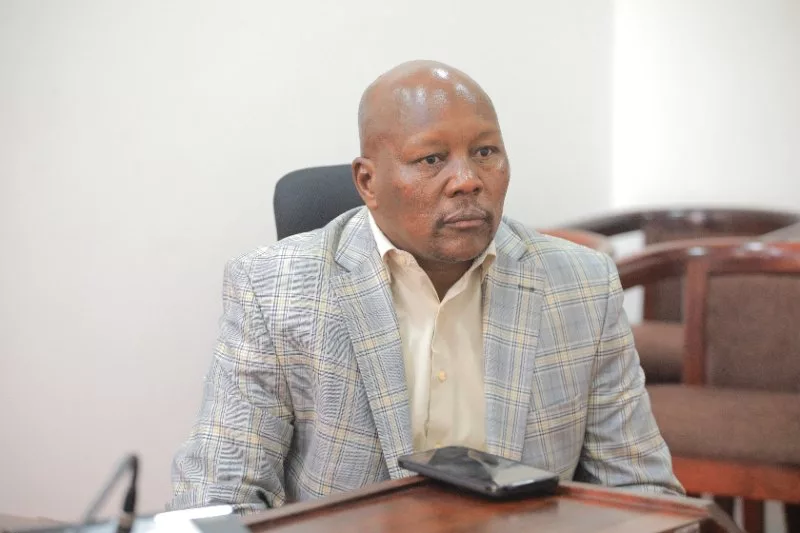
Kajiado Senator Seki Lenku Kanar speaks to The Star about the shifting political allegiances in the Maa community, President William Ruto's chances in the 2027 elections, land grievances, clan politics and his bid for the Kajiado governorship.
There appears to be a scramble by political leaders to secure the Maa Community's support. Which direction do you see the Maa community taking in the 2027 elections?
The Maa community is divided, depending on the counties. In Kajiado, where I come from, I believe a big percentage of the votes will go to the opposition, whoever the opposition eventually settles on as its presidential candidate.
Kajiado has never benefited from being in government. We have been promised many development projects, but none has materialised. That is why I believe the people are unlikely to support President William Ruto's administration in the next election.
I am also rallying behind the opposition, not for any other reason, but because the people of Kajiado are saying there has been no development in the county.
Take the Amboseli issue, which is close to the hearts of the people. The President came and handed over the relevant documents and assets relating to the management of Amboseli to the county government. He promised that by July 2026, the government would continue remitting money to the county. However, not even a single coin has been received.
There are many other promises involving roads, dams and other development projects that remain unfulfilled.
What about Narok, where President Ruto has made significant political inroads?
Narok is divided. I can see a lot of political competition, and the President himself is contributing to the confusion.
There is the Governor (Patrick) Ntutu side, which is perceived to be aligned with the President. However, there is another strong competitor, Narok West MP Gabriel Tongoyo, who is equally determined to contest for the governorship.
President Ruto will face a much bigger political contest in Maa land than he has experienced before. The competition will be serious, and some leaders may be surprised by the outcome.
President Ruto argues that he has included the Maa community in his administration by appointing people from the community to senior government positions. He has also maintained that the Amboseli transfer is part of his commitment to devolution, only delayed by a court order. Is that a fair assessment?
The Maa community has always had clan divisions. Unfortunately, the President does not seem to understand this.
The appointments made by his administration have largely benefited one clan. The other clan has received virtually nothing.
There are two major clans, the Black and the Red. The Red clan has benefited from this government, while the Black clan feels completely excluded. The Black clan is the larger of the two, and its members are deeply offended.
On Amboseli, the issue is not simply about a court order. The government made commitments to the people, but those commitments have not been honoured. The people want to see the benefits of devolution, not just hear promises.
Your governor recently unveiled a political party that he has presented as a vehicle for the Maa community. Would you consider joining it?
No. I will not join FEDA. That is his party, and he has his reasons for establishing it, but I do not consider it a Maa community party. It is a governor-linked political vehicle.
My position is that the Maa community should join national political parties so that it can participate meaningfully in national politics and benefit when a government is formed.
I am in DCP, and I want DCP to remain strong. We do not even know where some of these other political leaders stand. We do not know whether they are in government or opposition.
If the governor decides to join the opposition, we can sit down and discuss how he can work with us. We have no problem with that. But for now, I remain committed to DCP.
Land has historically been a major political and economic issue among the Maa community. Are you satisfied with the government's land reforms?
Land remains a very big issue in Maa land, and this government has not addressed it. Instead, we believe it is taking land away from the community.
Look at the Kibiko land, where about 2,700 acres were allegedly taken and subdivided forcefully. Powerful individuals in government are accused of acquiring large portions of that land.
Look at the situation in Narok, particularly the land associated with the Maasai Mara and the Kimana area. There are concerns about companies allegedly connected to powerful individuals taking over land on which the community depends for its daily livelihood.
On the Magadi issue, the President promised that about 240,000 acres would be allocated among different companies. But where was the consultation with the community? Who sat down with the people to establish what they wanted?
Land is bread. It is the livelihood of the Maa people. I can assure you that the land question will be a major issue in the 2027 elections.
Since the days of the late William ole Ntimama, the Maa community has struggled to produce a leader who can unite it across clan and county divisions.
We already have a kingpin and a spokesperson for the Maa community. That is Governor Joseph Ole Lenku.
The problem is that this government is trying to make him vulnerable and frustrate his leadership. He is constantly facing pressure, including corruption-related investigations and files being opened against him. Whether those cases have merit or not is for the relevant institutions to establish, but the effect is that he is constantly under pressure.
That makes it difficult for him to speak freely and bring the community together.
As far as I know, the Maa elders and the wider community recognise Joseph Ole Lenku as their kingpin. The church also recognises his leadership.
If Governor Lenku is the community's kingpin, why have leaders not rallied behind his political party to strengthen his voice?
The party came at a time when we had already made our political decisions. We had already decided which political direction to take, and you cannot expect people to abandon their decisions simply because another political vehicle has emerged.
It is only a matter of time. The party may become strong, but with elections approaching, we have already positioned ourselves politically.
That does not mean we do not respect him. He remains our community leader, and when he speaks on matters affecting the Maa people, we listen. But on national politics, we have our own positions.
You have declared interest in the Kajiado governorship. Why do you believe you are the right person to succeed Governor Joseph Ole Lenku?
I have a vision for Kajiado. My people have been telling me that I have served them well as senator and that they want me to take the next step.
They have seen my leadership and what I have delivered in the Senate. They believe I have the capacity to lead the county and implement a development agenda that addresses their needs.
But this is also something I had planned before. My vision for Kajiado has always been there. The time has now come for me to pursue it.
I want to provide visionary leadership and ensure that development projects are implemented rather than simply announced. The people need roads, water, better services and accountable leadership.
The race is expected to attract several heavyweight candidates, among them the State House Controller. How are you preparing to face them?
Everybody has their own plans, but mine are well organised. I am confident because I understand the political dynamics of Kajiado.
The State House Controller cannot easily win in Kajiado simply because he is associated with the government. UDA is almost a dead party in the county.
Kajiado has about 550,000 registered voters. Approximately 250,000 are Maa, while the remaining 300,000 come from other communities, including the Kamba, Kikuyu and Kisii.
These communities are also important in determining who becomes governor. I believe I have a strong relationship with them, and I expect to secure a substantial share of their votes.
You were among the senators who opposed the impeachment of former Deputy President Rigathi Gachagua. Was your decision based on political considerations or the belief that he was being unfairly targeted?
I stood with Gachagua because I believed he was being treated unfairly. At the time, we did not know that we would eventually become such a strong opposition force under DCP.
I did not stand with Gachagua because I expected political benefits or because of the communities living in Kajiado. I did not even know him personally before that impeachment process, apart from knowing him as the Deputy President.
I simply stood with what I believed was right. I stood with the truth, regardless of the consequences.
DCP leader Gachagua has largely concentrated his political mobilisation in the Mt Kenya and Maa regions.
Perhaps he strongly believes that Mt Kenya is his political home and that nobody wants to surrender their home ground to another person.
But he is also coming to support me because I stood with him when he was facing political difficulties. As a Maa leader in his party, I expect him to help me consolidate support in Kajiado.
If he does not support me, I will be in trouble politically. We need each other, and that is how political partnerships work.