Special edition: Portable charcoal-powered coffee roaster
A local innovator has developed a portable charcoal-powered coffee roaster designed to allow smallholder farmers and cooperatives to roast their own beans.
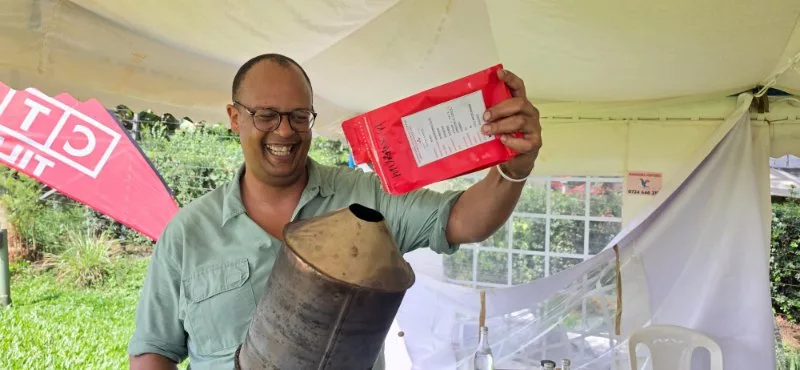
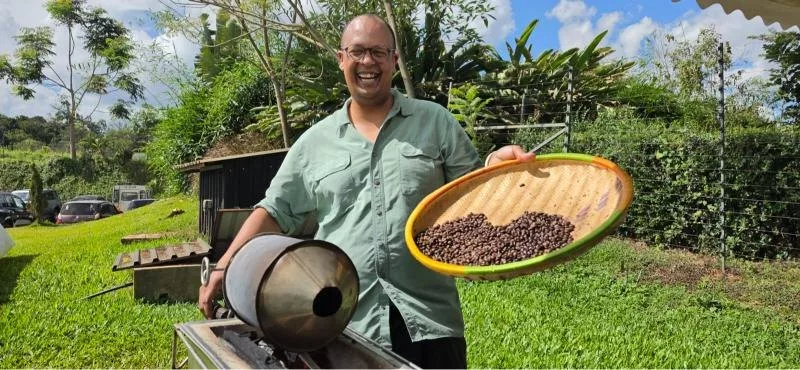
Teddy Kinyanjui, Sustainability Director at Cookswell Jiko said he is seeking to change how Kenyans interact with coffee through a portable charcoal-powered coffee roaster designed to allow smallholder farmers and cooperatives to roast their own beans.
The innovation, which costs Sh25,000 for the complete stainless-steel kit, is intended to make small-batch roasting accessible to farmers who would otherwise sell their coffee as raw beans without experiencing the final product.
Kinyanjui said the idea was partly inspired by his family's history in coffee farming. His grandfather was among the first Kenyans allowed to grow coffee in Githunguri, Kiambu County, but never drank the coffee he produced.
"That is why we decided to make this coffee roaster so that more smallholder farmers and cooperatives can do small-batch roasting, not only to taste their own coffee but also to think about other value-addition opportunities," he said.
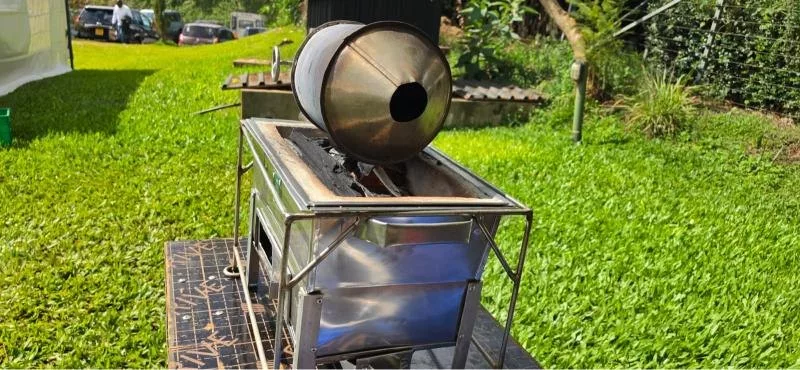
The roaster uses a stainless-steel drum fitted with small blades that keep the beans turning during the roasting process. It can roast about half a kilogramme of coffee in 10 to 12 minutes, depending on the desired roast.
It is multi-purpose design also allows users to roast meat, maize, peanuts and popcorn when they are not processing coffee.
Kinyanjui said the company was also demonstrating alternative uses of coffee, including coffee-flavoured cookies and a coffee-based dry rub for pork ribs, to encourage entrepreneurs to explore products beyond the traditional cup.
"You can now start drinking your own coffee wherever you are in Kenya and selling to your neighbours," he said.
He believes the technology could help stimulate local consumption while creating small businesses around coffee roasting and retailing.
At recently held Kenya Coffee Flavour and Origin Expo in Nairobi, industry players came together to showcase innovations aimed at encouraging Kenyans to consume their own coffee while connecting farmers and cooperatives with international buyers.
They noted that despite producing some of the world's most sought-after coffee, Kenyans consume less than five per cent of coffee annually. Most of the coffee beans are exported in their raw form before roasting, branding and packaging are done in foreign markets.
Beyond local processing, the industry is also seeking to strengthen the identity and market value of Kenyan coffee through a national coffee flavour map expected to be published in 2027.
Hez Gikanga, an adviser to the Agriculture Cabinet Secretary, said the initiative sought to document the distinct flavour profiles of coffee-growing regions and provide farmers, cooperatives and international buyers with credible information about the quality and geographical origins of Kenyan coffee.
He noted that Kenya's coffee reputation was built on decades of research, citing the development of the SL-34 variety by scientists at the former Scott Agricultural Laboratories in Loresho in the 1930s.
The initiative saw more than 630 coffee samples collected from different producing regions, including Nyeri, Kirinyaga, Kiambu, Murang'a, Embu, Machakos, Kericho, Nandi, Western and Nyanza.
The samples were tasted by professional cuppers, meaning they are assessed without revealing the identity of the cooperative, factory or county that produced them.
Gikanga said this approach will ensure that coffee quality, rather than the reputation of a particular cooperative or growing region, determines the assessment.
The sensory results will be combined with soil and climate suitability information to help explain why different regions produce distinct coffee characteristics.
The Kenya National Coffee Flavour Atlas will then be made freely available to farmers, cooperatives, roasters and international buyers.
Gikanga said the initiative was part of wider government reforms aimed at strengthening the coffee sector, including the re-establishment of the Coffee Board of Kenya and the Coffee Research and Training Institute under the Coffee Act 2026.
The government is also working with the United Nations Industrial Development Organisation (UNIDO) to establish a coffee training centre in Ruiru to develop skills in roasting, cupping, quality control and agronomy.
Lynette Luvai, UNIDO Kenya Deputy Country Representative, said the expo was designed to connect producers with buyers while promoting value addition, domestic consumption and greater international visibility for Kenyan coffee.
She said the flavour atlas would help address an information gap that has often prevented farmers from benefiting fully from the quality of their coffee.
"Turning quality into visible, credible knowledge that farmers, cooperatives and buyers can use to access markets and unlock greater value is an important step in moving up the value chain," she said.
Luvai said expanding local processing would create employment opportunities in roasting, grading, packaging, equipment manufacturing, barista services and café management.
She called for women and young people to be given a bigger role in the industry, noting that women undertake substantial work in coffee production, particularly picking, sorting and drying, but remain underrepresented in ownership, cooperative leadership and market decision-making.
She also urged financial institutions to develop accessible financing for smallholder farmers and emerging coffee enterprises to enable them to invest in value addition.
Fayari Zimudzi, Food and Agriculture Organisation (FAO) Representative in Kenya, said the country had recorded progress in coffee production and earnings, but significant productivity and domestic consumption gaps remained.
According to the Coffee Board of Kenya's 2024/25 yearbook, Kenya produced 50,598 tonnes of clean coffee, a 2.2 per cent increase, from 117,164 hectares in 33 counties.
Export earnings increased by 17.5 per cent to $344 million (about Sh43.9 billion), while the average auction price rose by nearly 50 per cent to $340 per bag.
The national average cherry payout to farmers also increased from Sh81 to Sh114 per kilogramme.
Zimudzi however noted that more than 800,000 smallholder farmers organised in 682 cooperatives produce 71 per cent of Kenya's coffee, yet average smallholder yields remain below those of estates. Smallholders produce an average of 439 kilogrammes of clean coffee per hectare compared with 520 kilogrammes for estates.
She said the government had set an ambitious target of increasing annual coffee production from about 50,000 tonnes to 150,000 tonnes by 2030, with improved productivity among smallholders being central to achieving the goal.
FAO estimates that improving yields from existing coffee bushes could significantly raise farmers' incomes without necessarily expanding the land under production.
For instance, increasing cherry production from two kilogrammes to five kilogrammes per bush could raise the gross margin from about Sh50,000 to Sh143,000 per acre annually for traditional varieties.
Zimudzi said the country needed to invest in disease-resistant varieties, healthy soils, affordable inputs, extension services, stronger cooperatives and accessible financing.
She added that Kenya's domestic coffee consumption grew by 12 per cent in the last coffee year, presenting an opportunity for local roasters, café owners and other entrepreneurs.
The flavour atlas is expected to provide a clearer identity for coffee from different regions, industry players believe farmers could have a stronger bargaining position while local businesses tap into a growing market.