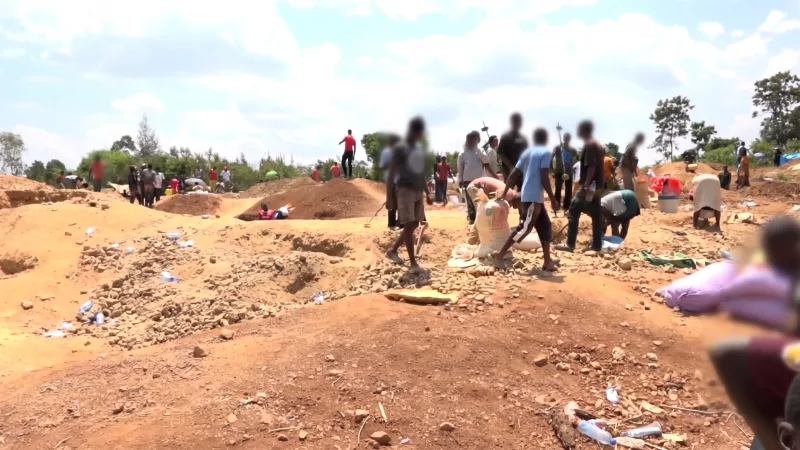
The hammer rises and falls rapidly, hitting the stone held between his feet. Dust particles swirl above his head as he pauses to wipe his sweaty brow, leaving a muddy mess on his forehead.
Brian* (not his real name) is only 15, but his small fingers hold the metallic hammer with the grip of an expert, one who has done this job for ages. Every rise, every fall, every hit is meticulous. He could easily do the job with his eyes closed. But it’s not what he wants. He dreams of becoming a pilot.
“Things are tough,” he says wistfully. “I have to work to help my mother with school fees and the family budget. I must balance school with this work. My family needs money and at times, school has to wait.”
Instead of spending the day in class, the Grade 9 pupil heads to a gold mine, where he breaks stones, helps with drilling and cleans sand for a wage. On a good day, he earns Sh1,000, money he uses to help meet school and family expenses.
He started mining in 2024 after his mother told him there was work available. Since then, the mine has become a source of income, even as his education competes with the demands of earning money.
“I can miss school for a week, but here, I come, crush stones and get money,” he says.
But every day away from class risks making the future he desires harder to reach.
Brian and hundreds of children in Luo Nyanza robbed of the right to education by poverty, which drives them to the gold mining areas of Siaya and Migori counties, where they are exposed to dangerous working conditions.
Brian knows of a Grade 9 boy who fell into a mine but survived. Shaft collapses remain a concern, while access to protective equipment is not always assured.
He is also aware of the academic risks: falling behind classmates and performing below their potential.
“If you don’t go to school, you forget about school issues,” he says.
DIFFICULT CHOICE
Jay*, 17, is in Form 4 and preparing for his final secondary school examinations. He has spent two years working at a gold mine.
As the firstborn in a family of four children, he feels the pressure to help his household. One parent farms while the other mines. His mother disapproves of his mining work, but the family’s financial circumstances remain a challenge.
“I really missed school this term. I can’t count the days,” he says.
With his final examinations approaching, Jay borrows notes from classmates to cover lessons he has missed. He is trying to catch up while preparing for a critical stage in his education.
On a good day, he says, he can earn up to Sh10,000, although the amount is not guaranteed. The money helps pay school fees and support his mother and siblings.
The earnings can be difficult for a struggling household to ignore. But they come at a cost that is harder to calculate: missed lessons, gaps in learning, health hazards and the risk of sitting examinations without having covered the syllabus.
Jay sometimes works underground and on other days does surface work. He understands the danger of a collapsing shaft, but protective equipment is not always available to him.
Sly*, another secondary school pupil, knows how absence can affect academic performance.
She missed examinations while in Form 2 after being sent home over school-related problems. She believes she could have scored a B+ instead of the C+ she received.
Her parents struggle to provide for her and her four siblings. Sly sends the money she earns from mining to her mother to help buy food for the household.
She wants to become a teacher, but she has to hustle to survive.
A parent whose child works at a mine says the decision is driven by financial hardship rather than a desire to keep the child out of school.
“If we had a reliable source of income, I would not bring my child to the mine. If I could earn enough to feed my family, pay school fees and buy books, I would let my child concentrate on education. I want my child to go to school and have a better future than mine,” the parent says in one of the mines in Siaya.
“But when there is no money and the children are hungry, you sometimes have to make difficult choices. I know the mine is dangerous, and every day I worry about my child's safety. All I want is help to provide for my family so that my child can leave the mines, return to school and have a chance at a better life.”
CLASSROOMS EMPTIED
At a school in Awendo, Migori county, attendance is irregular. The principal, who requested anonymity, describes pupils who attend on Monday, miss Tuesday, return on Wednesday and then disappear again.
The interruptions make it difficult for teachers to maintain continuity and for learners to keep up with their work.
“Some parents leave early for mining, and children divert to mining sites instead of going to school. In some cases, parents and children work at separate sites.”
The school enrolled 46 pupils in the National Education Management Information System in 2023 after numbers had fallen in preceding years. It currently has about 108, the principal said, without accounting for how many pupils work in mines.
The school has tried to encourage attendance through support. The principal recalls a miner offering Sh2,000 per term towards one pupil’s lunch on condition that the child attended consistently. The arrangement, however, did not resolve the attendance problem.
Chris Agunga, an International Labour Organisation officer working on child protection and child labour, says poverty and lack of decent work for adults push children into labour. Some families turn to children’s earnings because they cannot meet household needs, he says.
Chris Owala of the Community Initiative Action Group Kenya says, “Poverty and the high cost of education are pushing some children into gold mining in Siaya.”
He says some children came from child-headed households following the death of their parents, forcing them to fend for themselves and their siblings. Others are pushed out of school by additional levies and other financial barriers. Without adequate family support and alternative learning arrangements that allow vulnerable children to combine education with work, he warns, mining could trap them in a cycle of poverty.
Beyond the loss of education, he says children working in gold-mining areas face risks to their health, safety and dignity. Owala says the organisation has identified concerns about children's exposure to harsh mining conditions, including handling minerals with bare hands and inhaling dust.
A survey by his organisation of health facilities around mining areas found a high proportion of reported upper respiratory illnesses among people seeking treatment.
He also raises concerns about sexual abuse and the denial of children's right to play, privacy and protection.
Owala says enforcement of child-protection laws must go beyond occasional crackdowns.
“Government agencies, local administrators, schools, parents and mining businesses all have a role to play in keeping children out of hazardous work,” he says.
He calls for stronger action against employers who engage underage workers, alongside measures to address the financial pressures that drive families to rely on children's earnings.
Without sustained inspections, accountability for those exploiting child labour and support to help vulnerable children remain in school, he warns, efforts to remove children from the mines risk producing only temporary results.
Siaya county commissioner Norbert Komora says the employment of children in mining is against the law. Those found employing or using underage children risk prosecution.
Komora says he has visited several mining sites, including areas around the county border, and found children engaged in mining activities. He says some operators appear to know when inspections are coming, complicating efforts to identify violations during random visits.
“Children have rights that must be protected. They should be in school and enjoying their childhood rather than working in dangerous environments,” he says.
He says he has instructed deputy county commissioners and other officers to ensure children are not allowed to work at mining sites, warning that officers who fail to enforce the measures will be held accountable.
Komora calls on the Siaya county labour director to conduct inspections at mining sites. He also urges stakeholders in the mining and boda boda sectors to prevent underage children from working, noting that some pupils leave school after Class 8 to become motorcycle operators.
Komora says authorities are encouraging miners to organise into recognised associations so their activities can be monitored and officials held accountable for misconduct in their groups.
He says the State Department for Mining is pursuing more organised structures for operators, while a mining police unit is expected to improve oversight.
“The national and county governments must work together to restore order in the sector,” he says.
HAZARDOUS TRADE
Kephas Ojuka, chairman of the Migori County Mining Association, says some operators prevent minors from entering shafts and may restrict them to surface processing. But surface work is not necessarily safe, and the use of protective equipment is inconsistent across the sector.
Peter Onyango, a miner in Osiri village who has worked in the industry for about a decade, says surface processing, known as ‘parata’, is done by women and young people, including minors.
Workers are paid according to the sacks of ore they process. Onyango puts the payment at about Sh50 to Sh300 per day, depending on the quantity and hardness of the material. He says workers may be underpaid when clients fail to honour agreed payments.
A member in one of the mining committees in Siaya says minors have been reported at mining sites, although reliable figures on their numbers are unavailable. Their presence rises during school holidays, but some are also seen at sites on school days and weekends. He says crackdowns need to be more frequent.
Kenya’s Constitution protects children from hazardous or exploitative labour. The Children’s Act, 2022, and the Employment Act, 2007, also contain protections relating to children and work, while the Basic Education Act provides for compulsory basic education.
The ILO and Unicef estimate that about 135 million children worldwide were in child labour in 2024, including 54 million in hazardous work.
In Kenya, estimates cited by the Kenya National Bureau of Statistics put the number of children aged five to 17 engaged in child labour at about 1.3 million.
For Brian, the dream of becoming a pilot remains. Jay is still working towards his final examinations, while Sly hopes to become a teacher.
Their future is not yet decided. But the longer they must balance school against the need to earn, the harder it becomes to pursue those ambitions.
As I walk away from Brian, his tiny hands continue hitting at the stones piled up next to him. He hopes that by the time his job is done, he will have some energy left to read his books and keep his dream alive.
This Star investigative story was produced with support from the Mbegu Fund and the European Union