
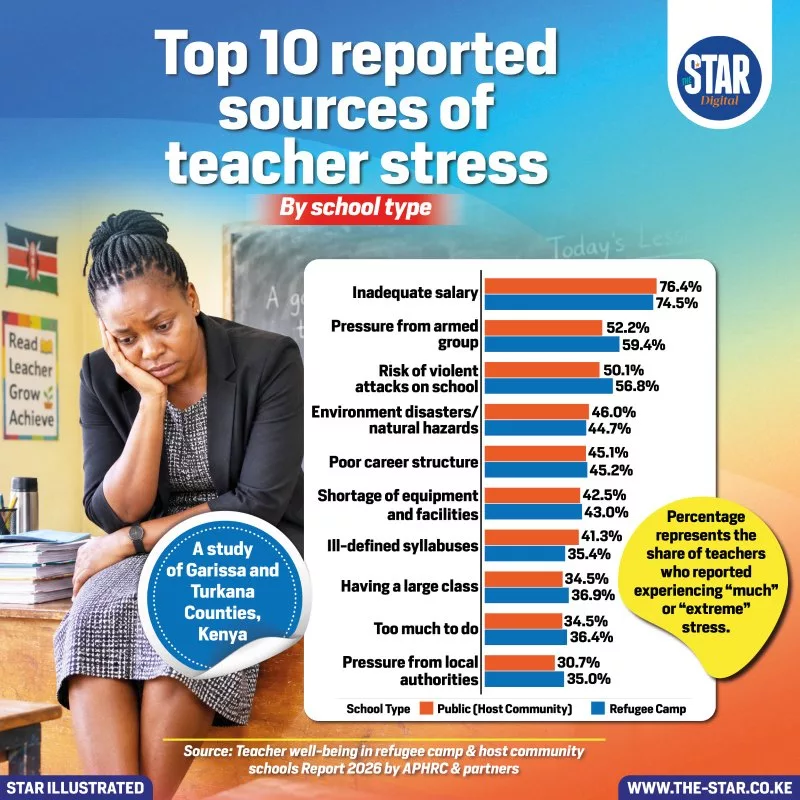
A recent study conducted in Garissa and Turkana counties highlights the primary drivers of stress among educators in public host community schools and refugee camps.
Financial strain emerges as the most dominant concern, with 76.4 per cent of teachers in public host communities and 74.5 per cent in refugee camps reporting much or extreme stress due to inadequate salaries.
Security and safety threats also weigh heavily on educators. Pressure from armed groups accounts for 52.2 per cent of reported stress in public host community schools and 59.4 per cent in refugee camps.
Similarly, the risk of violent attacks on schools affects 50.1 per cent of public host community teachers and 56.8 per cent of those in refugee camps.
Environmental disasters and natural hazards impact nearly half of the teaching workforce, registering at 46.0 per cent for public host communities and 44.7 per cent for refugee camps.
Meanwhile, career progression and institutional resources present ongoing challenges. Poor career structure is cited by 45.1 per cent of public host community teachers and 45.2 per cent of refugee camp educators.
Shortages of equipment and facilities affect 42.5 per cent and 43.0 per cent, respectively. Ill-defined syllabuses cause stress for 41.3 per cent in public host communities and 35.4 per cent in refugee camps.
Classroom management and workload pressures further compound the strain, with large classes affecting 34.5 per cent of public host community teachers and 36.9 per cent of refugee camp teachers, while excessive workloads impact 34.5 per cent and 36.4 per cent, respectively.
Finally, pressure from local authorities contributes to stress for 30.7 per cent of public host community educators and 35.0 per cent of those in refugee camps.