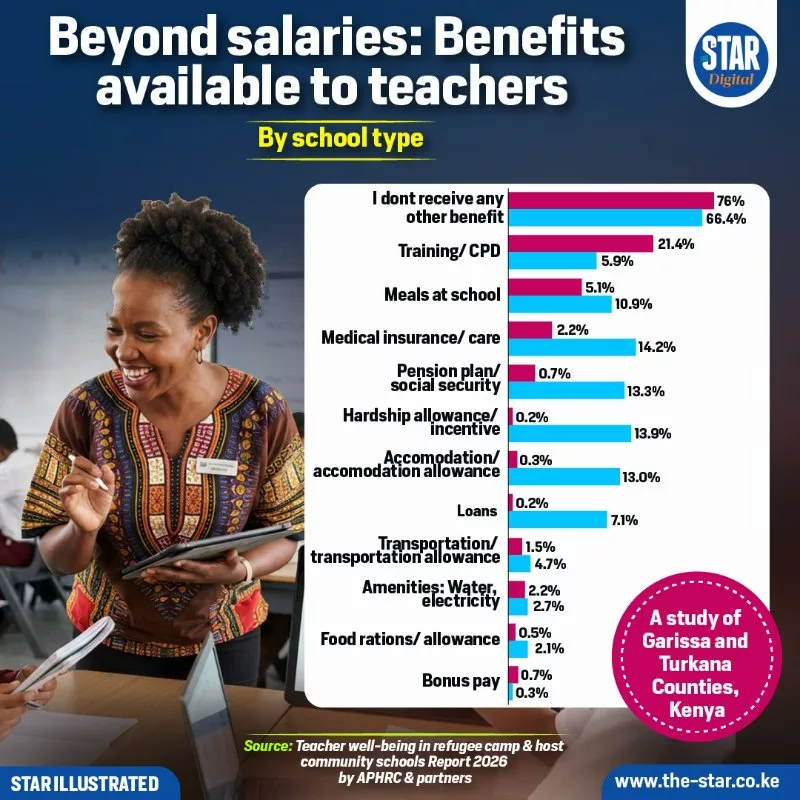
Teachers in refugee camp and host community schools in Garissa and Turkana counties receive varying benefits beyond their salaries, with a significant proportion reporting that they do not receive additional benefits, according to a 2026 study.
The report, Teacher well-being in refugee camp and host community schools, by APHRC and partners, shows that 76 per cent of teachers in one school category and 66.4 per cent in the other reported receiving no additional benefits.
Training and continuous professional development (CPD) were reported by 21.4 per cent of teachers in one category, compared with 5.9 per cent in the other.
The findings also reveal differences in access to medical insurance, pension plans, hardship allowances and accommodation support, depending on the school category.
Medical insurance or care was reported by 14.2 per cent of teachers in one category, compared with 2.2 per cent in the other. Similarly, 13.3 per cent reported access to pension plans or social security, compared with 0.7 per cent in the other category.
Hardship allowances or incentives were available to 13.9 per cent of teachers in one category, compared with 0.2 per cent in the other, while accommodation or accommodation allowances were reported by 13 per cent and 0.3 per cent, respectively.
The study further found that 10.9 per cent of teachers in one category received meals at school, compared with 5.1 per cent in the other. Access to loans stood at 7.1 per cent and 0.2 per cent, while transport allowances were reported by 4.7 per cent and 1.5 per cent, respectively.
Other reported benefits included water and electricity, food rations or allowances, and bonus pay, although the proportions receiving these were relatively low.
The findings highlight disparities in the additional support available to teachers working in refugee camp and host community schools, beyond their regular salaries.