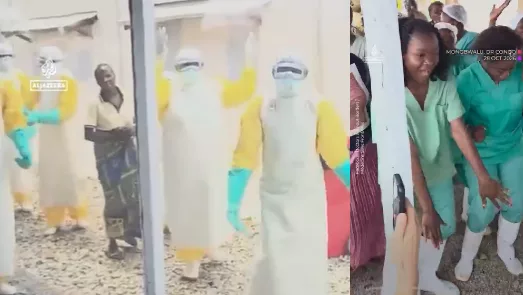
Healthcare workers at a Doctors Without Borders-run centre in Mongbwalu celebrated as the final patient recovered and left, marking a milestone in the response to the outbreak.
Healthcare workers in the Democratic Republic of the Congo broke into songs and dance as the last Ebola patient at a treatment centre in Mongbwalu recovered and left the facility.
Footage from the centre shows the patient, a woman dressed in civilian clothing, dancing as she walks out, surrounded by healthcare workers celebrating her recovery.
Some workers dance on the same side as the patient, while others join from the opposite side of a partition separating the two groups.
Those inside the treatment area wear full protective equipment, including yellow suits, white protective coverings, face shields or goggles, masks, gloves and boots.
On the other side, healthcare workers in green medical uniforms and boots join the celebration, with some wearing protective head coverings.
The footage shows workers waving their hands and dancing to music, accompanied by percussion instruments, including drums.
A person is also seen recording the moment on a mobile phone as the celebrations unfold across the partition.
The celebration took place at a Doctors Without Borders (MSF) Ebola treatment centre in Mongbwalu, Ituri Province, where the latest outbreak was first identified.
The departure of the final patient from the facility marks a significant milestone for the healthcare teams who have been treating patients and working to contain the outbreak.
However, the discharge of the last patient from one treatment centre does not by itself mean the wider outbreak has ended. Health authorities must continue surveillance and other response measures to detect any further cases.
This follows the outbreak of Ebola in the Democratic Republic of the Congo, confirmed in May 2026, after health authorities investigated clusters of severe illness and deaths in Mongbwalu and Rwampara health zones in Ituri Province.
The World Health Organisation confirmed that the outbreak was caused by the Bundibugyo virus, a species of Ebola. The Congolese Ministry of Public Health declared the outbreak on May 15, 2026, making it the country's 17th Ebola outbreak.
The outbreak initially affected Mongbwalu, Rwampara and Bunia health zones before spreading to other parts of the country.
By August, the WHO reported that transmission had expanded to 54 health zones across six provinces, making it the largest Ebola outbreak reported in the country at that time.
The outbreak posed significant challenges for health authorities because of population movement, insecurity and difficulties reaching some affected communities.
The Bundibugyo virus is particularly challenging because there is no licensed vaccine or specific treatment for the strain, although early supportive care can improve a patient's chances of survival.