African journalist leaders have adopted a continental advocacy action plan to promote responsible artificial intelligence (AI), improve journalists’ working conditions and strengthen media freedom amid rapid changes in the news industry.
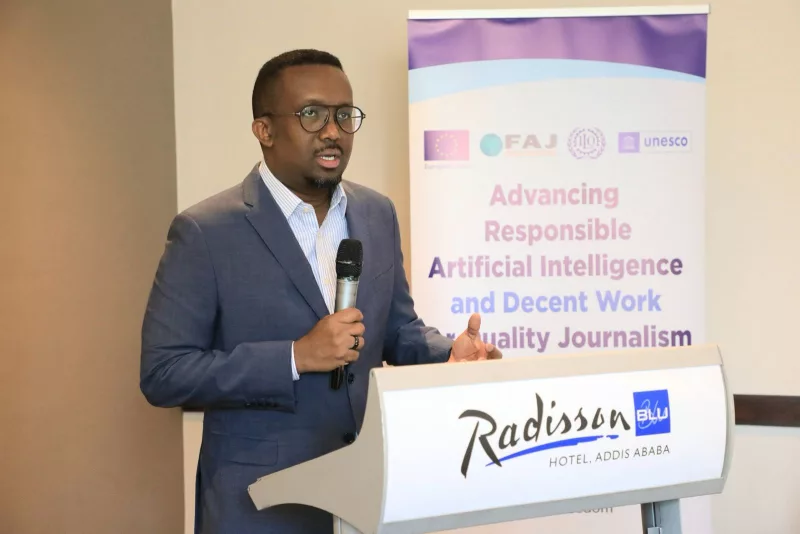
The plan was adopted at the end of a two-day dialogue and capacity-building programme convened by the Federation of African Journalists (FAJ) in Addis Ababa on October 24–25, 2026.
The meeting, held under the theme Advancing Responsible Artificial Intelligence and Decent Work for Quality Journalism in Africa, brought together journalist leaders and representatives of the African Union Commission, UNESCO, the International Labour Organization (ILO) and the European Union.
Participants examined how AI tools could support journalism through research, translation and information verification, while raising concerns about fabricated content, the impersonation of trusted sources and the rapid spread of misinformation and disinformation.
They also discussed the need for journalists and media organisations to adopt practices that protect information integrity, freedom of expression and editorial independence as AI becomes more widely used in news production.
FAJ President Omar Faruk Osman said the adoption of AI must not worsen the already difficult working conditions facing journalists across the continent.
“Artificial intelligence must not deepen the precarious conditions in which journalists across the continent continue to work,” Osman said, arguing that responsible technology use, decent work and media freedom were closely connected.
The dialogue also examined the potential effects of AI-driven automation and newsroom cost-cutting on employment, staffing levels and professional standards. Participants discussed labour rights, collective bargaining and digital organising as possible ways to strengthen workplace protections for journalists.
The discussions drew on a recent FAJ continental survey examining journalists’ working conditions, safety, labour rights and media freedom. According to the federation, the journalist-led survey collected responses from 1,586 journalists across 45 African countries.
The findings are expected to provide an evidence base for advocacy targeting media organisations, governments and other institutions on issues affecting the profession.
The programme was funded by the ILO, the European Union and UNESCO through its Multi-Donor Programme on Freedom of Expression and Safety of Journalists.
Under the adopted action plan, FAJ and its affiliates intend to pursue the identified priorities through engagement with the African Union, regional economic communities, United Nations agencies, labour organisations and human rights groups.
The initiative seeks to ensure that technological advances support rather than undermine professional journalism, while improving the conditions under which journalists gather, verify and report information.
The effectiveness of the plan will depend on how its priorities are translated into practical measures by journalist associations, media employers and relevant public institutions across the continent.