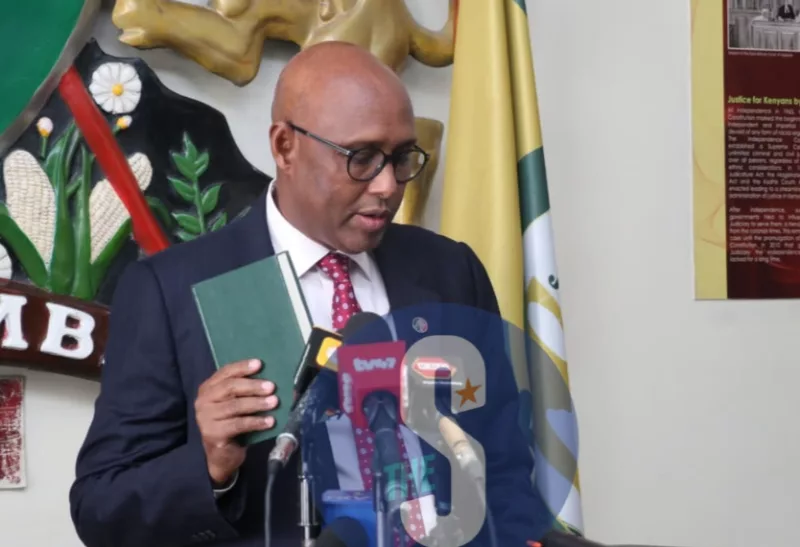
The Employment and Labour Relations Court has struck out a petition challenging the appointment of Kenya Revenue Authority (KRA) Commissioner General Adan Mohamed.
Justice Monica Mbarũ struck out the petition filed by Francis Awino after finding that it raised a public law dispute brought by a citizen who had no direct or indirect employment relationship with the respondents.
The judge relied on a Supreme Court decision in Moi Teaching and Referral Hospital & 3 others v Dr Magare Gikenyi & 74 others, which clarified the scope of the Employment and Labour Relations Court’s jurisdiction, including the limits of its authority to hear public interest constitutional challenges.
“The petitioner appreciates that he has no direct or indirect employment relationship with the respondents. His case is purely a public interest case,” the judge stated.
The court found that although the constitution allows citizens to institute proceedings to enforce constitutional rights and obligations, such a right does not automatically confer jurisdiction on a particular court.
Awino had argued that the petition concerned public employment, recruitment and eligibility for public office, matters he said fell within the specialised court’s mandate.
He challenged Mohamed’s appointment, alleging that it was made despite the latter having attained the mandatory retirement age, without disclosure of a lawful exemption and without a transparent, competitive and merit-based recruitment process.
The petitioner argued that the appointment raised constitutional questions concerning integrity, equality, administrative justice and the principles governing public service appointments.
He sought orders to quash the appointment, bar Mohamed from continuing to occupy the office and compel a fresh recruitment process that would be transparent, competitive and merit-based.
However, the respondents opposed the petition, arguing that it was a standalone public law challenge concerning the exercise of public power rather than an employment dispute.
KRA and its Board of Directors filed a preliminary objection arguing that Awino lacked the legal standing to institute the case and that the court had no jurisdiction to determine it.
The respondents maintained that the petition did not arise from an existing employment relationship or a recognised pre-employment dispute involving a person entitled to approach the specialised court under the applicable laws.
They argued that the dispute belonged before the High Court, which exercises general constitutional jurisdiction under Article 165 of the Constitution.
The petitioner, in his rejoinder, maintained that the Supreme Court decision did not mean every constitutional challenge involving recruitment or appointment to public office fell outside the labour court’s jurisdiction.
He argued that the court should consider the substance of the dispute and its connection to public employment rather than focus solely on his capacity as a public interest litigant.
But Justice Mbarũ said she was bound by the Supreme Court’s guidance, noting that she had previously presided over petitions seeking to enforce constitutional rights and freedoms under Articles 22 and 258.
The court consequently allowed the preliminary objection and struck out the petition, with no orders as to costs.