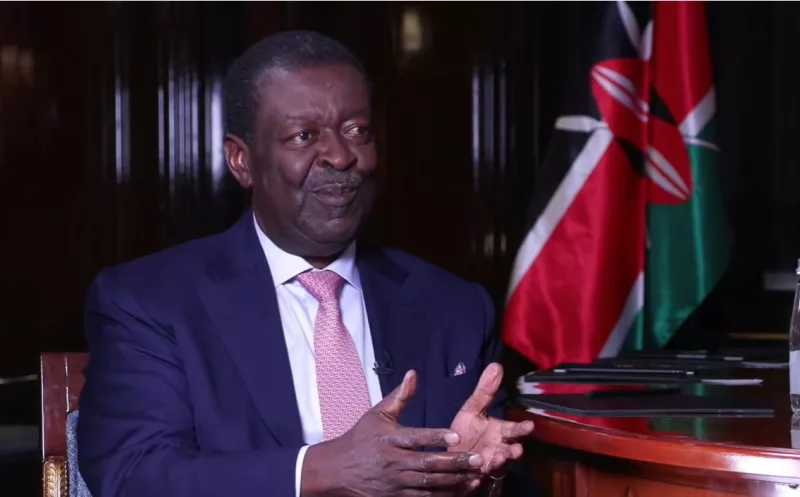
Prime Cabinet Secretary Musalia Mudavadi has warned that artificial intelligence could enable drones to fight each other without human control, calling for international regulation of military applications of the technology.
Mudavadi said the development of autonomous weapons raised concerns about the growing ability of machines to learn from one another and make decisions during combat.
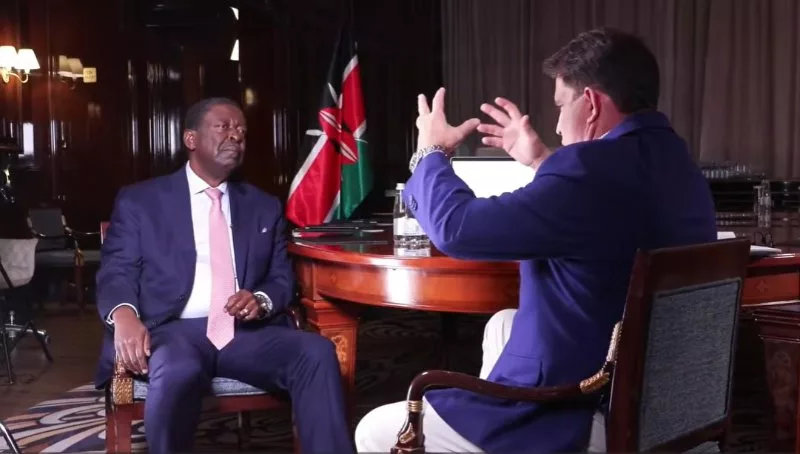
“That scares the hell out of me,” Mudavadi said during an interview with Russian broadcaster RT in Moscow on Tuesday.
He was responding to a discussion about the use of artificial intelligence in military operations, including the possibility of drones learning each other’s behaviour and engaging in combat without human operators directing their movements.
Mudavadi said the world needed to establish safeguards for the technology while protecting its potential to support scientific progress, economic development and wealth creation.
“I think we need to find a way of managing it, both for good use, for positive science, for wealth creation, for development of people,” he said.
The Prime Cabinet Secretary said artificial intelligence should not be viewed solely as a tool for destruction, noting that it was already being used in information gathering and other activities.
He called for regulation that would address the risks associated with the technology without undermining beneficial innovation.
Mudavadi said Russia had an important role to play in international discussions on managing emerging technologies because of its position as one of the five permanent members of the United Nations Security Council.
He said cooperation among countries would be necessary to establish an approach to the technology that balances security concerns with innovation.
“That is why a country like Russia, which is a member of the United Nations Security Council, a P5 member, becomes extremely important in helping the world and the international community to define the way forward,” he said.
The remarks come as governments worldwide grapple with the implications of artificial intelligence for national security, military operations and international stability.
The interview also covered Kenya’s technological development, economic relations with Russia and the changing global economic order.
Mudavadi defended Kenya’s reputation as the “Silicon Savannah”, pointing to the growth of mobile money and the digitisation of government services.
He said the government had digitised about 26,000 services, enabling citizens to access public services and carry out transactions through digital platforms.
He cited mobile money as an example of how technology had made financial transactions more accessible, including for people in rural areas.
However, he acknowledged that increased reliance on digital systems also brought risks, including fraud and cyber attacks, which required stronger security measures.
Mudavadi also discussed potential cooperation with Russia in the energy sector, including nuclear energy and petroleum gas.
The interview took place ahead of the third Russia-Africa Summit and the accompanying Russia-Africa Economic and Humanitarian Forum in Moscow, where Kenya is seeking trade, investment and technology partnerships.
Mudavadi said Kenya was pursuing opportunities to expand exports, attract investment and strengthen cooperation in areas including energy, science and technology.
The summit is scheduled for October 28 to 30, providing a platform for African and Russian leaders and officials to discuss economic development and diplomatic cooperation.