
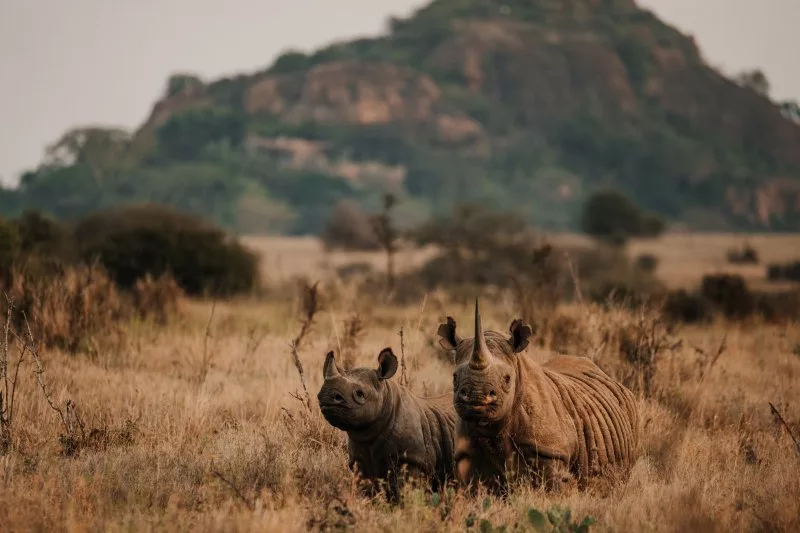
 Black rhinos /HANDOUT
As the populations of black rhinos increases in the country, wildlife experts are burning midnight oil seeking solution on how to curb deadly territorial fights.
The 2025 National Wildlife Census report by the Wildlife Research and Training Institute shows that the rhino population in the country is now 2,102; 1,059 black rhinos, 1,041 white rhinos, and two northern white rhinos.
This means there is an annual change of four per cent.
As their populations grow beyond ecological carrying capacity, fights are becoming more intense.
The Kenya Wildlife Service says there is an urgent need to expand black rhino habitat to avoid such clashes.
KWS Director General Erustus Kanga said even though the interventions that have been put in place has seen an increase in rhino populations particularly the black, rhino fights are now the new frontier that must be confronted.
“In 2023, we had over 280 rhino births in this country. In 2024, we recorded more than 260 rhino births,” Kanga said.
This means that the total rhinos calves born those two years were 540.
Kanga said he was shocked when he tasked his team to account for the over 500 rhino calves.
“Unfortunately, we could only account for 100.”
This means over 400 rhino calves could not be accounted.
The DG said he tasked his team to ensure that measures are in place to see each rhino calf grow to maturity.
Kanga attributed the deaths of rhino calves to territorial fights.
He said rhino males will often kill the calves that does not belong to them.
“And we are saying, no calf should die. Every rhino mother must see their rhino calf to maturity.”
Kanga said for generations, the country has put in place measures aimed at protecting the iconic species.
The DG said the eastern black rhino was part of Kenya’s wild landscapes.
“By 1970, Kenya held an estimated 20,000 black rhinos. Then came the devastating trophy hunting and poaching of the 1970s and 1980s, driven by the international horn trade.”
In the wild, black rhinos wants to establish their own territory at the age of between five and seven years.
Their instincts tell them to do so.
When this fails, a fierce clash to control their territories occurs, sometimes leading to injuries or even deaths.
Rhino sanctuaries must have intense security to curb the risk of poaching.
Such spaces should also allow rhinos to demonstrate their natural behaviours, including migration between territories and genetically diverse breeding.
To address the challenge of territorial clash, partners have unveiled a new initiative.
The Sh5.8 billion Kenya Rhino Range Expansion (KRRE) project seeks to secure the future of Kenya’s critically endangered Eastern black rhino by expanding and reconnecting landscapes where the species can thrive.
The initiative is a national initiative that seeks to promote nature-based economic opportunities, supports local livelihoods, and enhances long-term ecological resilience.
KRRE CEO Jamie Gaymer said the initiative is not just about rhinos and environmental conservation.
“It's about people. It’s about ensuring that we improve livelihoods for people surrounding the areas in which we hope to introduce rhinos. For the KRRE to be successful, we need to ensure that the people see the benefit of conservation. We need to drive a wildlife economy,” he said.
Gaymer said there is a need to create employment and tangible benefits for the people who coexist with the wildlife.
“Rhinos are a keystone species that can catalyse a sequence of changes required in order to preserve biodiversity and the health of our planet”.
Gaymer said the initiative continues to direct significant resources toward ensuring communities are part of this vision.
Working in partnership with KWS, conservation organisations, private landowners, and local communities, KRRE supports the creation of new, secure, and well-managed rhino habitats through ecological assessments, infrastructure planning, advanced monitoring systems, and coordinated implementation.
The new initiative is aligned with Kenya’s National Black Rhino Recovery Strategy.
Kenya aims to grow its rhino population to two thousand by 2037, a target that requires space, resources and unwavering commitment.
Driven by KWS, KRRE and a wider network of partners, private and public organisations are working together to bring that vision to life across Tsavo and Central Kenya.
Rather than each acting alone, these partners are connecting land, resources and expertise so that progress in any one landscape adds up to national gains for the species.
A central pillar of this work is the connection it is building between rhino conservation and local livelihoods.
Travel and tourism contributed 12.7 billion USD to Kenya's economy in 2025, equivalent to 9.3 percent of national GDP, and supported 1.8 million jobs, or roughly 8.3 percent of total employment, according to the World Travel and Tourism Council.
KRRE has set an ambitious goal of connecting rhino conservation to a further 45 million USD in economic activity in the coming years, anchored in the presence of the Big Five, which significantly strengthens tourism demand wherever it is found.
That growth is expected to translate into new rangers, lodges, drivers, builders, rhino monitors and researchers, along with a much larger number of indirect jobs tied to an industry that depends on thriving biodiversity.
The new Tsavo West Rhino Sanctuary, which has expanded the roaming range for the area's approximately 150 black rhinos from 92 to 3,200 square kilometers, more than 30 times the previous space has catalysed the deployment of over 100 rangers, along with new ranger accommodation, water points and fencing.
In the last few weeks, KWS in partnership with the KRRE completed a second ear notching and transmitter placement exercise that allows for 75 per cent of Tsavo West’s existing rhino population to be identifiable and monitored successfully across what is now the largest rhino sanctuary of its kind in Africa.
The initiative is working with several community conservancies, including Naibunga, where a prickly pear removal project will open habitat to rhino while restoring rangelands for community livestock that have suffered under the spread of this invasive plant.
The team is exploring the opportunity to expand their support further afield into other community conservancies across Kenya, including the continued support for Sera Community Conservancy and its ongoing rhino conservation initiative.
A report by Wildlife Research and Training Institute (WRTI) for the period ending December 31, 2022, showed that Tsavo West National Park (Ngulia Rhino Sanctuary) had 134 black rhinos, while the maximum productivity carrying capacity is 45, leaving a surplus of 89.
The sanctuary has since been expanded.
Now covering 3,200 square kilometres, it is the largest sanctuary for rhinos in the world and a major step forward for wildlife conservation, climate resilience, and nature-based economic growth.
The WRTI report showed that Ol Pejeta Conservancy had 166 black rhinos, while the maximum productivity capacity is 90, leaving a surplus of 76.
Nairobi National Park had 98 black rhinos against a maximum productivity capacity of 44, leaving a surplus of 54.
Lake Nakuru National Park had a population of 89 black rhinos against a maximum capacity of 50.
Lewa (Borana Landscape) had a black rhino population of 133 against a maximum capacity of 92.
Meru National Park had a black rhino population of 36 against a maximum capacity of 32.
Ruma National Park, however, had a population of 22 black rhinos against a maximum capacity of 62.
Sera Community Conservancy had a population of 21 against a maximum capacity of 40.
Authorities have however been translocating some of the rhinos to new habitats.







