
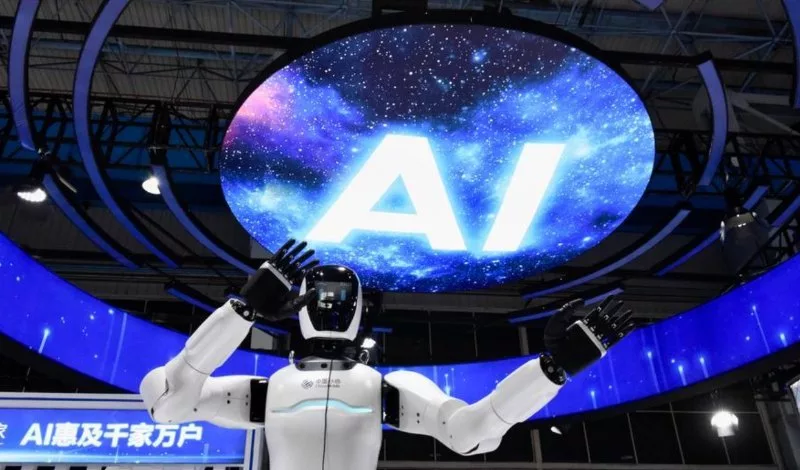
 A humanoid robot of China Mobile is pictured at the exhibition area of the 2025 Global Industrial Internet Conference in Shenyang, northeast China's Liaoning Province on September 7
Before I went to China, my understanding of artificial intelligence was, admittedly, fairly limited. It was mostly about typing a clever prompt into ChatGPT, asking DeepSeek to make sense of something, or getting an AI tool to rewrite a paragraph, generate an idea or explain something I could not quite understand.
At vending points. In restaurants. In taxis. At delivery points. Even when I needed to rent a power bank.
Suddenly, artificial intelligence was no longer something I opened on my laptop when I needed help. It was becoming part of how I moved through the city.
One of the experiences that particularly caught my attention was the driverless taxi.
The first time I got into one, I remember thinking about how strange the experience was. It turned out to be one of the best experiences.
There was no driver turning around to ask where I was going, of course over a translation app.
No familiar conversation about traffic or the weather. The car simply moved.
For someone coming from Nairobi, where negotiating traffic can sometimes feel like an extreme competitive sport, the experience was almost surreal.
Then there were the smaller encounters. I was particularly fascinated by the idea of rented power banks and robots serving in hotels.
Then, in some hotels, especially in Beijing, Shenzhen and Shanghai where I spent most of the time, there were automated systems designed to make collection or drop off process almost effortless.
Even vending machines felt different. Whether you were buying a soft drink or paying for goods at the supermarket, you simply needed to do quick product scans virtually and they would pop up at the counter. That was mind-blowing.
However, what struck me was not necessarily that each individual technology was revolutionary.
It was how seamlessly these technologies had been inserted into ordinary life. That was the part I had not anticipated at all.
In Kenya, when we talk about AI, the conversation often quickly turns to ChatGPT, image generation, automation and the possible threat to jobs. Those conversations are important. But China gave me another perspective.
It can help move a person, deliver food, organise a transaction, locate an item or make a service available without another human being standing on the other side.
And the more I encountered it, the more I began to appreciate the difference between using AI and living in an AI-enabled environment.
Before China, I thought I was using artificial intelligence. In China, I realised I had barely scratched the surface.
What fascinated me most was how ordinary it could feel. There was no grand announcement every time AI was involved.
You simply used the service and moved on. Perhaps that is where the real transformation is happening.
And especially when it becomes part of everyday life.
What happens to privacy when so much of daily life becomes digital? How much convenience are people willing to exchange for data?
And, perhaps most importantly, are countries like Kenya prepared for a future where AI is not an application we occasionally open, but an invisible layer running underneath everyday life?
I returned from China with a different understanding of artificial intelligence. I still use ChatGPTs of this world.
I still experiment with DeepSeeks of this universe. I still marvel at what a good prompt can produce.
But now, whenever someone talks about the future of AI, I think about that driverless taxi ride, the power-bank stations, the delivery systems and the countless little technologies I encountered in Beijing.
Because the future of AI, I learnt, may not be sitting inside your phone waiting for you to ask it a question. It may already be moving around you.







