
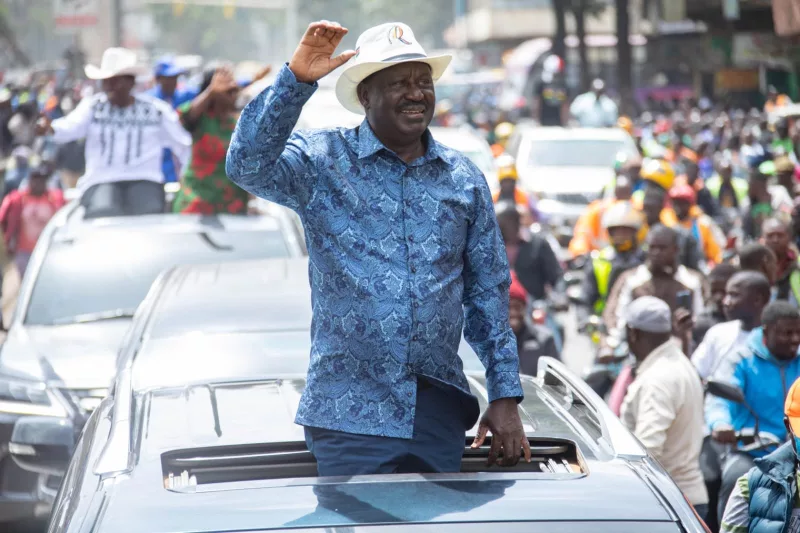
 The late Raila Odinga at a past political rally. Photo/Handout
One year after his death on October 15, 2025, Raila Odinga remains a defining figure in Kenya’s political discourse, with his legacy continuing to shape alliances, succession battles and the future of the Orange Democratic Movement (ODM).
Although no longer on the political stage, Raila’s influence remains evident in President William Ruto’s 2027 re-election calculations, the contest for leadership in Luo-Nyanza and divisions within the party he led for two decades.
When Ruto incorporated Raila into his broad-based government following their political pact on March 7, 2025, the President was banking on the veteran opposition leader’s influence to ease political tensions and strengthen his administration following his fallout with former Deputy President Rigathi Gachagua.
Before the pact, Ruto had appointed several Raila allies to his Cabinet following the June 2024 Gen Z-led protests against the Finance Bill 2024.
They included Ali Hassan Joho, who was appointed Mining Cabinet Secretary; Wycliffe Oparanya (Co-operatives); Opiyo Wandayi (Energy) and John Mbadi (Finance).
Ruto subsequently appointed another Raila ally, Betty Askul, to the Cabinet portfolio of East African Community Affairs.
He also nominated Agnes Oduor as Kenya’s first woman Attorney-General, an appointment linked by political observers to the broader political realignment.
Political analyst Martin Andati says the appointments helped Ruto navigate the political turbulence that followed the protests, during which over 60 people were killed.
“Tensions between Gachagua and Ruto had already started to manifest, and Ruto had no choice but to reach out to Raila to help him navigate that delicate political season,” says Andati.
He argues that Raila’s entry into the broad-based arrangement boosted Ruto’s political confidence after Gachagua’s impeachment in October 2024.
“For 2027, Ruto really banked on Raila’s support. His death greatly complicated his political mathematics. Therefore, with his absence, Ruto has been forced to recalibrate his 2027 journey,” says Andati.
Ruto has since continued invoking Raila’s name during political and development tours in Nyanza as he seeks support in the region.
During a tour of Kisumu County on September 13, the President linked his administration’s development agenda to priorities championed by the late leader.
“I understand why it has been so easy for us to agree on moving our nation forward together. I am confident and sure that our brother Raila Odinga is proud of what we are doing because we are implementing the very projects that were at the heart of his plan,” Ruto said.
Raila’s legacy has also become a point of contention among his former allies, who have taken different positions on whether ODM should remain in Ruto’s broad-based government.
National Assembly Minority Leader Junet Mohamed, a vocal defender of the arrangement, maintains that Raila wanted his allies to remain in government.
“Another thing Raila told us: we must stay in the broad-based government. Wale wakuskia waskie!” Junet said last Saturday.
However, Nairobi Senator Edwin Sifuna has disputed claims that Raila directed ODM to support Ruto’s re-election, arguing that the party has not made such a decision.
“Every time we sit in these meetings, do we agree on certain things? Very basic things. We agree that the party has not made a decision to support William Ruto. These people agree that Raila never said, never told us at any particular point in time that we should support William Ruto's re-election,” Sifuna maintains.
The senator has since been endorsed by The Equitable Party (TEP) as its presidential candidate for the 2027 General Election.
The party is affiliated with the Linda Mwananchi faction, which comprises Sifuna and other ODM politicians opposed to the party’s participation in Ruto’s broad-based government.
The contrasting interpretations of Raila’s political instructions underscore the divisions within ODM over its relationship with the President and the direction the party should take ahead of the 2027 elections.
Raila’s absence has also intensified succession politics in Luo-Nyanza, where he had not formally designated a political heir before his death.
Among those positioning themselves for influence are his brother, Siaya Senator Oburu Oginga, who succeeded him as ODM leader; Cabinet Secretaries Mbadi and Wandayi; Embakasi East MP Babu Owino; Siaya Governor James Orengo and Homa Bay Governor Gladys Wanga.
Raila’s name continues to feature prominently as these leaders seek to establish their political credentials and shape the region’s future direction.
Within ODM, the absence of its longstanding leader has exposed divisions between the Linda Mwananchi and Linda Ground factions, the latter comprising politicians aligned with Ruto’s administration.
The divisions have raised questions about whether the party can retain its influence beyond its traditional strongholds, including Nyanza, the Coast and Western Kenya.
Some political observers argue that Raila’s death has weakened ODM’s grip on these regions, creating room for rival political forces.
Andati says ODM’s standing will ultimately be measured by its electoral performance.
“The real ODM will be defined by the number of seats it will garner after the 2027 elections. However, there’s consensus that Raila was ODM’s galvanising figure. He was the party’s political strength. With his departure, its popularity has been greatly injured,” he says.
As Kenya moves towards the 2027 General Election, Raila’s political legacy remains a central reference point for leaders seeking to define new alliances, claim his political inheritance and shape the country’s next electoral contest.







