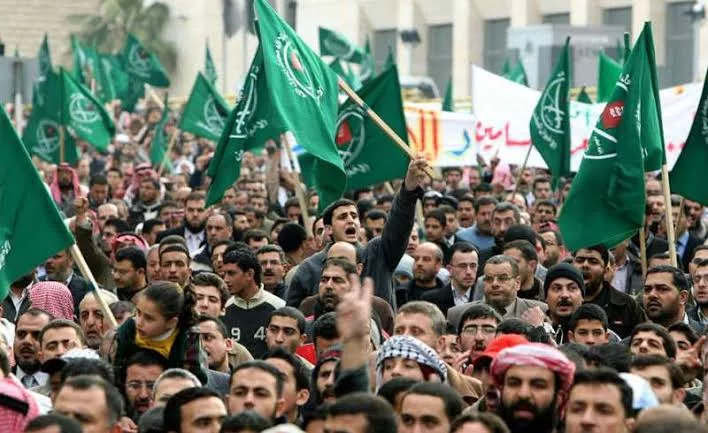
Debate over the Muslim Brotherhood and networks associated with political Islam is intensifying across Europe, with some countries increasingly viewing the issue through the lens of national security, the protection of democratic institutions and social cohesion.
Against this backdrop, the European Parliament voted on October 8, 2026, in favour of a resolution calling for a unified European strategy to address the Muslim Brotherhood and its influence. The move has brought the question of potentially listing the organisation and entities linked to it as terrorist groups before European Union institutions.
The resolution received 381 votes in favour and 167 against, while 15 members abstained, according to the parliamentary voting results. It calls for an assessment of whether individuals and entities linked to the Muslim Brotherhood should be included on the EU’s list of terrorist organisations, alongside proposed measures targeting funding and strengthening cooperation among member states.
The Parliament calls for an assessment of the possibility of listing entities and individuals linked to the Muslim Brotherhood on the European Union’s list of terrorist organisations, alongside measures concerning funding and cooperation among member states to counter the activities of networks associated with the group.
The resolution is expected to move the issue beyond fragmented national debates towards the pursuit of a common European approach encompassing funding, transparency and institutional relations, as well as an assessment of the possibility of placing entities or individuals linked to the Brotherhood on the European terrorist list, following the expansion of debate in several European countries over the relationship between political Islam and civil society activity.
European institutions are also expected to move towards a decisive phase of tightening measures and practical controls to track financial flows and dismantle the economic networks affiliated with the Muslim Brotherhood organisation.
This comes amid calls for a common policy establishing unified rules for dealing with political Islam networks and defining more stringent parameters for their relations with European institutions and member states.
Political confrontation
In some countries, the Muslim Brotherhood organisation has shifted from traditional religious outreach to civil and political activity, whether through associations, educational institutions, human rights organisations or electoral participation.
The European Parliament discussed a number of indicators, including the opacity of funding sources, the overlap between religious outreach and political organisation, and the possibility of exploiting efforts to combat discrimination or defend religious freedoms to pursue partisan or ideological objectives.
The parliamentary debate addressed issues of democracy, transparency and public funding, keeping the file prominent in European political discussions at several levels amid sustained political pressure.
The European vote represents a political development worthy of close attention. The debate has moved beyond warnings issued by certain governments, security agencies and researchers towards an explicit call for a broader European framework to address the phenomenon.
The resolution is expected to shift the approach to the Muslim Brotherhood, a controversial political and religious movement, towards closer scrutiny of the nature of its transnational networks, their funding sources and the extent to which some of its entities are linked to activities that may meet the criteria for terrorist designation. This scrutiny focuses on a broad network of entities that European parliamentarians consider ideologically, organisationally or financially linked to the group.
The dangers
Meanwhile, European countries regard “political Islam”, particularly organisations linked to the Muslim Brotherhood and its networks, as an ideology that affects national security and democratic values, rather than a religion or a matter of freedom of belief.
US Vice President JD Vance previously warned of a scenario he considered “not implausible”, suggesting that European nuclear powers such as France or the United Kingdom could, within 15 years, come under the influence of leaders “close to political Islam”.
In an interview with the British website UnHerd at the end of 2025, he said: “We have much stronger cultural, religious and economic ties with Europe than with anywhere else in the world. That is simply the nature of things. Therefore, I think we will have certain moral discussions with Europe that we might not have, for example, with the Democratic Republic of the Congo, because of this shared sense of history and shared cultural values.”
Linking this to a more specific or direct American interest, he said: “France and the United Kingdom possess nuclear weapons. If they allow themselves to be drawn into deeply destructive moral ideas, they are thereby allowing nuclear weapons to fall into the hands of people capable of inflicting serious harm on the United States.”
He continued: “I think we want Europe to be strong and vibrant. I want it to be a destination Americans visit, where they exchange cultures; where Europeans come to American universities and Americans go to European universities; where our militaries fight and train together. This is impossible without a shared cultural foundation. The United States and Europe possess that foundation, but there is a risk of losing it over the long term.”
US ban
On 13 January 2026, the US administration designated three branches of the Muslim Brotherhood as terrorist organisations and imposed sanctions on them under an executive order issued by President Donald Trump.
The US Departments of the Treasury and State said the targeted Brotherhood branches were in Lebanon, Jordan and Egypt, affirming that they posed a threat to US security and American interests in the region.
US Secretary of State Marco Rubio wrote on the social media platform X: “Today, we are designating Muslim Brotherhood branches in Lebanon, Egypt and Jordan as terrorist groups. Under President Trump’s leadership, the United States will make sure to eliminate the capabilities and operations of Muslim Brotherhood branches that threaten American citizens and our national security.”
The State Department designated the Lebanese branch as a “Foreign Terrorist Organisation”, the highest classification, under which providing any material support to the group constitutes a crime punishable under US law. Meanwhile, the Brotherhood branches in Jordan and Egypt received a separate designation from the Treasury Department as “Specially Designated Global Terrorists” on the grounds of providing support to Hamas.
In November 2025, the US state of Texas added the Muslim Brotherhood and the Council on American-Islamic Relations (CAIR) to its list of terrorist entities, barring them from purchasing land and threatening to shut them down.
The decision included the Council on American-Islamic Relations (CAIR), which is active in defending Muslim rights, according to an announcement by Texas Republican Governor Greg Abbott. He explained that the measure prohibits the two organisations from purchasing or owning land in Texas and allows authorities to initiate legal proceedings to shut them down.
The governor had previously issued a law prohibiting the establishment of residential complexes or facilities governed by Islamic Sharia law, in response to a Muslim real estate development project that included the construction of a mosque.