
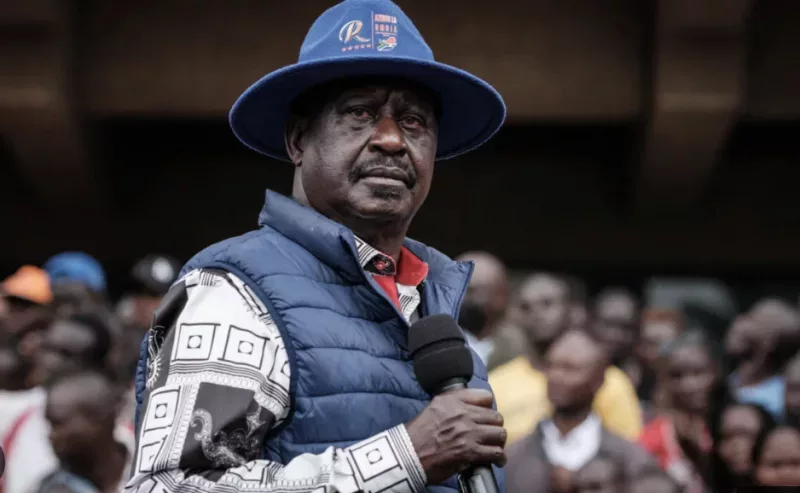
 The late former Prime Minister Raila Odinga/ FILE
For some young Kenyans, former Prime Minister Raila Odinga was the political figure their parents supported and discussed at home. For others, he was a familiar face on television, a name encountered in school lessons or a leader whose long political journey they came to understand through social media.
His name carried different meanings for young Kenyans, the moments they associated with his political career and what his legacy meant to their generation following his death.
Their accounts reflect different levels of familiarity with his history, from the struggle for multiparty democracy and the 2010 Constitution to the 2007/08 post-election crisis and the 2018 Handshake with former President Uhuru Kenyatta.
For Loreen Wamalwa from Kiambu County, Raila’s contribution to multiparty democracy remains central to how she understands his place in Kenya’s history.
She views the freedoms Kenyans enjoy today as a reminder of the political struggles associated with his name.
“I think the question should have been what doesn't matter, because all Raila fought for matters to my generation today,” Wamalwa said.
She linked his political journey to the ability of young people to speak out, question those in authority and demand accountability.
Wamalwa said she learnt about Raila’s detention during former President Daniel Arap Moi’s administration through her parents. His political journey was also shaped in her mind by his involvement in the struggle for multiparty democracy and the events that followed the disputed 2007 presidential election.
She recalled his role in the power-sharing arrangement with former President Mwai Kibaki, which saw Raila become prime minister from 2008 to 2013, and the 2018 handshake with Kenyatta.
Her first encounter with Raila was through her mother, who supported her and other members of her family. She later saw him in person when he visited her uncle, who was seeking election as a member of parliament.
That early exposure to politics through family relationships shaped how she understood Raila beyond his position as a political leader.
To Wamalwa, the name “Baba” carried the meaning of a father figure associated with sacrifice, protection and standing up for people facing difficulties.
She said his appeal extended beyond politics, with his presence, public appearances and dance moves becoming part of how people remembered him.
“ He’ll forever remain to be Baba,” she said.
Wamalwa said his death had not changed what the name meant to her. She continued to associate it with the struggle for democracy and the issues he raised during his political career.
She also drew a connection between his political legacy and the current generation of young people who have taken to speaking out on public issues.
She described Gen Z as a generation willing to question wrongdoing, demand accountability and insist that its concerns be heard.
For her, Raila’s history remains relevant because young people continue to engage with questions about leadership, governance and the rights of citizens.
Similarly, Jane Molly from Nakuru County also identified multiparty democracy as the part of Raila’s political legacy that continues to affect young people.
She said her understanding of him was shaped by mainstream media and her parents, who admired him.
“I know Raila Odinga as a champion of democracy because he continuously critiqued the ruling government when they failed to deliver to the citizens, when they failed to follow the manifesto and the constitution as well,” Molly said.
She also pointed to his role in building a strong opposition and the importance of having political parties outside the governing party.
For Molly, the freedom to establish political parties without fear is one of the benefits young Kenyans continue to enjoy.
“The biggest impact is what we get to enjoy up to date, that is multi-party when he was detained in the 1980s when he fought to ensure that we get to enjoy multi-party that we do right now and about the constitution in 2005 and 2010,” she said.
Molly said she first encountered Raila through her parents and mainstream media rather than social media searches.
Her understanding of his political career was therefore shaped by what she heard at home and what she watched in the media.
She described “Baba” as a name that reflected his relationship with Kenyans across ethnic communities, saying she associated him with a fight for a better country for everyone.
“As a young Kenyan Baba meant like Baba just the way the word means like father because he was there for everyone regardless of your tribe,” Molly said.
She said the meaning had not changed since his death because the multiparty system continued to remind her of his contribution.
Molly also pointed to the freedom young people have to form political parties as something future generations would continue to benefit from.
“We won't be led by one political party is the only ruling party and there's no opposition no that will not get to happen because he fought against that and he was able to achieve it that's why we have so many political parties right now and people are able to enjoy their right to form a political party with no fear of anything,” she said.
For her, that freedom remains a central part of what Raila’s political legacy means to young Kenyans.
On the other hand, James Otieno from Kilifi County grew up hearing Raila’s name in political discussions at home and during election campaigns.
He said Raila was among the politicians whose names were widely discussed at the Coast, although some of the earlier events in his career took place before Otieno was old enough to understand politics.
“I would say his contribution to the struggle for multiparty democracy and constitutional reform. We may disagree with some of his political decisions, but the freedom to criticise leaders and demand accountability matters to young people today,” Otieno said.
He said he learnt more about Raila’s earlier political journey through school, social media and conversations with older people.
His understanding of the former prime minister includes the struggle for multiparty democracy, his years as a major opposition figure, his repeated presidential campaigns, the 2007/08 post-election crisis, the 2010 Constitution and the Handshake with Kenyatta.
Otieno said he first encountered Raila mainly through his parents and television. During election periods, political discussions at home often centred on Raila’s campaigns and political battles.
As he grew older, he began following political conversations online and forming his own opinions rather than relying entirely on what older people said.
For him, “Baba” was a political identity associated with resistance and the pursuit of change, although he did not necessarily agree with every decision Raila made.
Otieno said Raila’s death had made him think more about the history behind the name and the importance of examining the former prime minister’s record as a whole.
“At the same time, I believe we should remember him as a human being whose decisions can be examined, rather than treating everything he did as unquestionable,” he said.
He linked that approach to the need for young people to understand Kenya’s political history rather than relying only on viral clips and online arguments.
“I think Raila’s political journey reminds us that change takes persistence, although our generation must also decide which methods and values it wants to carry forward,” Otieno said.
Mark Mogaka from Kisii County similarly identified Raila’s contribution to democracy and the 2010 Constitution as the aspects of his political career that mattered most to him.
He said the constitutional changes and political freedoms associated with Raila’s journey affect how the country is governed and the rights available to citizens.
“Young people today benefit from constitutional rights, devolution and the freedom to question those in power, even though we still have challenges with accountability and governance,” Mogaka said.
Mogaka first learnt about Raila through his family and political conversations he heard while growing up. During election periods, Raila’s name would come up frequently, and Mogaka watched his speeches and campaigns on television.
Social media later helped him understand why some people admired Raila while others criticised his political decisions.
Mogaka described “Baba” as a name that represented a political father figure to many of Raila’s supporters. For him, however, the name was also associated with the length of Raila’s political career and the loyalty he inspired.
Since Raila’s death, Mogaka said, the name had taken on a more historical meaning, with people reflecting on what he achieved, where he fell short and what future generations could learn from his life.
He said young people should learn about the struggles that shaped the country while retaining the ability to question the choices made by earlier leaders.
“Respecting someone’s contribution does not mean agreeing with everything they did,” Mogaka said.
Naomi Wamaitha from Nairobi remembers Raila through a combination of school lessons and family conversations, but her account also reflects the difficulty some young people face in separating the different episodes of his political career.
She recalled learning about his family background, his leadership of the Orange Democratic Movement and the arrests associated with his political journey.
Wamaitha also identified the 2007/08 post-election violence, his presidential campaigns, the Handshake and his pursuit of better governance as major moments in his career.
She said the post-election violence stood out because of the deaths and ethnic divisions associated with the period.
Asked about the political moment that had the biggest impact, she said the violence had a negative impact because of the loss of life and the divisions it left behind.
Her recollection of Raila’s history was shaped in part by social studies lessons in primary school, where she learnt about his role as an opposition leader and the arrests he had faced.
Wamaitha described “Baba” as a figure associated with the pursuit of peace and better governance, particularly for people who felt they had no voice.
“Baba meant or symbolized his fight for peace and better governance in Kenya. It meant 'our father' as in he fought for us and cared for the people who didn't have a voice,” Wamaitha said.
She also connected his political legacy to the way young people respond to government decisions and what they consider wrongdoing.
“I'd like to think that his legacy or his deeds somehow inspire our generation, in that we want what is best for us as a country and try to oppose the wrongdoings of the government, as he would have done,” she said.







