
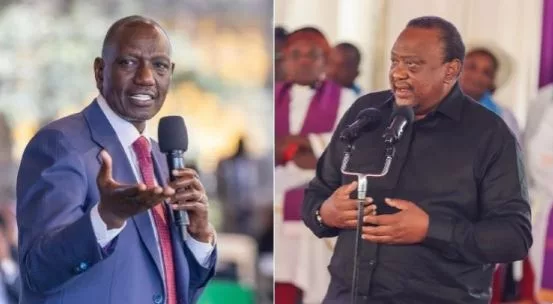
 A photo collage of President William Ruto and his predecessor, Uhuru Kenyatta./FILE
The long-running political rivalry between President William Ruto and retired President Uhuru Kenyatta has resurfaced, with the former allies exchanging barbs as Kenya’s political class positions itself ahead of the 2027 General Election.
The latest exchanges have revived the UhuRuto factor in Kenyan politics, with the two leaders now on opposing sides after years of political partnership.
On Monday, Ruto accused Uhuru of failing to support his presidential bid in 2022 despite backing him in previous elections.
“I, William Ruto, voted for you four times. I stood with you when you began your journey to seek leadership. I stood with you in 2013. I stood with you in 2017. You said 10 years of Uhuru, 10 years of Ruto,” Ruto said in Uasin Gishu.
The political relationship between the two dates back to 2002, when Uhuru, then a newcomer to national politics, contested the presidency on a KANU ticket.
Uhuru lost to National Rainbow Coalition (NARC) candidate Mwai Kibaki, but the two would later forge an alliance ahead of the 2013 General Election.
They joined forces under the Jubilee Coalition, formed through a merger of Uhuru’s The National Alliance (TNA) and Ruto’s United Republican Alliance (URP).
The alliance propelled them to victory in 2013, despite both facing charges at the International Criminal Court over their alleged roles in the 2007/2008 post-election violence, which claimed more than 1,300 lives.
They retained power in 2017 through the Jubilee Party, which brought together more than 20 political parties into a formidable political outfit.
During the 2017 campaigns, Uhuru publicly promised to support Ruto’s presidential ambitions after completing his two terms.
His declaration, “Yangu kumi na kumi ya Ruto” (my ten years and Ruto’s ten years), became a defining slogan of their political partnership.
However, their relationship deteriorated after Uhuru endorsed former Prime Minister Raila Odinga for the 2022 presidency.
The decision followed the March 2018 handshake between Uhuru and Raila, which eased political tensions after the ODM leader staged a symbolic swearing-in as the “People’s President” on January 30 that year.
Angered by what he viewed as a betrayal, Ruto began campaigning early, targeting Uhuru’s Mt Kenya political backyard through a group of youthful MPs known as Tanga Tanga.
The group included lawmakers Kimani Ichung’wah (Kikuyu), Ndindi Nyoro (Kiharu), Rigathi Gachagua (then Mathira MP), Jane Kihara (Naivasha) and Kimani Ngunjiri (then Bahati MP) among other lawmakers who opposed Uhuru’s political direction.
Ruto eventually defeated Raila in the 2022 presidential election, securing about 7.1 million votes against his rival’s 6.9 million, according to the official results.
The victory marked another chapter in the fallout, with Ruto succeeding Uhuru while the former president remained politically opposed to his administration.
The rivalry has since resurfaced as the country approaches the next election.
On September 16, Ruto accused unnamed political figures of sponsoring opposition leaders to challenge him in 2027, a remark widely interpreted as a reference to Uhuru.
“That is why they are sponsoring people — putting up puppets, you know — to try and cause confusion,” Ruto said.
He added that his opponents would not succeed in what he described as attempts to promote hatred, tribalism and marginalisation.
Two days later, while speaking in Murang’a, Uhuru appeared to respond sarcastically to the allegations by embracing the label of sponsor.
“Asanteni sana, ni hayo machache kutoka kwa sponsor, na tutaendelea kuwa pamoja,” he said.
Uhuru also explained that he had prepared his remarks to avoid his words being misinterpreted.
“I normally speak off the cuff, but these days life is becoming quite dangerous for me. So, I have decided that before the media goes to misinterpret my words, wacha nisome ile niko nayo,” he said.
Ruto’s allies have repeatedly claimed that Uhuru is financing opposition activities, allegations opposition figures have dismissed.
Political analyst Gichigo wa Mwangi says the rivalry will remain central to national politics following the death of former Prime Minister Raila Odinga last year.
“With the death of Raila Odinga, Uhuru and Ruto are the only remaining main political players in Kenya. Uhuru, too, is the only remaining retired president. Now, being on opposing sides means they will continue to shape the current political discourse,” Mwangi said.
He argued that the 2027 contest would again be significantly shaped by the political rivalry between the two former allies, whose partnership once defined the Jubilee era.







