
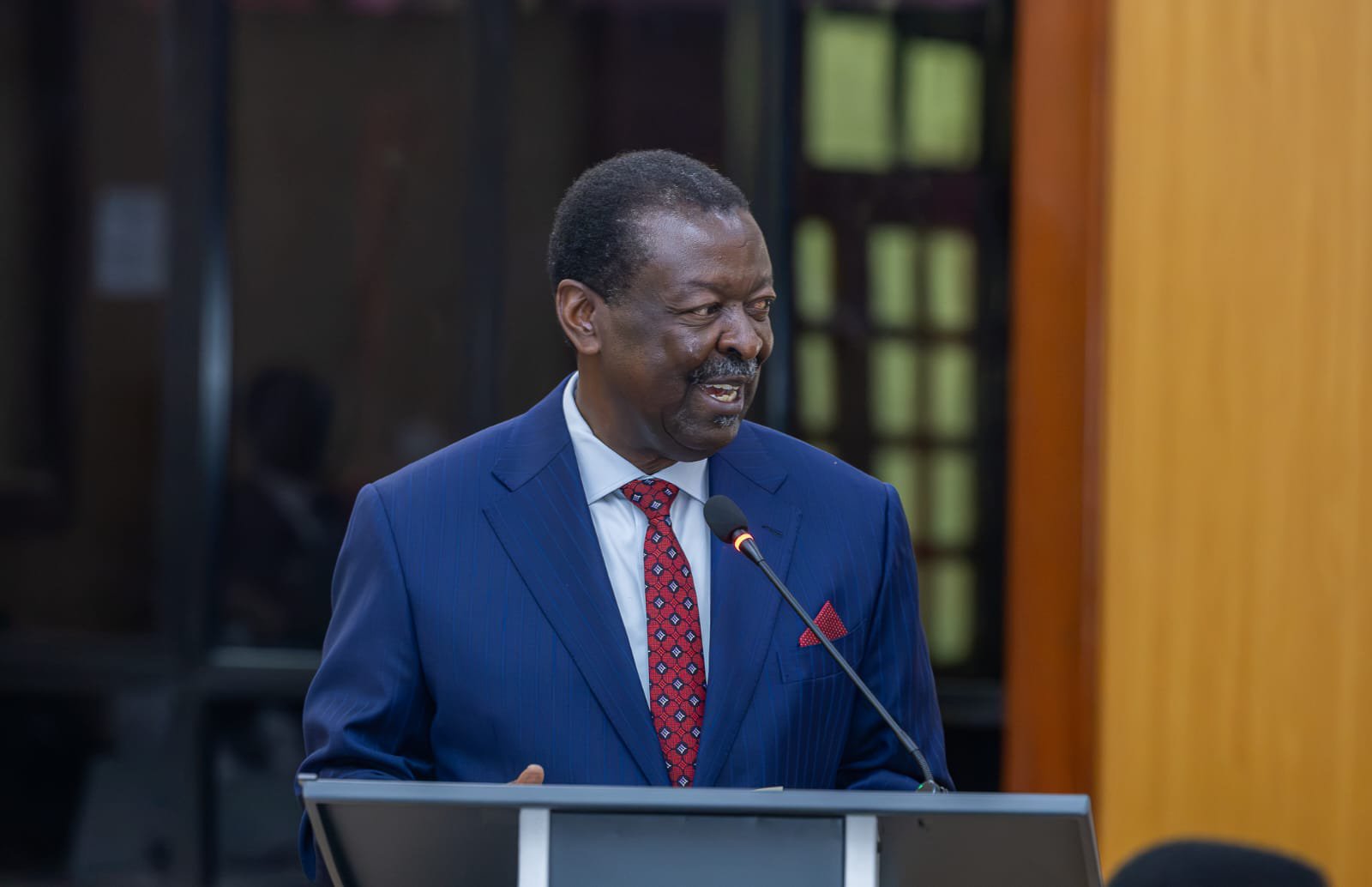
 Prime Cabinet Secretary Musalia Mudavadi speaks during the second National Development Implementation Committee meeting of 2026 at the Kenya School of Government on October 12, 2026. / OPCS
The government plans to have artificial intelligence (AI) deepfake detection tools in place six months before the 2027 General Election as authorities move to counter manipulated digital content that could undermine electoral integrity.
The National Development Implementation Committee (NDIC) has also directed that a protocol for detecting suspected deepfakes, verifying the content and communicating findings be developed and tested before the elections.
In a dispatch issued after its second meeting of 2026, chaired by Prime Cabinet Secretary Musalia Mudavadi at the Kenya School of Government, the committee identified AI-generated content as a major threat to election information security.
“AI deepfakes and synthetic audio are the primary threat vector for 2027,” the committee stated.
NDIC resolved that the detection tools should be operational six months before polling, alongside a tested process for verifying suspected manipulated content and issuing verified responses.
The committee also clarified the responsibilities of institutions involved in election cybersecurity. It said the Election Cybersecurity Operations Centre (ESOC), within the National Computer and Cybercrimes Coordination Committee (NC4), monitors external cyber threats, while the Independent Electoral and Boundaries Commission (IEBC) retains authority over its internal information and communications technology systems.
The directive comes as the committee assesses security preparations for the 2027 elections, including concerns over organised criminal networks and goonism.
NDIC cited findings from the Electoral Vulnerability Index 2026–2027 by the Kofi Annan Foundation, which gave Kenya a risk score of 45.4 per cent and indicated an 84.1 per cent probability of some form of electoral violence.
The committee also cited findings by the National Cohesion and Integration Commission that roughly nine in 10 organised criminal gangs were mobilised, financed and deployed by politicians.
The National Crime Research Centre documented 309 criminal groups across 11 counties in 2025. NDIC further reported that 109 organised gangs and groups had been documented as of September 2026, with the highest numbers recorded in Western, Rift Valley and Nairobi regions.
The committee said the groups were increasingly being used to intimidate people, disrupt political rallies, control territories and suppress voters.
It warned that arrests alone were insufficient to dismantle the networks if their financial and operational structures remained intact.
“NDIC stated that large arrests alone do not demonstrate the dismantling of networks, and that case-linking, financial disruption, intelligence mapping and prosecution support must be sustained to prevent re-mobilisation,” the dispatch stated.
The committee directed that election security measures also cover political party nominations, which it described as a critical security flashpoint.
It said threats against women candidates and persons with disabilities should be incorporated into hotspot mapping and early-warning monitoring.
NDIC further directed relevant agencies to continue mapping and disrupting criminal networks and provide risk-based protection for campaigns, party primaries and candidates.
The committee reaffirmed the government’s commitment to peaceful elections, saying candidates and citizens should be able to participate without fear.
It also emphasised that security institutions should act neutrally, lawfully, promptly and accountably.







