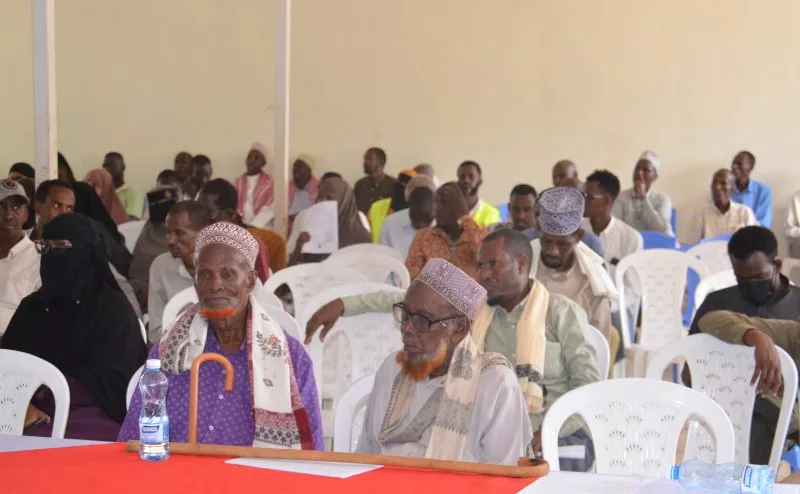
Residents of Garissa at the forum /STEPHEN ASTARIKO
Calls to abolish the controversial colonial-era three-mile land boundary between Garissa and Tana River counties dominated a public participation forum on proposed regulations governing historical land injustices.
Garissa residents attending the National Land Commission public participation on the National Land Commission (Historical Land Injustices) Regulations, 2026, urged the commission to use the new framework to reopen the long-running dispute and address what they described as a historical wrong affecting communities living along the Tana River.
The residents want the disputed strip, which they argue was placed under the administrative control of the former Tana River district during the colonial period, restored to Garissa in the region for generations since Kenya's independence.
Resident Aden Bille questioned why the colonial arrangement remained after independence, arguing the government should have consulted local communities when it reorganised districts.
“The continued existence of the boundary has effectively left communities living on one side of the Tana River at the mercy of an administrative arrangement they had never participated in creating,” he said.
Amina Issa urged the NLC not to allow the dispute to remain unresolved for generations, saying communities needed a definitive legal and administrative solution.
“One thing that needs to be clear is that the dispute was not merely about the ownership of land but also about access to water, grazing areas, markets and public facilities that serve communities living along the river,” she said.
Hussein Mohamed asked the commission to expedite the process and establish whether the colonial boundary could be overturned through the historical land injustices framework.
NLC commissioners attending the forum acknowledged the three-mile strip issue had emerged prominently during consultations and indicated it could be revisited under the proposed regulations.
Commissioner Daniel Muriungi said the commission had taken note of the scale of the dispute, including the number of public facilities and administrative areas affected.
“We have heard that there are at least 60 schools, markets and five subcounties which are involved. Now with these new regulations, once adopted by Parliament, we will be able to listen to the issues and determine them as per the law,” he said.
Commissioner Esther Murugi said some historical land injustice claims had previously stalled because of limitations surrounding the commission’s original mandate.
She said changes to the land law had extended the period within which historical land injustice claims could be considered, allowing the commission to continue examining cases affected by the expiry of its mandate.
“Some of the mandate that the commission was given at inception had elapsed and Parliament changed the land law last year and reviewed the term for the historical land injustice which had expired in 2021 and the review of grants which had expired in 2017,” Murugi said.
“Some very interesting issues have come up in Garissa, especially on the three-mile strip. That is a historical land injustice. It has been heard before and determined but the citizens here are not happy with the determination, so we shall revisit the issue so that we can address it afresh,” she said.
The three-mile strip dispute has its origins in the colonial administration, when land running parallel to the Tana River on the Garissa side was placed under the administrative control of the then Tana River district.
The colonial administration established a boundary extending about three miles, or about 4.8 kilometres, from the river.
But the political circumstances that informed the arrangement changed after independence, while the boundary and its consequences have continued to generate controversy.
The dispute has at times affected access to water, grazing land and other resources along the Tana River, contributing to tensions between communities and the two counties.
The matter has also reached the courts. Last year, the Environment and Land Court in Garissa issued temporary orders stopping new settlements and expansion of existing developments along the disputed strip at the Garissa-Tana River boundary.
The case followed a petition by Ijara MP Abdi Ali, who accused the Tana River county administration of encroaching on what he considers Garissa territory.
The petitioner has maintained the alleged expansion into the disputed territory has heightened tensions among residents and could undermine peace in an area where relations between neighbouring communities remain sensitive.

Commissioner Daniel Muriungi speaking./STEPHEN ASTARIKO

Aden Bille, a resident, making his contributions. /STEPHEN ASTARIKO

Amina Hussein, a resident, making his contributions. /STEPHEN ASTARIKO
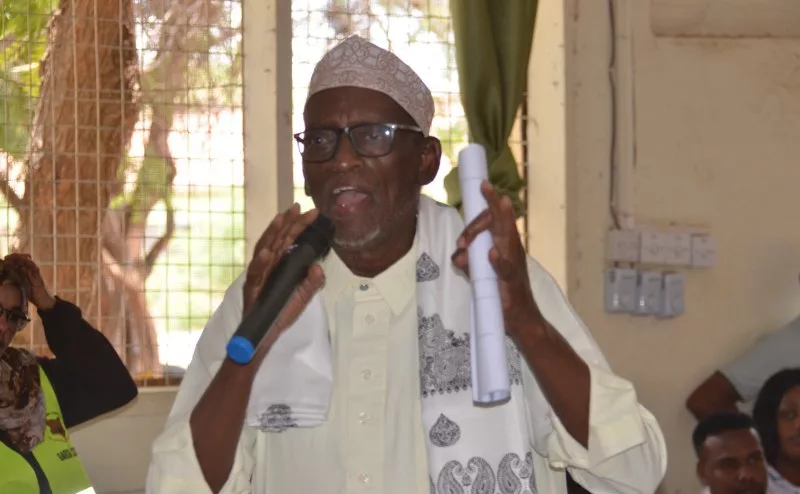
Hussein Mohamed, a resident making his contributions. /STEPHEN ASTARIKO