
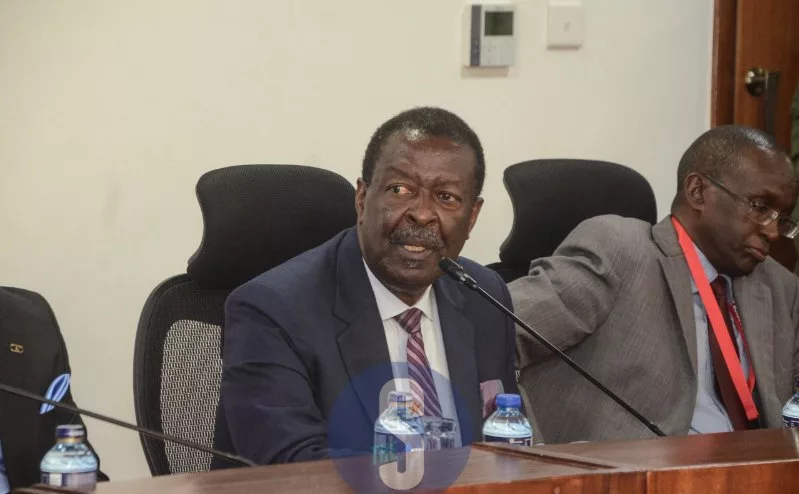
 Prime Cabinet Secretary and Foreign and Diaspora Affairs Cabinet Secretary Musalia Mudavadi when he appeared before the Delegated Legislation Committee at Bunge Towers on October 8, 2026./DOUGLAS OKIDDY
At least 84 Kenyans involved in the Russia-Ukraine war have been killed or remain missing in action, Prime Cabinet Secretary and Foreign and Diaspora Affairs Cabinet Secretary Musalia Mudavadi has said.
Mudavadi said the Ministry of Foreign and Diaspora Affairs has records of 354 Kenyan nationals involved in the conflict, with 84 listed as either killed in action or missing in action.
“The Ministry has records of 354 Kenyan nationals involved in the Russian-Ukraine crisis,” Mudavadi said in a response to a parliamentary petition on the recruitment of Kenyans into the Russian Army and the detention of Kenyans in Ukrainian prisons.
The ministry's records show that 77 Kenyans are currently on the frontlines, while 38 are in camps and 52 are listed under unknown location or unclassified.
Another 34 are hospitalised, 62 have been repatriated, five are prisoners of war, one is in detention and one has completed their contract.
Mudavadi said the figures are based on information received through the ministry's diplomatic missions and from affected families.
He urged families to contact the State Department for Diaspora Affairs as soon as communication with relatives in Russia is disrupted.
Once a case is reported, the department obtains identification and travel details before escalating it to the Kenyan Embassy in Moscow for verification.
The latest figures come months after Kenya and Russia reached an agreement aimed at stopping the recruitment of Kenyans into Russian military operations and facilitating the disengagement of those already involved.
Mudavadi travelled to Moscow in March for talks with Russian Foreign Minister Sergey Lavrov, with the welfare and repatriation of Kenyans involved in the conflict among the key issues discussed.
Following the talks, Mudavadi announced that Russia had agreed to stop enlisting Kenyans through its Defence Ministry and place Kenya on a military recruitment “stop list”.
Russia also agreed to facilitate consular access to affected Kenyans, support the repatriation of remains and allow Kenyans who no longer wished to participate in the military operations to disengage.
The two countries also agreed to strengthen cooperation against human trafficking and illegal recruitment networks and to explore a labour cooperation framework to provide safer and regulated employment pathways for Kenyans seeking jobs in Russia.
Mudavadi later told Parliament that the number of Kenyans involved remained difficult to establish because some had travelled secretly and outside official channels, with the figures continuing to change as new cases were verified.
By May, the government had confirmed 291 Kenyans as having been recruited to fight in the war, with 53 already repatriated.
The latest parliamentary response now puts the number of Kenyans recorded as involved in the conflict at 354.
Mudavadi said the government had also engaged Ukrainian authorities over Kenyans captured while fighting for Russia.
Five Kenyans are currently listed as prisoners of war in Ukraine. Kenya's honorary consul in Ukraine visited the Zakhid 1 prisoner-of-war camp and reported that the detainees were being held in humane conditions and had access to medical services.
The ministry also said the remains of four other Kenyans were in Ukrainian custody, according to reports from Ukraine's Defence Intelligence.







