
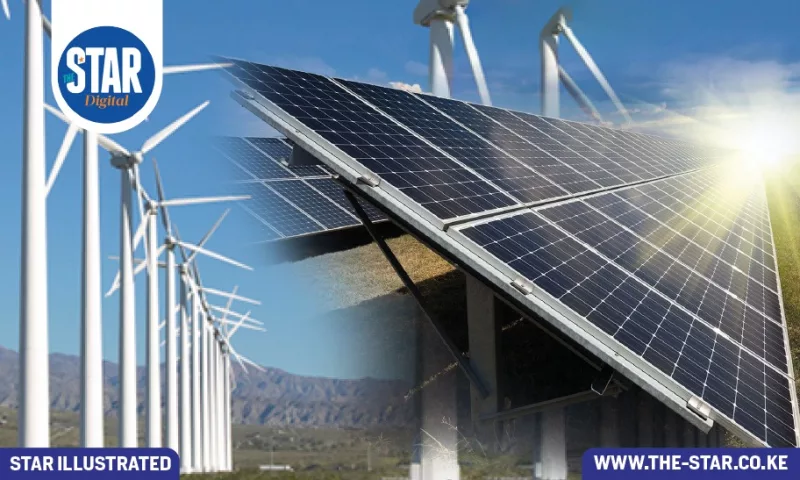
 Renewable energy/FILE
Kenya is among eight African countries set to benefit from more than £2 million in UK-backed investment for clean energy projects aimed at reducing reliance on diesel generators.
The funding will support 10 projects across the continent, including two in Kenya targeting healthcare facilities, schools and small businesses.
The projects are being supported through the ZE-Gen Scale-up Fund under the UK Government’s Ayrton Fund and will focus on expanding clean energy systems that have already undergone pilot testing.
In Kenya, Acele Africa will deploy locally designed and assembled modular battery systems to help healthcare facilities, schools and small businesses with unreliable grid power reduce their dependence on diesel generators.
The project will focus on energy storage systems that can be repaired and expanded locally.
A separate project by SHIELD, a University of Oxford spin-out, will support hospitals in Kenya to shift from diesel generators to solar and battery systems.
The project will use a financing model intended to reduce the cost of the transition and attract further investment. It will begin with a major Kenyan hospital, according to the project organisers.
The wider investment will also support projects in Uganda, Rwanda, Tanzania, Madagascar, Nigeria, Mozambique and Lesotho.
In Uganda, Telford-based battery company AceOn will deploy battery-powered systems for telecommunications infrastructure, healthcare facilities and humanitarian operations, including testing sodium-ion batteries as an alternative to lithium-ion technology.
In Nigeria, Farm Warehouse will install 100 solar-powered cold storage systems in major markets for fish, meat and dairy vendors.
Another Nigerian project by KAMIM Technologies will establish four solar-powered agricultural hubs combining irrigation, cold storage, ice production and grain processing.
In Mozambique, Gommyr will establish renewable-powered fishing hubs using solar power, battery storage and cold-chain systems to help fishing communities preserve catches and access markets.
The projects also include rural electrification in Madagascar, solar systems for small businesses in Uganda and Tanzania, second-life battery storage in Rwanda and modular battery systems for mini-grids in Lesotho.
ZE-Gen Programme Director Lily Beadle said the projects were intended to help companies move from pilot projects to wider deployment.
"Through the ZE-Gen Scale-up Fund, we are helping innovative companies move from pilot projects to larger-scale deployment," Beadle said.
The fund is backed by the UK Government’s Ayrton Fund through the Transforming Energy Access platform, which is funded through its Global Research and Technology Development portfolio.
The organisers said the latest projects build on earlier UK-supported programmes, including the Energy Catalyst and Powering Renewable Energy Opportunities initiatives.
The projects will focus on sectors where unreliable electricity can affect essential services and businesses, including healthcare, telecommunications, agriculture, food storage, fishing and rural enterprises.
Acele Africa CEO Joseph Mungai said the Kenyan project would test whether locally developed battery storage could provide reliable power for healthcare facilities and small businesses while reducing dependence on diesel generators.







