

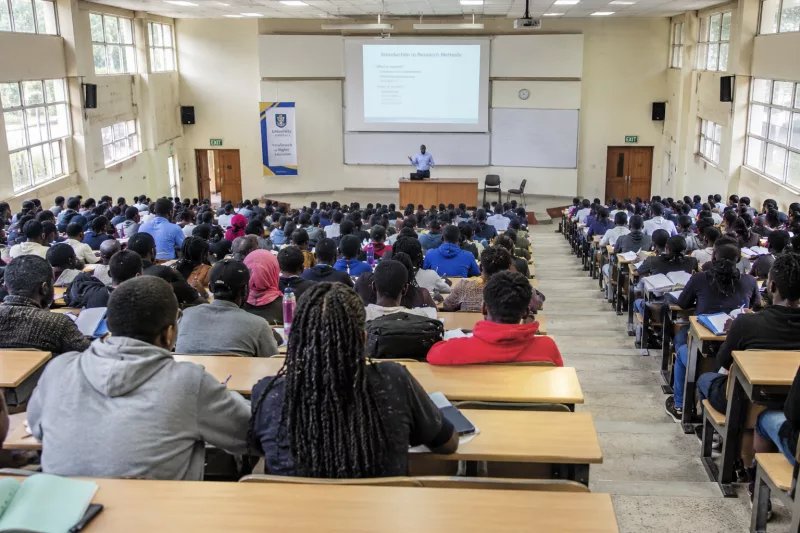
 University students in a lecture hall /AI ILLUSTRATION
Kenyan universities are shifting more academic staffing towards computing and health-related disciplines as the number of lecturers in engineering, agriculture and mathematics and statistics declines, a new report by the Commission for University Education (CUE) shows.
The changes were recorded against an overall increase in academic staff from 15,383 in 2024 to 16,434 in 2025, representing growth of 1,051 staff, or about 6.8 per cent.
Computer Science recorded the largest increase among the academic domains tracked by CUE, rising from 346 staff in 2024 to 602 in 2025, a gain of 256 lecturers.
Medical Studies also recorded a significant increase, from 752 to 918 staff, while Social Sciences rose from 1,053 to 1,248.
Biological and related Sciences increased from 498 to 638, while Nursing grew from 325 to 460.
Business, the largest academic domain by staffing, increased from 2,005 to 2,166, while Education Arts rose from 841 to 965.
The growth in computing was accompanied by increases in other technology-related areas.
Information and Computer Technology staff rose from 277 to 349, while Information Systems and Services also recorded growth.
The report notes that significant growth in health-related academic fields, including Medical Studies, Nursing and Allied Health and Clinical Sciences, reflects a broader expansion of staffing beyond traditional academic domains.
CUE says the pattern points to a changing academic workforce, with universities increasingly building capacity in digital and technology-related disciplines.
“Second, the rise in computing-related staff (notably Computer Science, and also Information and Computer Technology and Information Systems and Services) points to a strategic shift toward digital skills and technology programmes,” the report says.
The shift was less favourable in several disciplines considered important to science, technology and national development.
Engineering staff fell from 843 to 745, a reduction of 98. Agriculture declined from 620 to 538, losing 82 staff, while Mathematics and Statistics fell from 705 to 664, a reduction of 41.
Arts recorded the largest numerical decline, falling from 593 to 443 staff, while Education Science declined from 266 to 227.
CUE warns that continued contraction in some of these disciplines could create capacity gaps, particularly where they support strategic sectors of the economy.
“Contractions in Engineering, Agriculture, Arts and declines in Mathematics and Statistics raise potential concerns about capacity in foundational and strategic disciplines—especially where national development priorities depend on STEM breadth (engineering capacity) and food systems (agriculture),” the report says.
The Commission says the staffing changes need to be assessed alongside student enrolment, graduation patterns and programme accreditation to determine whether universities are building capacity in areas where demand is growing.
“The practical implication is that staffing plans should be interpreted alongside enrolment, graduation outputs, and accreditation needs, so that growth does not inadvertently create bottlenecks in essential feeder disciplines like mathematics/statistics capacity supporting data-intensive programmes or engineering supporting industrial development,” the report says.
CUE says rapidly growing areas will require corresponding investment in specialised infrastructure, laboratories, equipment and other support systems if increased staffing is to translate into better training outcomes.
The Commission cautions that while staff concentration in computing may reflect demand for digital skills, persistent declines in engineering, agriculture and mathematics could leave some strategically important disciplines under-resourced.







