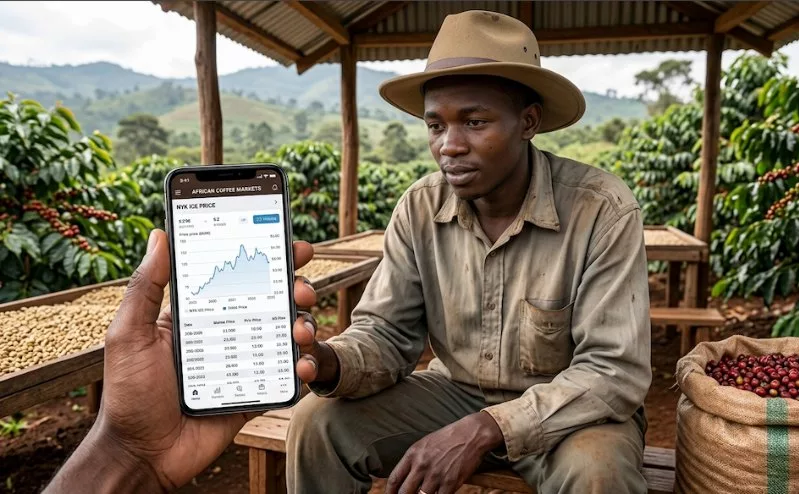
Technology's real value will be measured by whether a farmer in a remote village can use it to access a service, obtain useful information, manage risk or secure a better market /AI ILLUSTRATION
As Kenya prepares for the upcoming Agriculture Summit, the country has an opportunity to ask a fundamental question: Are agricultural policies finally translating into meaningful change for the farmer?
For years, Kenya's agricultural conversation has been dominated by policies, strategies, programmes and promises. Yet for millions of farmers, the real measure of progress has always been much simpler: Can I produce more? Can I sell at a better price? Can I protect my investment from drought and disease? And, ultimately, can farming provide a decent livelihood?
These are the questions that should define the conversation at the Agriculture Summit.
There are signs that Kenya's agricultural policy is becoming more connected to practical interventions. The government is pursuing reforms that touch different points of the agricultural value chain.
The significance of this approach lies not necessarily in the number of programmes being implemented, but in the attempt to address agriculture as an interconnected system.
A farmer cannot become more productive simply because fertiliser is available. The farmer also needs reliable information, appropriate technology, access to finance, insurance, extension services, storage, processing and, most importantly, a market that rewards production.
This is why initiatives such as the Digital Agriculture Roadmap are important. Better agricultural data and digital services can help government plan more effectively while giving farmers greater access to information, services and markets.
But technology should not become another impressive policy document sitting on a shelf. Its real value will be measured by whether a farmer in a remote village can use it to access a service, obtain useful information, manage risk or secure a better market.
The same principle applies to agricultural insurance.
The partnership with Pula Advisors, targeting smallholder farmers and linking insurance to subsidised fertiliser purchases, represents an attempt to protect farmers from some of the risks that have traditionally made agriculture a gamble.
That is important because no amount of productivity gains can secure a farmer's livelihood if one drought, disease outbreak or pest invasion can wipe out an entire season's investment.
Yet insurance must be accessible, understandable and responsive when farmers need it. The success of such programmes will therefore depend not simply on the number of farmers enrolled, but on whether farmers understand the cover and receive meaningful support when disaster strikes.
There is another equally important issue: accountability.
The Ministry's Compliance Monitoring Initiative with the Ethics and Anti-Corruption Commission points to an important reality—that agricultural support must reach the intended beneficiary.
A subsidised input programme can only be judged successful if the farmer receives the support, uses it productively and ultimately sees an improvement in production and income.
The same emphasis on practical outcomes is emerging in livestock.
Technology-enabled animal health, traceability, smart dairy management, precision feeding and online livestock markets point towards a livestock sector that is increasingly commercial and data-driven.
This matters because livestock is no longer simply about keeping animals. It is an extensive economic ecosystem involving breeding, veterinary services, feed, genetics, processing, marketing, finance and technology.
It also presents an important opportunity for Kenya's young people.
The revival and rebranding of 4-K Clubs, alongside initiatives to expand training and enterprise opportunities, could help change how the younger generation views agriculture.
Young people should not be encouraged to see agriculture merely as an occupation involving manual production. They should see opportunities in agritech, veterinary services, genetics, logistics, processing, digital marketing, finance and other businesses surrounding the farm.
That is how agriculture becomes an engine of employment rather than simply a source of food.
The question of value addition is equally critical.
For farmers, producing more does not automatically mean earning more. If farmers continue to sell raw commodities while most of the value is created elsewhere, increased production alone will not deliver the transformation they need.
Developments such as the Sh51.9 million grant to upgrade Kapkoros tea factory, work on an avocado packhouse and investment in common-user value-addition facilities point in the right direction.
The objective should be to ensure that a greater share of the value created from Kenya's agricultural products remains with farmers, local enterprises and communities.
This is particularly important for commodities such as tea, coffee, dairy, horticultural produce and livestock, where processing and branding can significantly change the economics of production.
The Agriculture Summit therefore comes at an important moment.
It should be more than another gathering where stakeholders exchange speeches and recommendations. It should provide an opportunity to examine whether the reforms already underway are delivering measurable results and what must be done differently to accelerate implementation.
The government has articulated an ambition under the BETA agenda to make agriculture more productive and profitable. The challenge now is to demonstrate that ambition in the everyday lives of farmers. Ultimately, agricultural transformation will not be judged in Nairobi offices or conference halls.
It will be judged on the farm where a farmer harvests more from an acre, in the dairy enterprise that earns more from processed milk, in the tea factory that creates greater value for growers, and in the young person's agribusiness that grows from an idea into a sustainable enterprise.
Kenya has no shortage of agricultural policies. What the country needs is consistent implementation, stronger accountability and a relentless focus on outcomes.
The Agriculture Summit provides an opportunity to shift the conversation from what government intends to do to what farmers can demonstrate has changed.
That is where agricultural policy acquires its real meaning.
And if Kenya can successfully bridge that gap between policy and the farmer, agriculture can become more than a sector that feeds the nation. It can become one of the country's strongest engines of jobs, enterprise, innovation and shared prosperity.
Technical adviser, Ministry of Agriculture