

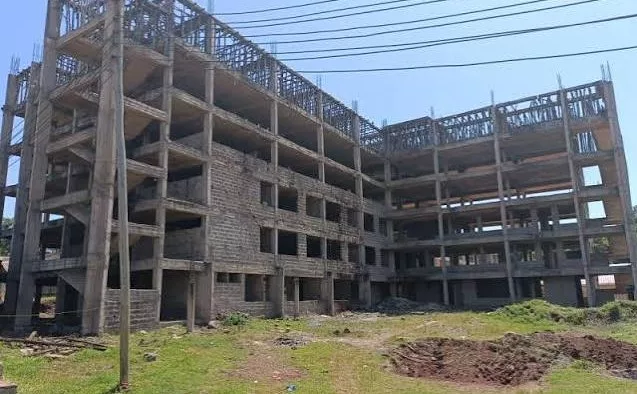
 Stalled project /HANDOUT
For residents of Mua in Machakos, the promise was a hospital close to home.
For traders in Naivasha, it was a modern fish market where business could thrive.
In Mbagathi, Nairobi, patients were supposed to get a new medical block with outpatient, high-dependency and intensive care facilities.
But years after these projects were launched, the buildings remain incomplete, contractors have walked away and residents are still waiting.
Across the country, 189 county development projects worth Sh10.51 billion have stalled, turning what were supposed to be symbols of devolution into monuments of unfinished promises.
A new report by Controller of Budget Margaret Nyakang’o shows counties had paid Sh4.21 billion towards the projects before they stalled.
The projects range from hospitals, roads and water schemes to markets, social halls, offices, youth centres and Early Childhood Development Education facilities.
“Reported causes included inadequate budgetary allocations, unresolved contract variations, contractor abandonment, contract termination, missing contract files and projects under investigation,” Nyakang’o said in the report.
Nairobi has the highest number, with 57 stalled projects valued at Sh2.24 billion.
Kakamega has 26 projects worth Sh848.95 million, while Baringo has 23 projects valued at Sh163.32 million.
Nyakang’o said counties must stop allowing projects to remain unfinished and instead direct resources towards completing those that can be operationalised.
“A review of the stalled projects revealed that Nairobi county recorded the highest value at Sh2.24 billion (57 projects),” she said.
The Nairobi list reads like a catalogue of services residents are still waiting for.
A medical block at Mbagathi Hospital, valued at Sh255.87 million, was only 15 per cent complete.
At Mwiki, a Sh76 million social hall remains stalled after the contractor left the site because of non-payment.
In Dandora II, a youth complex valued at Sh50 million is also incomplete.
The rehabilitation of Makina market, estimated at Sh42 million, has similarly stalled because the contractor was not paid.
For residents who were expecting better health services, safer trading spaces and facilities for young people, the figures translate into daily frustrations.
Some projects had moved significantly towards completion before running out of steam.
A maternity wing at Umoja I health centre was 50 per cent complete.
A medical block at Karen health centre had reached 75 per cent under a previous contract but remained stalled.
The county had also spent Sh150 million on the Care Integrated County Revenue Management System/ERP project at City Hall, valued at Sh847.23 million. It was only 37 per cent complete.
The county attributed the problems to funding, procurement, contractor, land, design and legal issues.
“County governments should prepare verified schedules of stalled projects, prioritise projects that can be completed and operationalised and allocate adequate resources in future budgets,” Nyakang’o recommended.
In Machakos, the human cost is equally visible.
The county reported 22 stalled projects, with Sh314.26 million already paid out of their total estimated value of Sh891.58 million.
At Mua, a community hospital valued at Sh11.53 million had reached 80 per cent completion before the work stopped.
Despite being close to completion, the facility remained non-functional.
Another community hospital at Kwa Mwatu in Matuu was 60 per cent complete when the contractor walked away.
The county also has a Sh55.5 million commercial development project in Mua that was just 10 per cent complete when the contract was terminated over non-performance.
A community recreation centre worth Sh55.44 million suffered the same fate.
Residents therefore face a frustrating paradox: money has been spent, structures have risen from the ground, but the facilities remain unavailable for public use.
In Kakamega, 26 projects worth Sh848.95 million have stalled, with Sh218.98 million already paid.
One of the projects is the Ingotse-Navakholo-Chebuyusi road, valued at Sh100 million.
It was only 40 per cent complete when its contract was terminated and the county began preparations to re-advertise.
Another road, Butali-Malekha, valued at Sh45 million, stalled after delayed payments.
The same problem affected the completion of the Emang’ala-Emahongoyo road.
Even projects that were almost complete have not escaped the crisis.
The Khwisero subcounty offices were 90 per cent complete, while a water project in Yala Butwehe had reached 85 per cent.
Yet both remained stalled.
In Nakuru, three projects worth Sh60.65 million have stalled after Sh40.93 million was paid.
A fish market in Naivasha, valued at Sh9.66 million, was 50 per cent complete when work ground to a halt.
A market shed at Naivasha was 77 per cent complete but was also abandoned.
Both projects are now earmarked for re-tendering.
For traders, the consequences are not contained in a county report. They mean continuing to operate in spaces the county had promised to replace with better facilities.
In Nandi, six projects worth Sh23 million were reported as stalled.
Among them is the Cheptewai Hospital Complex Phase II, which was 80 per cent complete.
Education and youth facilities also feature prominently, including projects at Kabore Vocational Training Centre and Timobo ECDE.
The reasons for the stalled projects vary.
Nyakang’o cites inadequate or delayed funding, unresolved contract variations, contractor abandonment, contract termination, missing contract files and investigations.
Other problems include procurement delays, delayed payments, poor project planning and design, failure to obtain regulatory approvals and weak contract management.
The report also points to shifting political priorities as one of the factors behind stalled projects.
That means communities can be left waiting even after a project has consumed public funds.
The controller has recommended that counties prepare verified schedules of all stalled projects and develop time-bound recovery plans.
Nyakang’o asked the devolved units to prioritise projects that can be completed and operationalised, allocate sufficient resources and resolve contractual disputes.
“Resolve contractual disputes promptly and in accordance with the law. Ring-fence projects under investigation and pursue appropriate recovery, enforcement, or corrective actions where loss or irregularity is established,” the report states.
In Siaya, the county reported one stalled project valued at just Sh1.88 million, but the controller noted Sh3.72 million had been paid, resulting in an excess payment of Sh1.84 million.
For citizens, however, the bigger concern is what happens after the money has been spent.
INSTANT ANALYSIS
The stalled-project crisis exposes weaknesses in county planning, funding and contract management. With Sh10.51 billion tied up in 189 projects and Sh4.21 billion already paid, residents are bearing the cost through delayed hospitals, markets, roads and other services. Contractor abandonment, delayed payments, inadequate budgets and shifting priorities point to implementation failures. Governors now face pressure to prioritise completion, strengthen oversight and ensure public money delivers tangible results.







