When Lake Ol Bolossat dried up in 2023, the community that have lived around the lake for decades was thrown into panic mood.
What followed was devastating. A herd of hippos started attacking the local community.
Lake Ol Bolossat Community Conservation group member Moses Muriuki says the lake has been the lifeline for the community since time immemorial.
“We have depended on it for water, farming, livestock, fishing, tourism and other livelihoods,” he said.
“At the same time, we have lived alongside its remarkable biodiversity, including its rich birdlife and other wildlife that make this lake unique in Kenya. However, we have also watched the lake change.”
The drying of the lake was attributed to challenges such as a prolonged drought, human encroachment and catchment degradation.
The lake is Kenya’s only natural high-altitude lake in the highlands. It lies at the head waters of the upper Ewaso Ng’iro basin.
The lake provides water for more than two million people, livestock and wildlife across five counties, while supporting agriculture, livestock, fisheries, local entreprises and emerging ecotourism.
Following the drying up of the lake, some hippos were forced to seek refuge in the three-acre unfenced Mukindu public dam, bringing them into close contact with nearby farms and homes.
The Kenya Wildlife Service translocated the hippos with the help of technology.
Strategically placed 360-degree night vision monitoring equipment quietly revealed the animals’ movements, helping the team identify the perfect window for a successful capture in the wee hours of the morning.
The animals had killed a number of people, destroyed property and maimed hundreds.
The drying up jolted the government, the community and NGOs into action. Their efforts have yielded positive results.
Today, the water in the lake is calm, save for the regular interruptions by the hippos.
Experts say the presence of the hippos in the lake shows that it is a functioning wetland ecosystem.
Muriuki said they have witnessed degradation of the catchment, encroachment, pollution, siltation, over-abstraction, habitat destruction and other pressures on this fragile ecosystem. “Most painfully, we witnessed the lake completely dry up in 2023,” he said.
He said the drying of the lake was not simply an environmental event.
“It was a warning,” he said with a firm stare.
The drying up, he said, showed them very clearly that the future of the lake and the future of the community are inseparable.
“When the lake suffers, the community suffers. When the lake is healthy, the community has a future.”
RAMSAR SITE
Already, plans are in place to have the wetland protected by declaring it a Ramsar site.
A Ramsar site is a wetland designated as being of international importance under the Ramsar Convention on Wetlands.
There are six Ramsar sites in Kenya. They include Lake Nakuru, listed in 1990 and covering 18,800 hectares. Lake Naivasha joined the distinction in 1995 and covers 30,000 hectares.
In 2001, Lake Bogoria, covering 10,700 hectares, was added to the list.
Lake Baringo was listed as a Ramsar site in 2002 and covers 31,469 hectares.
Lake Elementaita (10,880 hectares) was listed n 2005 and Tana River Delta (163,600 hectares) in 2012.
Experts now want Lake Ol Bolossat listed as the seventh Ramsar site in the country.
When a place has been declared a Ramsar site, it receives enhanced conservation and sustainable use.
They also signify a commitment to the conservation and sustainable use of the wetland’s resources, promoting the wise use and recognising the ecological, economic, cultural and recreational values of the site.
The move fosters international cooperation and effective monitoring and reporting.
It also promotes and enhances education and public awareness.
Before a place is declared a Ramsar site, there are several steps and it is primarily the responsibility of the country where the wetland is located.
The site is identified and nominated before it is assessed and evaluated.
It is then approved and designated, which is then followed by regular review and monitoring.
Such sites attract international cooperation.
To bolster the ongoing efforts of getting the lake listed as a Ramsar site, scientists have conducted a study to map out biodiversity within Lake Ol Bolossat.
BIODIVERSITY HOTSPOT
The report, ‘Unlocking Biodiversity Data to Facilitate Designation of Lake Ol Bolossat as the 7th Ramsar Site in Kenya’, report shows that the lake is a hot biodiversity hotspot.
The new assessment records 518 plant species, 162 bird species and 278 fungi species, providing fresh evidence for stronger protection of the threatened wetland Ol Kalou, Nyandarua county.
The biodiversity and socioeconomic assessment of Lake Ol Bolossat documented an exceptionally rich diversity of plants, birds, fungi and other wildlife.
The evidence now provides information to support efforts to secure stronger protection for the threatened wetland and advance its proposed designation as Kenya’s seventh Ramsar site.
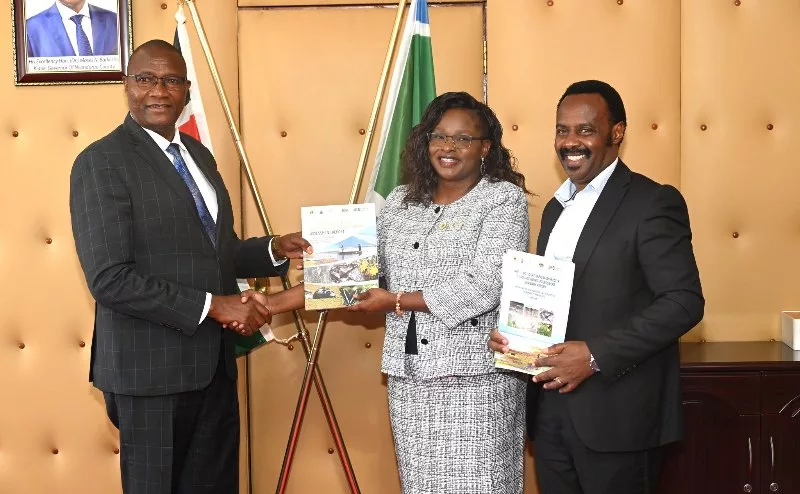
The report was launched in Ol Kalou on September 14 records 518 plant species, including 148 species newly recorded during the assessment.
Two of the plants recorded — Calceolaria tripartita and Lactuca serriola — had not previously been recorded in Kenya, while three regional endemic species were also documented.
The assessment also found remarkable fungal diversity.
East African Wild Life Society project officer Ann Mukaindo said 278 fungal species were documented, compared with only 35 previously recorded, including 141 macrofungi and 25 arbuscular mycorrhizal fungi recorded for the first time in the Lake Ol Bolossat ecosystem.
“Among the notable findings was Myriostoma cf. coliforme, a rare species listed as Critically Endangered in Britain,” she said.
Bird surveys recorded 162 species within the basin.
Of these, 24 were species of conservation concern, including three endangered species, two vulnerable species and one endemic species.
The survey also recorded migratory birds, including 20 Palearctic and two intra-African migrants.
Mukaindo said modelling indicates that as many as 200 to 375 bird species could potentially be recorded with more extensive survey effort.
The assessment recorded 126 hippopotamuses, underlining the continuing importance of Lake Ol Bolossat as a functioning wetland ecosystem.
“Seven mammal species were recorded during the survey, which also documented 206 invertebrate species from 16 orders and 17 species of reptiles and amphibians,” Mukaindo said.
The findings are significant because Lake Ol Bolossat is not only an important biodiversity site but also an ecosystem with a much wider human significance.
The assessment describes it as supporting the livelihoods of more than two million people and as an important water source for landscapes extending into Laikipia and Isiolo counties.
The report, however, also presents a warning about the pressures facing the ecosystem.
It identifies land conversion, illegal harvesting of vegetation, overgrazing, water abstraction, invasive alien species, pollution, encroachment and climate change among the major threats to biodiversity.
The assessment found evidence of a marked reduction in open water and macrophyte cover, as well as substantial loss of surrounding tussock and forested habitats between 1973 and the 2020s.
Aspatial analysis found that about 12 per cent of the Lake Ol Bolossat Management Plan area comprises biodiversity hotspots requiring prioritised conservation action.
Weru ward accounts for 44 per cent of the areas classified as “very hot” for biodiversity conservation, providing a basis for targeting future conservation and restoration interventions.
Agricultural activities are among the pressures affecting the ecosystem.
The socio-economic survey found that 11 per cent of 253 respondents practised irrigation on their farms, with sprinkler or overhead irrigation accounting for 36 per cent of irrigation systems.
The assessment links irrigation to abstraction from rivers, springs and streams and raises concerns about pollution associated with the increased use of pesticides and fertilisers.
In addition, diversion of water for irrigation and domestic use has led to overabstration from streams that feed the lake, reducing inflow into the lake.
THREE-YEAR PROJECT
The report is the principal output of a three-year project, ‘Unlocking Biodiversity Data to Facilitate Designation of Lake Ol Bolossat as the 7th Ramsar Site in Kenya’, implemented from 2023 to 2026 by the East African Wild Life Society in partnership with the Wangari Maathai Institute for Peace and Environmental Studies, University of Nairobi and the Wildlife Research and Training Institute, with funding from the JRS Biodiversity Foundation.
The project was designed to address a longstanding shortage of reliable biodiversity data needed to guide conservation, management and policy decisions and to support the proposed designation of Lake Ol Bolossat as a Ramsar site.
The assessment covered seven taxonostragroups — plants, fungi, reptiles and amphibians, mammals, invertebrates, birds and fish — alongside water quality, land-use and land-cover change, spatial analysis and socioeconomic surveys.
All biodiversity data generated through the project have been uploaded to the Global Biodiversity Information Facility, making the information available to researchers, conservation practitioners and decision-makers.
The assessment recommends that the lake be designated a Ramsar site, noting that the ecosystem meets Ramsar Criteria.
EAWS chief executive Nancy Ogonje said since 1973, the lake has lost about 10,137 hectares of tussock grassland, while forest and thicket cover fell from 1,208 hectares to 485 hectares by 2019.
She called for strengthening governance, restoring ecological function and putting communities at the centre of all the interventions.
Research and accountability must be sustained, she said.
This is based on its distinctive wetland characteristics; its support for vulnerable, endangered and critically endangered species and threatened ecological communities; its importance for maintaining biological diversity; and its support for species at critical stages of their life cycles because of its distinctive wetland characteristics.
Other characteristics include the lake’s support for vulnerable, endangered and critically endangered species and threatened ecological communities, and support of species in their critical life cycle stages.
The launch, therefore, marks not simply the publication of a scientific report but an opportunity to translate a substantially expanded evidence base into policy and practical action to secure the future of one of Kenya’s important and increasingly threatened wetland ecosystems.