

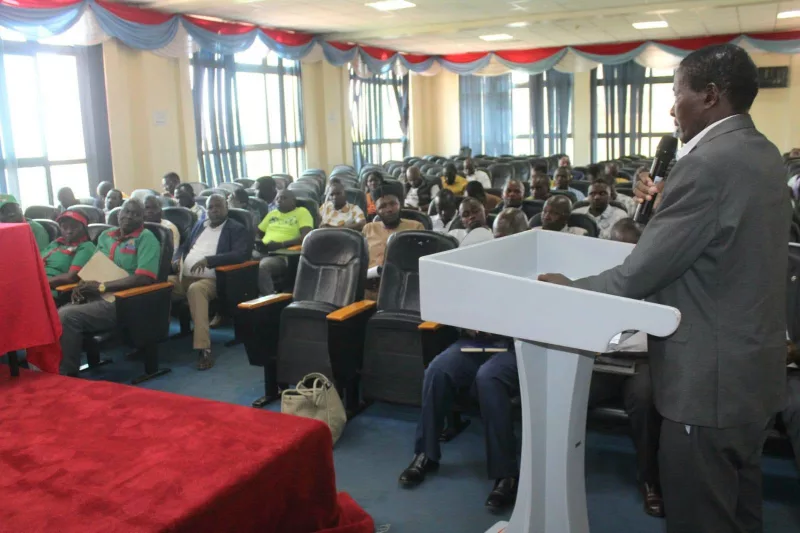
 Public participation forum at Chuka University Hall on the proposed education reform bills, October 1 /PARLIAMENT
A proposal to have county commissioners chair County Education Boards has been rejected by education stakeholders in Tharaka-Nithi who want the positions held by people with education expertise.
Speaking during a public participation forum at Chuka University on Thursday, stakeholders told the National Assembly Departmental Committee on Education that the proposed arrangement could undermine the effective management of education matters at county level.
The forum was part of the committee's nationwide public participation exercise on six education reform Bills, with the committee led by Kitutu Masaba MP Clive Gisairo.
County Director of Education Mbugua Kabaki said the law should instead recognise school head teachers as accounting officers with a clear and redefined mandate.
"The County Education Board needs a sober mind, someone who is present with an education background. We cannot have a law enforcement officer head such an institution. Let them stick to administrative issues," he said.
The proposal was also shot down by officials from the County Education Board.
Stakeholders also proposed changes to the governance of the Kenya Institute of Curriculum Development (KICD), with the Kenya National Union of Teachers (Knut) seeking inclusion in the institute's governing council.
Knut representative Albert Muthoni submitted a memorandum proposing that the giant teacher union be given a representative on the KICD Governing Council.
"We want Knut to provide KICD with timely information on curriculum developments in the country. We are a body of professional teachers who understand what ails the sector; therefore, having us there is important," he said.
The union, together with the Kenya Union of Post-Primary Education Teachers (Kuppet), also called for continuous teacher training, arguing that inadequate training has affected the rollout of the Competency-Based Education (CBE) curriculum.
The unions said regular training would help address knowledge gaps among teachers and improve the implementation of the new curriculum.
Kuppet also raised concerns over the management of comprehensive schools, proposing that the structure be separated into primary, Junior School, secondary and tertiary levels, each with a clearly defined administrative mandate.
The union argued that separating the levels would help address administrative conflicts arising from the current comprehensive-school arrangement.
The management of Junior schools has been a recurring issue during the public participation exercise, with Kuppet advocating greater autonomy for the level while Knut has supported the comprehensive-school model.
A Junior School teacher, Kennedy Mutai, meanwhile questioned the treatment of scholarships in the proposed Tertiary Education, Placement and Funding Bill.
He argued that the proposed financing framework places too much emphasis on loans while failing to provide a clear framework for scholarships.
"The Bill omits the part on granting scholarships. Funding education is now turning to loans with interest. The loan recovery interest has been placed at 25 per cent. This makes it difficult for a low-income teacher to survive; that interest must be lowered," he said.
The Tertiary Education, Placement and Funding Bill is one of six proposed laws currently undergoing public scrutiny alongside the Basic Education Bill, Kenya National Educational Assessments Council Bill, Pre-Service Education and In-Service Training Bill, Kenya National Qualifications Framework (Amendment) Bill and Kenya Institute of Curriculum Development (Amendment) Bill.
The proposed laws seek to introduce changes in tertiary education financing and placement, basic education management, national assessments, teacher training, qualifications and curriculum development.
Committee sub-committee members Christine Ombaka and Abdul Haro urged stakeholders to continue examining the Bills and submit additional proposals before the lapse of Friday deadline.
"You have excellent ideas. I am challenged by your contributions. You have given us ideas that will help shape the education sector in the country," Ombaka said.
Abdul Haro urged residents to use the remaining time to submit their views through the available channels.
"You have done well by standing up for this noble cause. It is a critical national issue that we have taken to the 47 counties. Your views are no less. Tomorrow is the last day to submit your views; please make time to share all your proposals through our electronic channels," Haro said.
Gisairo said the committee would consider the views submitted as it prepares its recommendations on the proposed legislation.
He also urged residents to submit any additional views by 5pm on Friday, October 2, when the extended public participation exercise concludes.







