

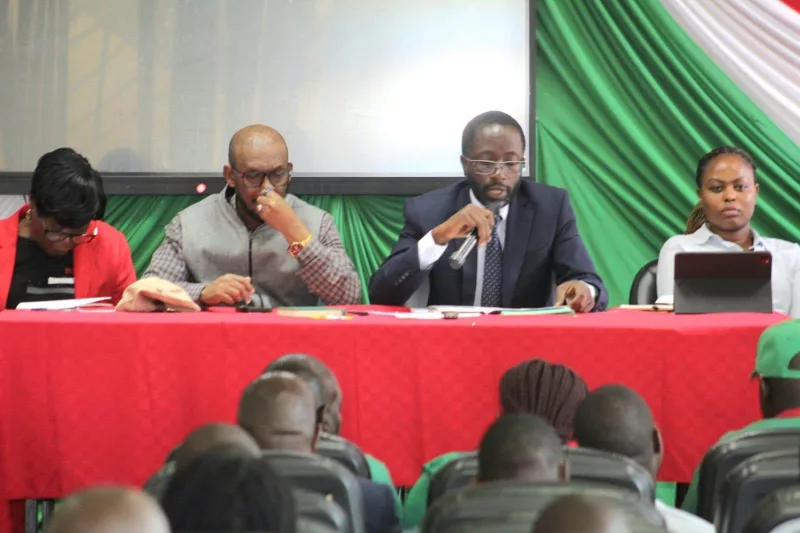
 National Assembly Departmental Committee team led Kitutu Masaba MP Clive Gisairo during public participation forum at Chuka University, October 1 /PARLIAMENT
The curtain falls on nationwide public participation on six proposed education reform Bills on Friday, with calls for Junior schools to be granted greater autonomy emerging as one of the most prominent proposals presented to Parliament.
The National Assembly Departmental Committee on Education is concluding the exercise with hearings in Bomet and Samburu, bringing to 47 the number of counties covered since the engagements began on September 14.
The final forums will be held at Bomet University College from 9am to 12.30pm and Kenya Medical Training College, Maralal Campus, in Samburu from 10.30am to 1.30pm.
The written memorandum deadline also expires on Friday at 5pm, giving stakeholders who did not attend the physical hearings an opportunity to submit their views to the Clerk of the National Assembly.
Stakeholders have argued that Junior School should have its own administrative structure and resources rather than operate as part of the comprehensive school model.
Presenters said Junior School has distinct curriculum demands, specialised teachers, national assessments, learning needs and resource requirements that warrant a management structure tailored to the level.
They argued that treating Junior School simply as an extension of primary education could weaken accountability and overstretch school administration, while diverting attention from the specific needs of learners at the level.
The proposal has featured prominently in submissions on the Basic Education Bill, 2026, which seeks to establish the legal framework for management and delivery of basic education.
Those calling for autonomy have argued that the model would give Junior School clear leadership, dedicated resources and professional accountability as Kenya implements Competency-Based Education (CBE).
They want Parliament to reconsider the comprehensive-school model and establish a framework under which Junior School can operate with greater administrative independence.
The proposal has, however, faced opposition from the Kenya National Union of Teachers (Knut), which supports the comprehensive school model in which Early Childhood Development, primary and Junior schools remain under one management structure.
The Kenya Union of Post-Primary Education Teachers (Kuppet), in contrast, has pushed for greater autonomy and independent leadership for Junior School.
The debate is among several issues raised during the public participation exercise, which has taken the committee to all 47 counties.
The six Bills under consideration are the Tertiary Education, Placement and Funding Bill, 2026; Basic Education Bill, 2026; Kenya National Educational Assessments Council Bill, 2026; Pre-Service Education and In-Service Training Bill, 2026; Kenya National Qualifications Framework (Amendment) Bill, 2026; and Kenya Institute of Curriculum Development (Amendment) Bill, 2026.
Together, the proposed laws seek to overhaul the legal framework governing major areas of education, including tertiary placement and financing, basic education, national assessment, teacher preparation and professional development, qualifications and curriculum development.
The Tertiary Education, Placement and Funding Bill proposes a new framework for financing and placing students in tertiary institutions, including the creation of the Tertiary Education Funding Authority through the proposed consolidation of functions currently performed by the Higher Education Loans Board, Universities Fund and TVET Funding Board.
The Kenya National Educational Assessments Council Bill proposes a new legal framework for national educational assessment, while the Pre-Service Education and In-Service Training Bill seeks to regulate teacher preparation and continuing professional development.
The Kenya National Qualifications Framework (Amendment) Bill seeks changes to the framework governing national qualifications, while the Kenya Institute of Curriculum Development (Amendment) Bill proposes changes to the institute's mandate and functions.
The exercise was initially scheduled to run from September 14 to 25 across 31 counties before the committee extended it to October 2 and added 16 more counties.
The extension followed concerns, including from Kuppet, that the initial two-week period was inadequate for meaningful public participation and that some venues were inaccessible to stakeholders in rural and marginalised areas.
After Friday's sittings, the committee is expected to retreat to consider the submissions received during the hearings and prepare a report setting out the views and recommendations presented by stakeholders.
The report will inform the committee's consideration of the Bills as they proceed through the legislative process.







