
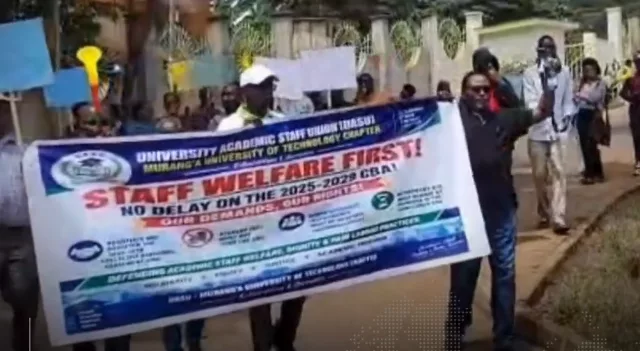
Lecturers at public universities across Kenya have begun a strike over grievances surrounding the implementation of collective bargaining agreements (CBAs), university funding and the payment of university employees.
KUSU Egerton branch secretary Bernard Ojiambo said teaching and learning had been paralysed at Egerton University as university-based unions began the industrial action.
“Comrade Power! Comrade Power! Today, today is a sad day in the Republic of Kenya,” Ojiambo said while addressing union members.
He said the strike was prompted by delays in negotiating and implementing the 2025-2029 Collective Bargaining Agreement (CBA).
Ojiambo said the unions had signed a return-to-work formula on November 5, 2025, which provided for the CBA to be concluded and registered at the Employment and Labour Relations Court within 30 days.
“Today officially we are launching mega strike here in Egerton, learning and teaching totally paralyzed,” he said.
The unions' grievances also include the implementation of previous CBAs and concerns over the current university funding model.
A university union official addressing the gathering said the unions wanted university employees to be paid through a centralised system and for university workers to be placed on the Exchequer payroll.
She said the unions were also calling for the implementation of the 2025-2029 CBA and the release of funds owed to universities.
The official said the unions estimated the outstanding funds at more than Sh100 billion, including amounts they said had not been remitted under previous university funding models.
She also raised concerns about the funding model, under which funding is linked to individual students, saying the unions wanted a system that would ensure university employees were paid through a centralised arrangement.
The unions involved in the strike are the Universities Academic Staff Union (UASU), Kenya Universities Staff Union (KUSU) and Kenya Universities and Colleges Staff and Allied Workers Union (KUDHEA).
She added that their demands were broadly similar across the three unions and that members had withdrawn their labour until their respective union leaderships issued further instructions.
Ojiambo said the strike would continue until the unions' demands were addressed.
He acknowledged that the industrial action would affect students but said the unions would continue pursuing their grievances.
“For now, go home. Do not come to work until instructions are given otherwise by our principals,” Ojiambo told union members.
The strike was also launched at Tom Mboya University, where lecturers called on part-time tutors from neighbouring universities to respect the industrial action.
“We ask part-time lecturers from neighbouring universities to respect our collective action. Keep off for the purpose of replacing our teaching,” the union official said.
The official said the chapter had formally launched its mobilisation for the national strike, subject to applicable court orders and national guidance.
At Tom Mboya University, the union said its position was that commitments made to university workers should be honoured and that collective bargaining should produce timely results.
On October 1, UASU Secretary General Dr Constantine Wasonga said the nationwide strike followed what the union considered prolonged delays by university councils, the Ministry of Education and the National Treasury in implementing agreements reached with academic staff.
Wasonga said the union had exhausted available channels of engagement and could no longer postpone industrial action over the delayed implementation of the 2025–2029 CBA.
He said the union had also rejected a proposed Sh9.76 billion allocation that the government was expected to table during negotiations in Machakos, arguing that the amount was insufficient to finance the demands contained in the four-year agreement.
“The figure of Sh9.76 billion they are proposing in Machakos, the union is going to reject it. A CBA of four years cannot consume Sh9.76 billion,” Wasonga said.
According to the UASU secretary general, the proposed amount was comparable to what was allocated to the previous agreement despite the difference in the scope and duration of the two CBAs.
“When we negotiated the 2021–2025 CBA, for two years we consumed Sh9.7 billion, so we cannot imagine a CBA for four years can also consume Sh9.7 billion,” he said.
Wasonga said the 2025–2029 agreement contains several issues that were not covered in the previous negotiations, meaning the financial requirements cannot be assessed solely on the basis of the previous CBA.
He said university lecturers were seeking, among other issues, the harmonisation of allowances as well as provisions relating to car loans and mortgages.







