
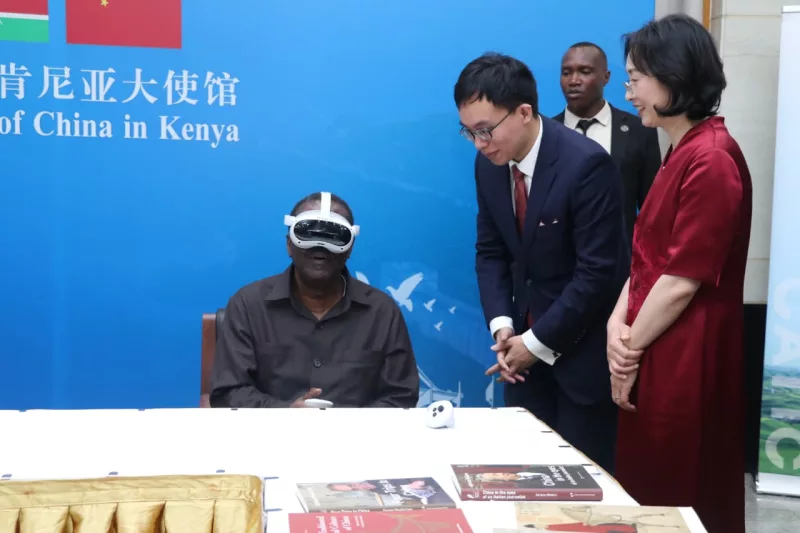
 Prime Cabinet Secretary Musalia Mudavadi wears the VR headset as Chinese ambassador to Kenya Guo Haiyan watches during the celebrations of the 77th anniversary of the founding of the People's Republic of China at the Chinese embassy in Nairobi on September 30 /LEAH MUKANGAI
Kenya’s exports of avocado oil to China have surged by 700 per cent since Beijing introduced zero tariffs for African products, Chinese Ambassador Guo Haiyan has said.
Guo said exports of aquatic products, including sea cucumbers, had increased by 350 per cent, while coffee exports had nearly doubled by the end of August.
She attributed the growth to the implementation of China’s zero-tariff policy for African countries, which came into effect in May.
“More and more high-quality Kenyan speciality products are now entering the Chinese market,” Guo said.
The ambassador was speaking in Nairobi on Wednesday during a reception marking the 77th anniversary of the founding of the People’s Republic of China.
China began applying zero tariffs to products from 53 African countries with which it has diplomatic relations on May 1, covering all tariff lines.
Kenya and China had earlier signed an Early Harvest Agreement under the China-Africa Development Economic Partnership framework.
The arrangement has opened duty-free access to the Chinese market for a wide range of Kenyan exports.
Coffee, tea, avocadoes, macadamia nuts, flowers and horticultural products are among the commodities benefiting from the arrangement.
The early figures cited by Guo point to increased trade following the removal of tariffs.
Separate data showed avocado exports to China rose by 63.22 per cent between May and August compared with the same period in 2025, while unroasted green coffee exports increased by 139.66 per cent.
Guo said China was ready to do more to help Kenyan products access its market, including through a strengthened ‘green channel’ for agricultural exports.
She said China also intended to deepen cooperation with Kenya in infrastructure, energy, agriculture, education, youth affairs, science and technology.
The ambassador said the trade gains were part of a broader expansion in China-Kenya relations.
“Facts have shown that the development of China-Kenya relations serves the respective and common interests of both sides and helps improve the well-being of our two peoples,” she said.
Guo said China wanted more Kenyan products to enter its market ‘faster and in greater quantities’.
She also pointed to increased exchanges between the two countries, attributed to the elevation of Kenya-China ties.
The accelerated engagements are attributed to the successful meeting between President William Ruto and his Chinese counterpart Xi Jinping in April last year.
More than 1,000 Kenyans from various sectors have travelled to China for training courses and study programmes under the 2026 China-Africa Year of People-to-People Exchanges, Guo said.
The two countries have also held more than 20 events under the programme.
Guo said China and Kenya had continued to cooperate in multilateral affairs.
She congratulated Kenya on becoming a founding member of the International Organisation for Mediation, the World Artificial Intelligence Cooperation Organisation and the International Alliance Combating Telecom and Cyber Fraud.
Prime Cabinet Secretary Musalia Mudavadi, who spoke at the same event, said the zero-tariff arrangement was contributing to growth in coffee, avocado and tea exports.
Mudavadi said Kenya was ready to begin comprehensive negotiations with China under CADEPA to unlock further investment and trade opportunities.
China’s zero-tariff policy was introduced to stage measures such as streamlined customs procedures and upgraded green channels for African agricultural and food products.
The ambassador said China remained ready to deepen its partnership with Kenya as the two countries pursued their respective development and modernisation agendas.







