
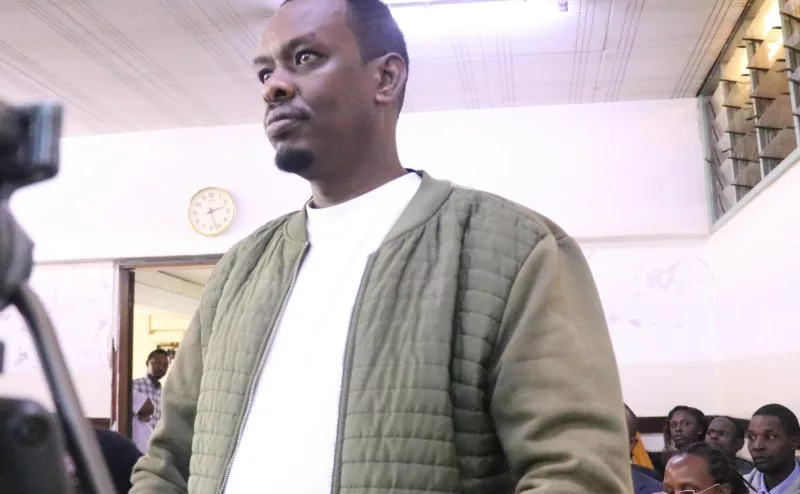
 Police Sergeant Ahmed Rashid appears before Justice Diana Kavedza during the hearing of the case over accusations of killing two boys in Eastleigh in 2017 at Kibera Law Courts, Nairobi, on September 29, 2026 /LEAH MUKANGAI
The long-awaited murder trial of former Pangani police officer Ahmed Rashid hit another procedural delay on Tuesday after the High Court was forced to push proceedings to allow the court to structure the final phase of the state's prosecution.
Presiding High Court Judge Diana Rachel Kavedza-Mochache paused the trial at the Kibera Law Courts, asking the Office of the Director of Public Prosecutions, represented by Senior State Counsel Wangui Timoi, to release the legal teams.
The judge confirmed that the case against Rashid could not be heard on Tuesday due to lengthy proceedings in the Tob Cohen murder trial, which was running concurrently on the court's calendar.
Addressing the challenge of juggling competing high-profile dockets, Justice Kavedza underscored the necessity of protecting procedural fairness for all accused persons.
"I cannot do an injustice to do a justice," Justice Kavedza stated, explaining that rushing through Rashid’s hearing while managing the complex Cohen case would compromise the judicial process.
During the session, the DPP requested to proceed with two remaining witnesses in the Cohen matter.
Upon reviewing the docket, the judge noted that out of 43 witnesses listed in the Cohen trial, the 10th witness was currently on the stand.
Highlighting that Sarah remains in custody while Rashid is out on bond, Justice Kavedza ruled that the former matter, which has dragged on, must take priority going forward to ensure a swift conclusion to its prosecution.
Given that the prosecution has only one witness left to call, Justice Kavedza directed that the court would give a mention date on October 26, to formally fix a final hearing date.
The decision marks another chapter in a nine-year legal saga stemming from the March 31, 2017, deaths of teenagers Jamal Mohamed (16) and Mohamed Dahir Kheri in Eastleigh.
Captured on phone and surveillance video showing a plainclothes officer firing at close range into a wounded youth on the street, the incident sparked widespread outrage and calls for police accountability.
Rashid entered a not-guilty plea in April 2023, and 21 prosecution witnesses have testified so far.
The final scheduled witness is the lead investigating officer from the Independent Policing Oversight Authority.
The case stems from the March 31, 2017, fatal shooting of Jamal Mohamed (16) and Mohamed Dahir Kheri in Eastleigh.
Video footage showed a plainclothes officer in a red T-shirt chasing suspects near Amal Shopping Complex before shooting one youth and repeatedly firing downward into another wounded teenager.
IPOA concluded its investigation in 2022, finding the fatalities "were occasioned by police action," and recommended murder charges.
Rashid was formally charged in April 2023 and pleaded not guilty.
Senior firearm examiner Commissioner Lawrence Nthiwa testified that analysis could not conclusively link Exhibit PA2 to the bullets recovered, citing heavy bullet deformation.
Defence lawyer Danstan Omari challenged the lack of embedded timestamps on photographs taken at the scene and questioned witnesses about why the Pangani station officer-in-charge kept possession of essential exhibits rather than surrendering them to the court.
The proceedings were also undermined by interference with witnesses. In February 2026, two of the three witnesses scheduled to testify did not appear.
Benna Buluma, convener of the Mothers of Victims and Survivors Network, explained that witnesses often decline to give evidence because they fear being pursued and threatened by police officers.
Jamal’s grandfather, Ramadan Karani, travelled from Tana River County to identify his grandson’s body and later testified in court. Amnesty Kenya has maintained that the families of victims deserve to know what happened to their sons.







