
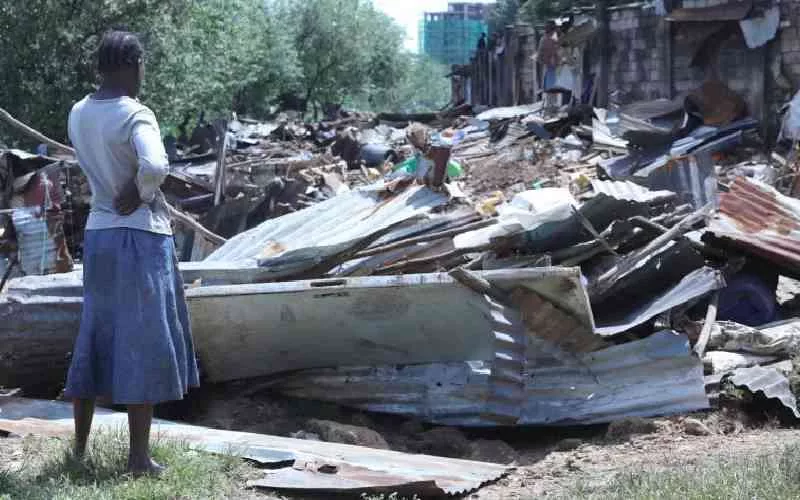
 Forced eviction in a flood-prone area in Nairobi /FILE
The Kenya Human Rights Commission (KHRC) has warned that the anticipated El Niño rains could deepen human rights violations across the country.
The commission said the government needs to place human rights at the centre of its disaster preparedness and response measures.
It urged the government to adopt a rights-based approach in preparing for and responding to the heavy rains expected between late September and December.
“Article 19(1) of the Constitution requires human rights to serve as the framework for social, economic and cultural policies, meaning disaster responses should combine humanitarian interventions with protection of citizens’ rights,” the commission said.
KHRC said its concerns were informed by the experience of the 2024 floods, which resulted in widespread deaths, displacement and destruction of property and livelihoods.
According to Human Rights Watch, at least 170 people died and more than 200,000 displaced by May 2, 2024, as flooding affected various parts of the country.
The commission called on the government to ensure evacuation, relocation and relief measures do not result in human rights violations or disproportionately affect low-income communities.
KHRC cited incidents during the 2024 floods in which police reportedly raided the Mathare Social Justice Centre and Ghetto Foundation offices in Nairobi and arrested 27 human rights defenders who were protesting the eviction of residents affected by flooding.
The commission also raised concerns over demolitions in Mukuru Kwa Reuben and Kiamaiko, saying bulldozers moved into the settlements before a 24-hour government deadline had elapsed and without adequate notice or consultation, leaving thousands of residents homeless.
“The response raised questions about whether vulnerable communities received treatment equal to that accorded to residents in more affluent areas affected by flooding.”
The commission also called for greater scrutiny of government spending on disaster preparedness and response.
Kenya has secured about Sh51.8 billion from the World Bank’s Rapid Response Option to prepare for the anticipated rains, while public debt stands at about Sh12.05 trillion, equivalent to 67.3 per cent of GDP, according to the commission.
KHRC warned that emergency conditions should not be used to bypass procurement laws and public oversight.
The commission also urged the government to ensure evacuations do not result in forced or arbitrary evictions or extrajudicial killings, while protecting human rights defenders and community organisations monitoring the flood response.
It also called for continued access to healthcare, clean water, sanitation and education, alongside equitable and accountable distribution of humanitarian assistance.
KHRC further demanded publication of accessible information on financing, procurement and expenditure related to the El Niño response, as well as updates on previous interventions, including commitments made to compensate victims of the 2024 floods.







