
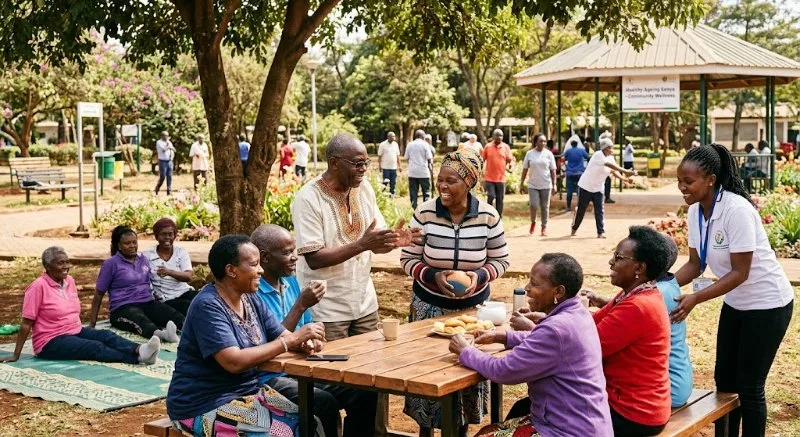
 Older people in Kenya/ AI ILLUSTRATED
Kenya will have about 6.4 million people aged 60 and above by 2045, and the country needs to begin preparing now for their healthcare, income security, social protection, and care needs, a geriatrician has said.
Geriatrician and healthy ageing expert Tasneem Yamani, who is medical director at Hamar Healthcare and a technology adviser at Suqoon, said longer lives were an achievement of public health but required changes to the systems supporting older persons.
“By 2045, Kenya will have 6.4 million people aged 60 and above. We cannot wait until 2045 to start preparing,” Yamani said.
The 2019 Kenya Population and Housing Census recorded 2,740,040 people aged 60 and above, representing 5.7 per cent of the population, according to the Kenya National Bureau of Statistics. KNBS data show the number of older persons had increased steadily from 1.93 million in 2009.
The census also found that 84 per cent of older persons lived in rural areas, compared with 16 per cent in urban areas.
Yamani said Kenya therefore needed to consider ageing in the design of health services, community care, workplaces, social protection programmes and the wider environment.
She said healthy ageing was not simply about avoiding disease but also maintaining people's ability to function, remain independent and live with dignity.
Esther Muinga of the Ministry of Health's Division of Healthy Ageing, Palliative Care and Older Persons said the response to ageing should begin much earlier in life.
Muinga said healthy ageing was a life-course issue in which nutrition, immunisation, education, safe environments and mental wellbeing could influence people's health and independence later in life.
She said the question should not simply be how Kenya would manage older people, but what kind of country Kenyans wanted to live in as they grew older.
Muinga said the Ministry of Health has a Healthy Ageing and Older Persons Strategy for 2022-2026, aligned with the United Nations Decade of Healthy Ageing.
Yamani said the health system would need to respond to chronic diseases, disability, dementia, mental health conditions, rehabilitation, palliative care and long-term care as the number of older persons increased.
She said geriatric care should be incorporated into primary healthcare, community health and home-based care instead of being concentrated in specialist facilities.
Muinga said non-communicable diseases account for a significant share of Kenya's disease burden and become increasingly important as people age.
The distribution of older persons also has implications for how services are delivered. With 84 per cent of older persons living in rural areas, KNBS data show that most older Kenyans are outside urban centres where specialist services are more concentrated.
The discussion also examined the economic role of older persons.
KNBS data show that 1,518,340 people aged 65 and above were employed in 2019, up from 886,850 in 2009. The employment-to-population ratio for people aged 65 and above increased from 66.7 per cent in 2009 to 81.6 per cent in 2019.
A member of the International Day of Older Persons planning committee Maurice Omollo, said the figures demonstrated the importance of income security as people aged.
Omollo said only 5.9 per cent of older persons had private insurance, while more than 40 per cent of people aged over 60 were living in absolute poverty, according to figures cited during the discussion.
He said income security was important because people needed resources to access healthcare, food and other basic services.
“Older persons require cash, care, and compassion,” Omollo said.
KNBS data provide further evidence of the economic challenges facing older persons. The 2019 census found that 57.1 per cent of older persons were living in poor households, although the proportion varied significantly between counties.
Omollo said social protection discussions should also consider people who leave employment around the traditional retirement age but may not immediately have adequate financial support.
The issue of care also affects people supporting older relatives.
Peninah Ndonye of the Ministry of Health's State Department for Medical Services, Division of Healthy Ageing, Palliative Care and Older Persons, said many caregivers continued working while also caring for ageing parents or relatives.
“The question is, who cares for the caregivers?” Ndonye said.
She said caregivers needed financial and psychological support as part of the country's response to an ageing population.
Yamani said reliance on families as the main source of care was becoming more difficult as children lived away from their parents, families became smaller and more women entered the workforce.
She said Kenya needed trained caregivers, stronger community and home-based care, respite services and support for family caregivers.
Yamani said investment in care could also create employment while allowing families to remain economically active.
The discussion also considered whether Kenya's physical environment was suitable for people as they aged.
Jane Muita said buildings, hospitals, transport systems and communities should be designed with people at different stages of life in mind.
She cited wider doors, ramps and accessible toilets as examples of features that could help older persons remain independent.
Muita said such considerations should be incorporated when buildings and communities were designed rather than introduced only after people developed mobility challenges.
Ageing was also discussed in terms of participation and contribution.
Muita said older persons should not be portrayed simply as dependants because many continued working, caring for relatives, providing leadership, mentoring younger people and participating in their communities.
“Age is an achievement, not a problem,” Muita said.
She called for changes in how older persons are represented, including media coverage that moves away from stereotypes of frailty and dependency.
Omollo said ageism could also affect people before they reached retirement age.
He said some workers experienced age-based discrimination in their 40s and 50s, making ageism an issue that needed to be addressed across workplaces and generations.
Micheni Makena said intergenerational discussions would provide an opportunity for younger and older people to discuss retirement, leadership, caregiving and the sharing of experience.
She said older people could continue mentoring younger generations rather than being expected to withdraw completely from public and economic life.
The need for better evidence was also raised during the discussion.
Assistant Director, Social Development Julie Omolo said the government, academic institutions and health partners were undertaking a national assessment of the socio-economic realities, healthcare requirements and income security needs of older persons.
She said the assessment would provide a clearer picture of the conditions facing older persons across the country.
The scientific conference linked to the national programme has attracted 131 abstracts covering areas including geriatric medicine, long-term care, social protection, rights and healthy ageing.
At county level, Ndonye said more than 30 counties had confirmed plans for medical camps targeting older persons and their caregivers.
She said the activities would include cancer screening, surgical services, assistive devices, social protection awareness, elder-abuse discussions and physical activities.
Ndonye said some counties were also planning intergenerational forums, tree planting, cultural activities and recognition of older persons who had contributed to their communities.
Yamani said Kenya needed to prepare its systems for longer lives while ensuring older persons could remain healthy, independent and supported as they aged.







