

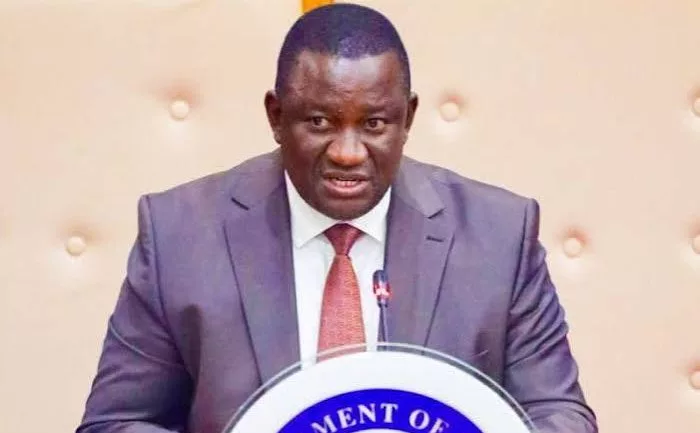
Youth Affairs Cabinet Secretary Salim Mvurya/ HANDOUT
The government has outlined an ambitious programme to expand economic opportunities for young people and women, with targeted financing, job placements and skills training.
Youth Affairs Cabinet Secretary Salim Mvurya said the government was decentralising services and using targeted programmes to ensure young people can easily access opportunities.
“We are operating through Youth Development Offices to reach youth in rural and remote areas, thus reducing the need for expensive travel to seek services in Nairobi,” Mvurya said.
The CS said the government had also set specific targets for women, youth and persons with disabilities under the National Youth Opportunities Towards Advancement (NYOTA) programme.
“Reservation targets 50 per cent women and five per cent youth with disabilities in the Project Appraisal Document (PAD), with age extended up to 35 years for Persons with Disabilities (PWDs),” he said.
The measures include childcare support and facilities for lactating mothers, flexible schedules and transport or proximity support where feasible.
Mvurya said the government was also designing programmes to accommodate young people with lower levels of formal education.
He cited NYOTA, which targets youth with education levels below Form 4, and the Youth Enterprise Development Fund (YEDF), which offers products including Vuka and Talanta loans and group-based lending.
The government is also seeking to remove barriers to accessing credit by allowing flexible collateral requirements.
“We are utilising ‘soft’ collateral, such as group guarantees, household/business assets, or flexible repayment terms,” Mvurya said, adding that conventional securities such as land title deeds would not be the only option.
The strategy also seeks to ensure that youth in remote and underserved communities are identified and enrolled in government programmes.
Mvurya said the ministry was using partnerships with local organisations to identify vulnerable youth, while regional quotas and representation targets were being used to promote non-discrimination.
The government has also made specific provisions for refugee and host-community youth in Garissa and Turkana under NYOTA.
On employment, Mvurya said 51,604 youth had so far been reached through NYOTA's on-the-job experience component, out of a national target of 90,000.
The remaining lots will cover 39,176 youth in counties including Baringo, Isiolo, Kajiado, Kiambu, Kilifi, Mandera, Marsabit, Mombasa, Nairobi, Nandi, Turkana, Uasin Gishu and Wajir.
Mvurya said the programme had also moved into business support, disbursing Sh2.55 billion to 101,721 youth in the first tranche.
He said the government was taking measures to prevent duplication among NYOTA, YEDF, the Uwezo Fund, the Women Enterprise Development Fund and other state and county programmes.
“We have beneficiary Identification Systems in programmes like NYOTA, which use the ID as a unique identifier,” he said.
The government aims to link its programmes so beneficiaries can progress from start-up support to expansion financing.
Mvurya said YEDF would provide expansion loans to young people who had already received NYOTA start-up grants.
“For instance, in the National Youth Opportunities Towards Advancement project, YEDF will provide expansion loans specifically for youth who have already received initial startup grants from the project,” he said.
Beyond financing, the government is banking on skills development and entrepreneurship training to improve the survival rate of youth-owned enterprises.
“Mandatory pre-financing training and continuous entrepreneurship development programmes equip beneficiaries with essential business management skills, improving enterprise viability and resilience,” Mvurya said.
The CS said YEDF had supported more than 1.3 million youth to start or expand businesses and facilitated the creation of more than 2.18 million jobs.
The fund has disbursed about Sh15.27 billion in loans, while more than 2.57 million youth have received training in entrepreneurship, financial literacy and business management.
The government has also expanded its youth health and social programmes. Under the Vijana Vuka na Afya (VIVA) programme, Mvurya said more than 201 health professionals had been trained on youth-friendly services, alongside 183 peer educators and 330 community advocates.
Forty public health facilities have also been onboarded to improve access to sexual and reproductive health services.
INSTANT ANALYSIS
Mvurya said the ministry would rely on monitoring and evaluation systems, quarterly and annual reporting, performance contracts and work plans to track implementation. Implementation progress is tracked through quarterly and annual reporting cycles, supported by performance contracts and annual work plans, thereby strengthening institutional accountability and transparency.







