

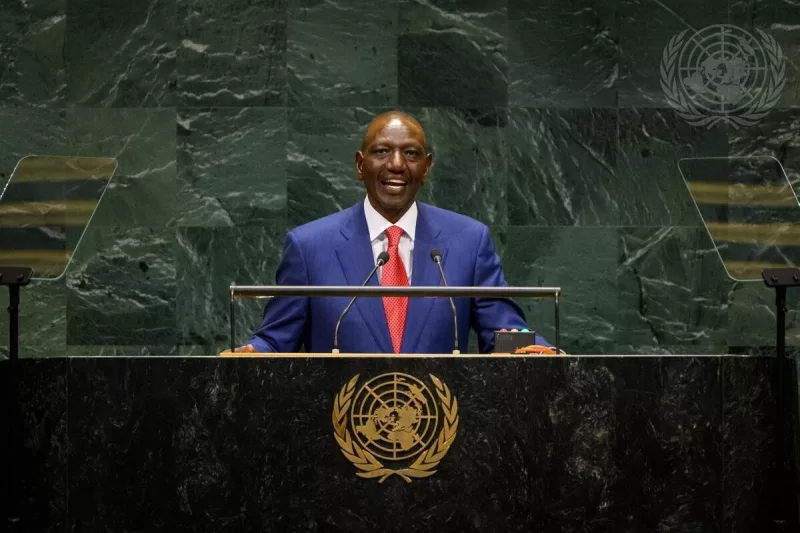
 President William Ruto delivers Kenya's national statement at UNGA/PCS
President William Ruto put Africa’s demand for a greater voice in global affairs at the centre of his United States tour, using his address to the United Nations General Assembly to call for reforms of the UN Security Council and international financial system.
Addressing the General Debate of the 81st Uinted Nations General Assembly in New York, Ruto said Africa could no longer remain on the margins of institutions that make decisions affecting global peace, security and development.
“The UN has transformed our world by advancing peace, self-determination and human progress. Yet it has also fallen short of its promise as conflicts persist, international law is applied inconsistently and inequality remains embedded in the institutions meant to uphold sovereign equality,” he said.
Ruto called for Africa to be given equitable and permanent representation on the Security Council, with the same privileges and prerogatives attached to permanent membership.
“Africa must have a meaningful voice in the decisions that shape global peace and security,” he said.
He also turned his attention to the global financial system, arguing that developing countries were paying too much to access capital while debt servicing was eating into money needed for development.
“Development cannot remain most expensive for the countries that need investment most, while debt service crowds out classrooms, healthcare and opportunity,” Ruto said.
He said developing countries needed greater access to affordable, long-term capital, guarantees and risk-sharing instruments to finance development.
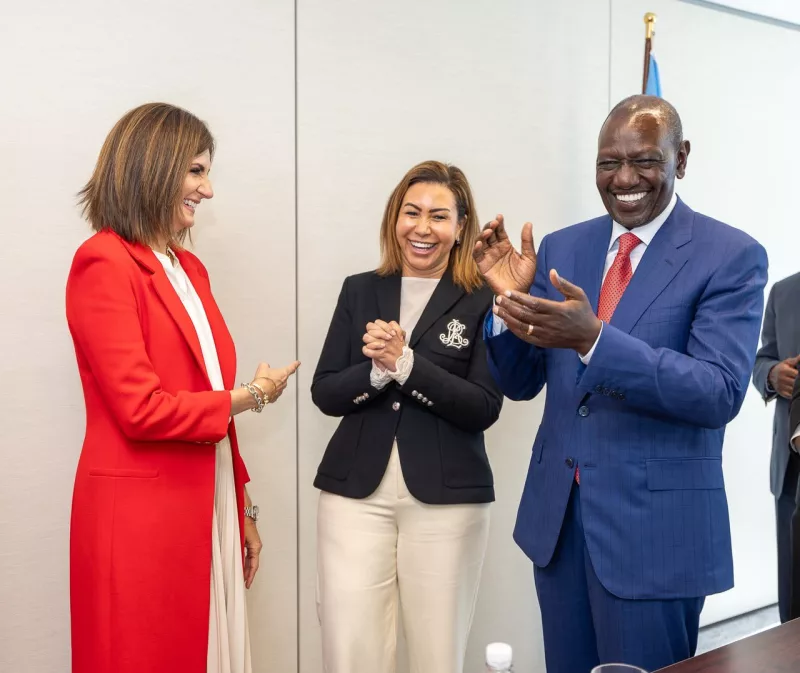 President William Ruto during a meeting with Cisco Executive Vice President Francine Katsoudas on the sidelines of the United Nations General Assembly in New York/PCS
The President’s speech capped a busy tour that began on September 20, when he arrived in New York with an agenda centred on investment, trade, technology, energy and Kenya’s role in global affairs.
He sought to position Kenya as a destination for African and global capital while pushing for greater African participation in the digital and artificial intelligence economy.
“Our focus is clear as we expand trade and investment and drive growth in energy, infrastructure, manufacturing, health, agriculture and technology, creating jobs and opportunities for Kenyans and opening new markets for our farmers and businesses,” Ruto said.
One of the early engagements focused on Kenya’s diaspora, with the President backing the creation of a Kenya Diaspora Impact Platform to connect Kenyans abroad with investment and development opportunities at home.
The government, United Nations in Kenya and Equity Group Holdings signed a Joint Declaration of Intent on the platform, which is expected to support MSMEs, enterprise creation, community projects and skills transfer.
“Our diaspora is a vital part of Kenya’s growth story, not only through remittances, but through investment, expertise, innovation and global networks,” Ruto said.
He added: “We are building a stronger bridge between Kenyans abroad and opportunities at home, founded on trust, transparency and measurable results.”
The President also used the tour to make a case for Africa to rely more heavily on its own capital.
At an Africa We Build high-level roundtable, he said African countries had accumulated significant domestic savings but lacked financial instruments capable of directing the money into productive investments.
“Africa is not short of capital. Our domestic capital pools have surpassed $4 trillion,” he said.
“What stands between these savings and the infrastructure we need are the rules that determine where capital can go.”
Ruto said Kenya was working to develop instruments that could channel domestic savings into power, transport and industry.
He then turned his attention to one of the biggest proposed investments linked to his New York mission — the planned East Africa refinery in Lamu.
Ruto held talks with Dangote Industries president and chief executive Aliko Dangote and Africa Finance Corporation CEO Samaila Zubairu on the financing and final preparations for the project.
“We are ready to break ground on the East Africa refinery in Lamu, a transformative project that will enhance the region’s energy security, deepen local value addition, create jobs and advance our industrialisation agenda,” Ruto said.
He said the refinery would unlock new economic opportunities, strengthen regional supply chains and position East Africa as a competitive energy and industrial hub. The project was a major focus of his investment pitch in New York.
The International Committee of the Red Cross was another key engagement, with Ruto meeting ICRC president Mirjana Spoljaric.
The discussions centred on humanitarian cooperation and the organisation’s plans to establish a global operations centre in Kenya.
“The International Committee of the Red Cross is an important partner in advancing global humanitarian efforts, particularly in protecting vulnerable communities and supporting people in need,” Ruto said.
“We will continue working closely with the ICRC to deepen our partnership and strengthen humanitarian efforts in Kenya and beyond.”
On security, Ruto met UN Office on Drugs and Crime Executive Director Monica Juma, agreeing to establish a team bringing together the Interior ministry, Attorney-General’s office, Health ministry and other agencies.
The team will develop a strategy covering cybercrime, maritime crime, border control and drug abuse.
“We will deepen cooperation with UNODC on training and strengthening law enforcement capacity, while exploring collaboration on standards for the treatment of drug abuse,” Ruto said.
He also said Kenya would advance internal processes on the cybercrime convention, including submitting the matter to Parliament.
With Austrian Chancellor Christian Stocker, Ruto discussed trade, investment, labour mobility and artificial intelligence.
“Kenya and Austria enjoy long-standing bilateral relations founded on shared interests and mutual respect,” he said, adding that the structured bilateral labour agreement was opening “new pathways for our young people”.
The two leaders also discussed AI governance and reform of the UN and international financial architecture.
AI remained one of the strongest themes of the tour.
Co-chairing a High-Level AI Middle Powers Coalition meeting with Finnish President Alexander Stubb, Ruto warned against Africa becoming dependent on technologies developed elsewhere.
“The AI era must expand the ability of nations to shape their own future, not create new forms of technological dependency,” he said.
He said Kenya was pursuing this through its National Artificial Intelligence Strategy, with investments in digital infrastructure, data, governance, research, innovation and commercialisation.
The President also held talks with US Secretary of State Marco Rubio, covering the broad Kenya-US partnership, trade, security and emerging technologies.
“We welcome the extension of AGOA, which will strengthen trade between Africa and the United States and expand economic opportunities,” Ruto said.
He said Kenya and the US also discussed cooperation in artificial intelligence and its application in health, education and financial services, as well as critical minerals and nuclear energy.
On security, the talks covered sustaining the security mission in Somalia, supporting stability in Haiti and efforts to address the worsening humanitarian crisis in Sudan.
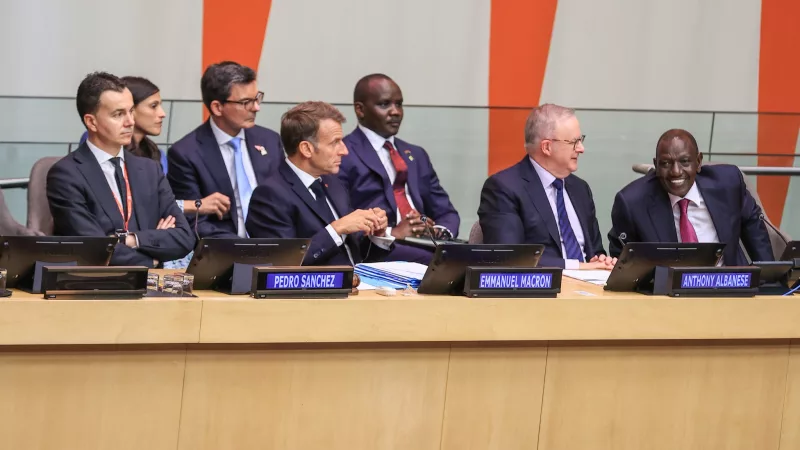 President William Ruto during a President William Ruto during the meeting on Coalition for Children’s Rights and Protection in the Age of AI l /PCS
Ruto also used the tour to advance his argument that Africa must shape the rules governing emerging technologies.
“Africa must be a builder of the technologies defining this century and a contributor to the rules that govern them,” he said at a high-level convening on the Accra Reset.
He said Kenya was taking a leadership role in the MasterKey Corridor, designed to connect African skills and credentials with opportunities across borders.
Diplomatic engagements with African leaders were equally prominent.
With Ghanaian President John Mahama, Ruto discussed expanding trade and investment and strengthening air connectivity, with Ghana positioned as a potential West African hub for Kenya Airways.
The two leaders also agreed to work closely on peace and stability in South Sudan.
With Liberian President Joseph Nyuma Boakai, Ruto agreed to deepen bilateral relations, trade and investment, with Liberia’s decision to open a diplomatic mission in Kenya expected to strengthen ties.
With Sierra Leone’s President Julius Maada Bio, discussions covered trade, investment, energy, mining and green industrialisation.
The two leaders also agreed to establish a Joint Commission to implement agreements in tourism, wildlife and air connectivity, including plans for direct flights between Nairobi and Freetown.
Ruto also pushed the child online safety agenda, joining other leaders at a high-level meeting on children’s rights and protection in the age of AI.
“No child should have to choose between being connected and being safe,” he said.
On debt, he told a UNICEF-convened high-level dialogue that debt servicing should not undermine investment in children.
“Debt becomes a children’s rights issue when interest payments crowd out investment in classrooms, healthcare, nutrition and social protection,” Ruto said.
He called for more affordable and concessional finance, guarantees, risk-sharing instruments and faster resolution of unsustainable debt.
Climate finance was another major plank of the tour.
Chairing the Committee of African Heads of State and Government on Climate Change, Ruto said Africa needed to move from climate pledges to actual investment.
“The world does not lack climate pledges, it lacks delivery,” he said.
He called for affordable capital, guarantees and risk-sharing mechanisms to support renewable energy, green industry and climate-resilient infrastructure.
He also co-hosted, with Norway, the first high-level event on clean cooking in Africa during UNGA, announcing a $600 million investment opportunity targeting schools, healthcare facilities and correctional institutions.
With Swiss President Guy Parmelin, Ruto discussed trade, investment, technology and climate action, including progress towards eliminating double taxation.
The two sides also explored cooperation in artificial intelligence and a proposal for Kenya and Switzerland to jointly host the Geneva AI Summit in 2027.
On September 24, Ruto held talks with Iraqi Prime Minister Ali al-Zaidi, discussing trade, investment, education, energy, oil and natural gas, ICT and human capital.
They also explored greater labour mobility, including opportunities for Kenyan educators.
With Bahamas Prime Minister Philip Davis, Ruto similarly discussed opportunities for Kenyan teachers to work in the country, while the two leaders reaffirmed cooperation on Haiti.
The President also sought to deepen partnerships in Kenya’s health sector.
With the Susan Thompson Buffett Foundation, Ruto welcomed the elevation of the partnership to a strategic level, focusing on maternal, adolescent and newborn health infrastructure and support for SHA, DHA and KEMSA.
He also met Unesco director general Khaled El-Enany, with discussions covering education, AI, climate action, skills and innovation. UNESCO plans to invest about $10 million in Kenya, while Nairobi is preparing to host the Unesco World Conference on Education for Sustainable Development in January 2027.
Ruto also met Open Society Foundations chair Alex Soros and Ford Foundation president Heather Gerken, where discussions centred on democratic governance, accountable institutions, civic participation, social justice and economic inclusion.
His sports engagements included meetings with FIFA president Gianni Infantino and NBA deputy commissioner Mark Tatum.
With Infantino, Ruto discussed regional technical centres for identifying and nurturing young football talent, while with the NBA he reviewed basketball development, the Basketball Africa League, Railway City’s multi-purpose arena, Kasarani and grassroots courts.
Technology companies also featured prominently.
Meeting Cisco executive vice-president Francine Katsoudas, Ruto discussed the Moran AI and Cyber Center of Excellence and the development of skills in AI, cybersecurity and emerging technologies.
He also met Bloomberg founder Michael Bloomberg, welcoming the company’s interest in investing in Kenya.
“We welcome Bloomberg’s interest in investing in Kenya,” Ruto said, adding that its presence would help attract investors and showcase opportunities through its global network.
The two also discussed public health, clean energy and climate action, including plans for a Green Technology Accelerator Hub in Kenya.
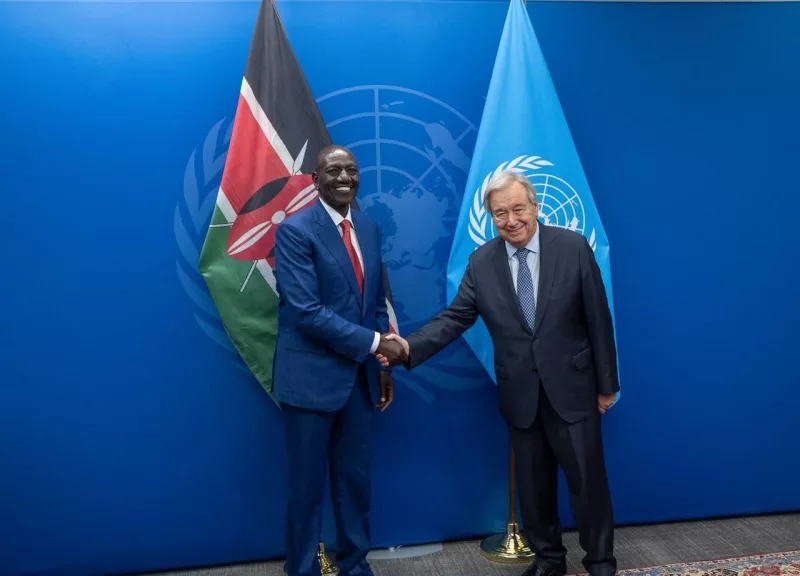
Ruto met United Nations Secretary-General António Guterres, with the two discussing regional peace and security, African-led solutions and the strengthening of the UN Office at Nairobi.
“We value our partnership with the United Nations in strengthening the UN Office at Nairobi and consolidating Nairobi’s place as the UN’s principal hub in the Global South,” Ruto said.
He also backed reforms to give Africa a greater voice in global institutions.
Across the tour, Ruto repeatedly framed Kenya’s foreign policy around investment, technology, domestic capital mobilisation, African agency and reform of global institutions.
“Africa must be in the room where tomorrow’s economic architecture is designed; not waiting outside to inherit it,” he said.
“Our partnerships must move beyond aid and extraction towards investment, value addition and shared prosperity.”







